


Farewell to a giant of global health: Dr William Herbert Foege, architect of smallpox eradication

On 24 January 2026, the world lost a towering figure in public health and vaccine science. He was not only a physician, but also an epidemiologist, public health leader, scientist, and global vaccine expert. To date, smallpox remains the only severe and deadly infectious disease that humanity has completely eradicated from the planet through vaccination and systematic surveillance of vaccine-preventable diseases. Among the global leaders who made this historic achievement possible, Dr William Herbert Foege stands out as one of the most influential.
Dr Foege, a lifelong servant of medicine and public health, was born on 12 March 1936 in Decorah, Iowa, United States. He passed away at the age of 89 on 24 January 2026 in Atlanta, Georgia. In 1961, he earned his Doctor of Medicine (MD) degree from the University of Washington, followed by a Master’s degree in Public Health from Harvard University in 1965.
 For all latest news, follow The Daily Star's Google News channel.
 His professional career began in 1960 when he joined the Epidemic Intelligence Service of the United States Centers for Disease Control and Prevention (CDC).
In 1966, during a catastrophic outbreak of smallpox in Nigeria, Dr Foege was deployed to support emergency public health operations. Most of the population in the affected region had not been vaccinated, and vaccine supplies were extremely limited, allowing the outbreak to spread rapidly. In this critical situation, Dr Foege introduced one of the most effective strategies in the history of vaccination: the ring vaccination approach.
In simple terms, this method involves rapidly identifying not only the infected individual but also all those who have had close contact with that person, and vaccinating them without delay. This creates an invisible yet powerful protective “ring” of immunity around the case and their contacts. As a result, the pathogen is unable to spread beyond this ring and gradually disappears. The greatest advantage of this strategy is that even with limited vaccine supplies, a relatively small number of targeted vaccinations can successfully control, eliminate, and ultimately eradicate the disease.
This groundbreaking strategy later became the core operational approach of the World Health Organization (WHO)-led, 13-year Global Smallpox Eradication Programme. As a result, the last naturally occurring case of smallpox was identified in Somalia in 1977, and in 1980 the WHO officially declared the world free of smallpox during the 33rd World Health Assembly.
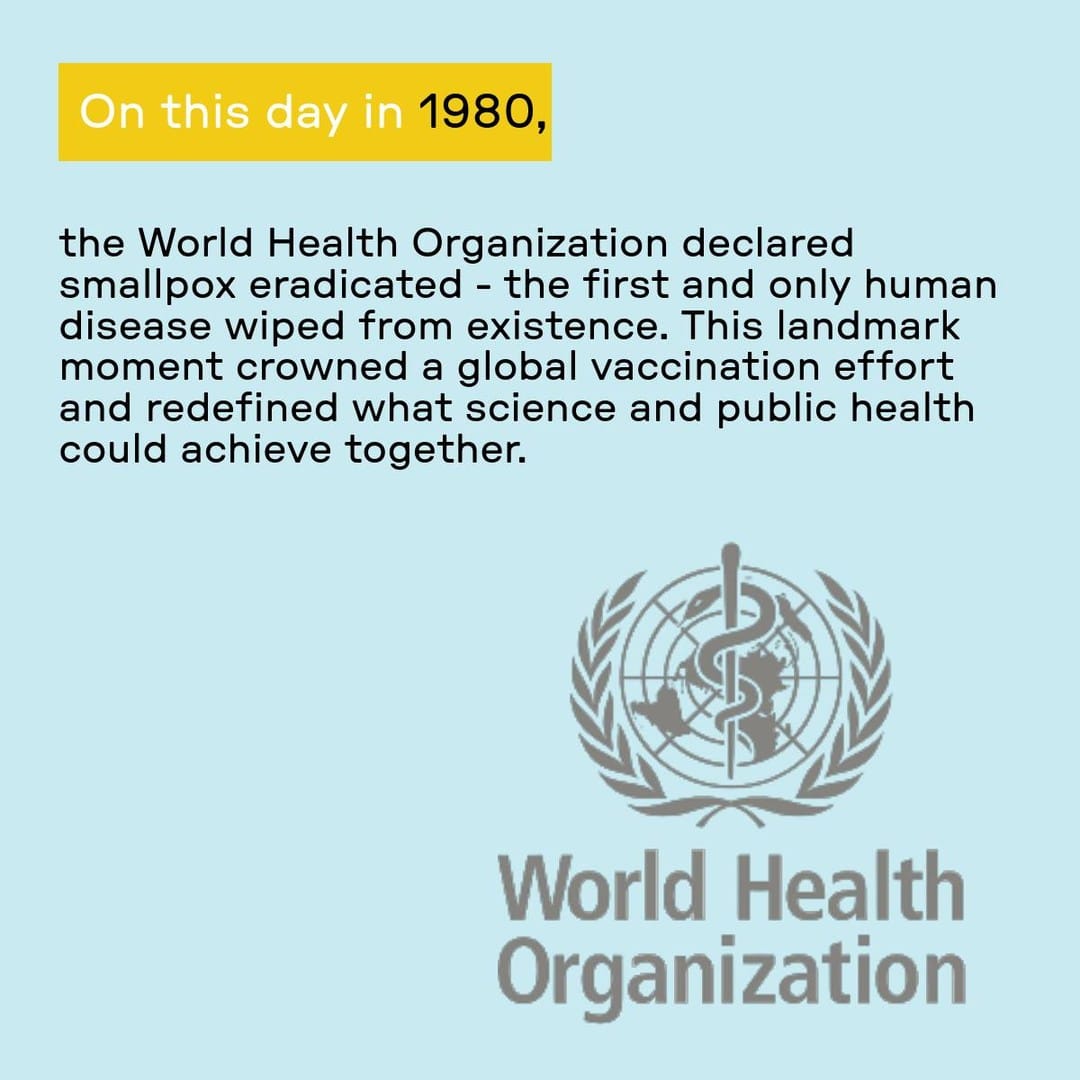
Although it may sound almost ordinary today, few diseases in human history have been as devastating as smallpox. Before its eradication, nearly one-third of those infected died, often after intense suffering and with little or no effective treatment. The origins of the disease are ancient and uncertain, but experts believe it first emerged in ancient India or Egypt. Numerous ancient Indian texts mention smallpox, and in Hindu tradition there is even a goddess associated with the disease, known as Shitala Mata. Epidemiological data indicate that as late as 1960, approximately 60 per cent of the world’s smallpox cases occurred in India alone.
Evidence of the disease’s antiquity has also been found in Egyptian mummies dating from approximately 1100–1500 BC. One of the most notable examples is Pharaoh Ramesses V, whose mummified remains show clear pockmarks on the skull, particularly on both cheeks, suggesting that he likely died of smallpox around 1157 BC.
Smallpox was caused by the variola virus and existed in two forms: Variola major and Variola minor, the latter being less fatal. Before eradication, it was estimated that approximately one in three people infected with Variola major died.
Dr Foege later served as Director of the US CDC from 1977 to 1983. Under his leadership, the organisation significantly strengthened its global role in public health, particularly in infectious disease control, immunisation, surveillance of vaccine-preventable diseases, outbreak investigation and response, and the prevention of deadly conditions such as AIDS.
In 1984, driven by a deep commitment to improving the health of disadvantaged populations worldwide, Dr Foege co-founded the internationally respected organisation The Task Force for Child Survival and Development, now known as The Task Force for Global Health. Today, the organisation operates across nearly every region of the world. Many experts believe that the concept of major global health financing mechanisms—most notably the Global Fund—can be traced back to the vision and institutional groundwork laid by Dr Foege and his organisation.
From 1986 to 1992, Dr Foege served as Executive Director of the Carter Center. He also worked as a Senior Medical Advisor to the Bill & Melinda Gates Foundation, continuing to shape global health policy and practice at the highest levels.
In recognition of his extraordinary contributions to public health and vaccine science, US President Barack Obama awarded him the Presidential Medal of Freedom—the highest civilian honour in the United States—in 2012.
Because of his transformative impact on global public health, many refer to Dr Foege as the Father of Global Health. It is estimated that his work contributed to saving more than 300 million lives worldwide—an achievement that is almost beyond comprehension.
Although he has passed away, there remains much to learn from his life and legacy. As we bid him farewell, let our commitment be to follow the path he showed—continuing to implement innovative and effective solutions in public health and immunisation, and dedicating ourselves to saving even more lives in the years to come.
Dr Md Tanvir Hossen is a Bangladeshi physician, researcher, and public health and vaccine specialist. He currently serves as Immunisation Technical Advisor at Jhpiego Bangladesh Country Office, Dhaka. E-mail: tanvirantik@gmail.com
Comments