


What the duck: World Cup gets quackers in North America
Across the vast landscape of the FIFA World Cup, where giants battle under the roar of thousands, some of the most unexpected stars are emerging far from the pitch. They do not score goals, track back, or understand the offside law, rendering them only slightly less tactically confused than Spain and Portugal’s midfield.
However, they have found their own way into the tournament folklore.
 For all latest news, follow The Daily Star's Google News channel.
 Meet Dawn the Duck, a remarkable resident of Providence in Rhode Island who has waddled into World Cup fame. Already a social media sensation with more than 30,000 followers on Instagram, Dawn has built a reputation as a “rally duck” at local sporting events.
Now, he has added a new chapter to his growing legend.
Adorned with a Scottish flag on his back and his familiar golden medallion, Dawn joined the Tartan Army’s pre-match bagpipe march ahead of Scotland’s clash with Morocco, becoming an unofficial symbol of the travelling supporters’ spirit.

Among a sea of kilts, flags, and songs, this small feathered companion moved seamlessly alongside thousands of Scotland fans. It became quite obvious that World Cup fever is not restricted to those with two legs, a team shirt, and a stomach and liver currently enduring a severe tactical test.
But Dawn is not the first duck to discover the magic of this North American edition.
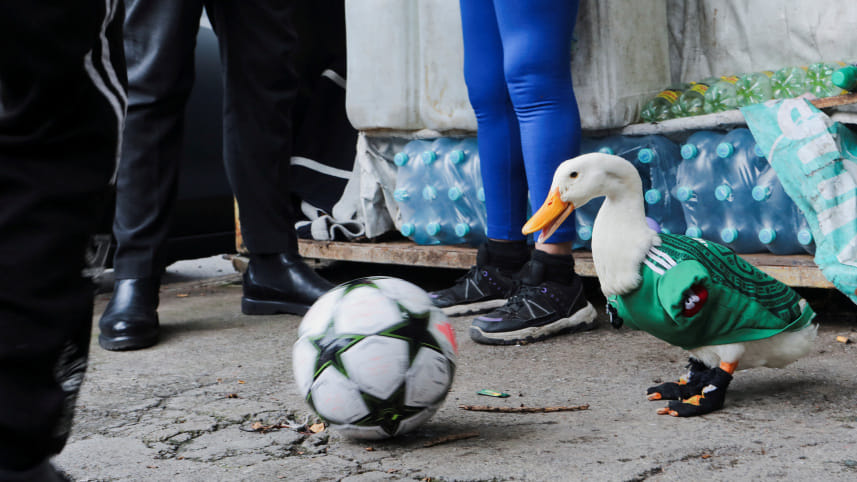
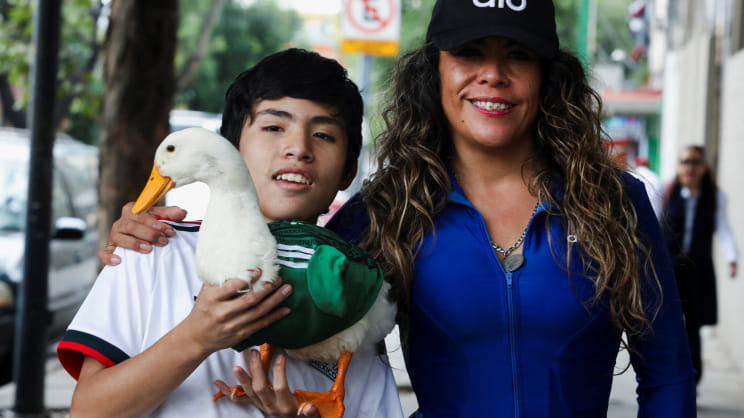
Before his arrival on the scene, Merlin, a domesticated duck from Mexico City, had already captured global attention. During celebrations after Mexico’s opening-match victory over South Africa, Merlin wandered through the ecstatic crowds on Reforma Avenue wearing a miniature Mexico shirt and custom-made duck socks.

After all, even in the chaos of a World Cup party, proper footwear is non-negotiable.
The unlikely sight spread rapidly online, transforming an ordinary day for Merlin and his owner Karla Gomez into an instant viral sensation. Some supporters even suggested the duck deserved official mascot status, though tournament purists might argue that Mexico’s official axolotl symbol already had the amphibious-representation quota well covered.
Of course, the World Cup has long provided a stage for creatures beyond the footballing world. For those with longer memories, the benchmark remains Paul the Octopus, who became a global sensation in 2010 after correctly predicting Spain’s victorious campaign.
Paul’s remarkable run made him one of the most famous non-human personalities in tournament history, operating with a level of precision that the likes of Mikel Oyarzabal, Ferran Torres, Bruno Fernandes and Cristiano Ronaldo can only envy after their recent showings.
Official mascots have also frequently borrowed from nature. Brazil 2014 introduced Fuleco, the armadillo-inspired character, while Russia 2018 featured Zabivaka, the cheerful wolf.
In a World Cup already writing its own script, Merlin and Dawn are proving that even the smallest characters can end up in the credits.
One may wonder what lies next for these ever-increasing dear ducks. Multi-million-dollar contract or sponsorship row?
Will Jose Mourinho’s Real Madrid be desperate to garner more media exposure by roping them in after Marc Cucurella, Bernardo Silva, and Ibrahima Konate?
Time will tell, but for now, it’s one quack at a time.


Comments