


Italy’s world triumph at a stadium lost to time

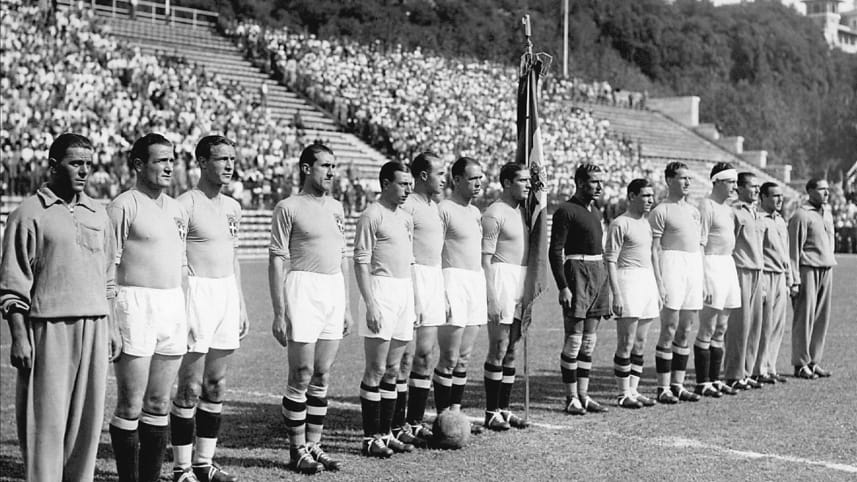
Today, there is no trace of the Stadio Nazionale del PNF (National Stadium of the National Fascist Party) on the map of Rome. Built in 1911, the stadium was permanently closed in 1953 and later completely demolished. Yet, if one brushes off the dust of history, it becomes clear that it was on this now-vanished ground that the story of Italy’s first world triumph was written.
June 10, 1934. The final of the second World Cup organised by FIFA witnessed a thrilling battle for supremacy. But that was not all -- it also served as a political stage for Italian Prime Minister Benito Mussolini to showcase the power of his fascist regime.
 For all latest news, follow The Daily Star's Google News channel.
 Under Vittorio Pozzo, the legendary coach who would go on to win two World Cups, hosts Italy had emerged as a rising power in world football. On the other hand, Czechoslovakia were known for their artistic style of football. In the intense heat of nearly 40 degrees Celsius, the two teams faced off in a battle for the title. The 55,000 spectators in the stands could hardly have imagined that this match would become the first World Cup final in history to go into extra time.
Playing qualifiers despite being hosts and accusations of ‘deception’
The 1934 edition was unique in World Cup history for one major reason -- it was the first time teams had to play qualification matches to reach the final tournament. Even the hosts Italy were not exempt. Although they secured their place in the main draw by thrashing Greece 4-0 at home at San Siro, that victory remains controversial to this day.
There are allegations that Italy violated FIFA’s rules by fielding three players in that match -- Luis Monti, Enrique Guaita and Anfilogino Guarisi -- who were not legally eligible to represent Italy. According to the rules, a footballer who had played for one country needed to reside in another country for at least three years before representing them. But Monti and Guaita, who had played for Argentina, and Guarisi, who had represented Brazil, fulfilled none of those conditions. Interestingly, while FIFA strictly enforced the rule in the case of Romania’s Iuliu Baratky around the same time, they mysteriously turned a blind eye to Italy’s ‘deception’.
And that was not the end of the controversy. The second leg of the qualifier was supposed to take place in Athens, but it was never played. At the time, it was said that Greece -- already humiliated in the first leg -- did not want to suffer further embarrassment at home. However, about 60 years later, it emerged that Italy had offered to buy a two-storey house for the financially struggling Greek Football Federation. In return, Greece withdrew from the World Cup, and the match was cancelled.
In search of a new world champion
Uruguay, the hosts and champions of the 1930 World Cup, were angered by the fact that most European nations had refused to participate in that tournament. As a result, they completely boycotted the 1934 World Cup hosted by Italy. It remains the first and only instance in World Cup history where the defending champions did not participate to defend their crown. Consequently, it was certain from the outset that football would crown a new world champion.
Meanwhile, Argentina -- the runners-up of the previous edition -- did not fare much better. They were eliminated in the round of 16 (essentially the first round) after losing to Sweden.
The road to the final
Sixteen teams participated in the second World Cup, played entirely in a knockout format, meaning there was no group stage.
Italy began their campaign by crushing the United States 7-1. In the quarterfinal, after their match against Spain ended 1-1 following extra time (penalty shootouts had not yet been introduced), they won the replay 1-0 to reach the semifinals. Then the Azzurri defeated the in-form Austria 1-0 to book their place in the final.
Czechoslovakia, meanwhile, defeated Romania 2-1 in their opening match. They then beat Switzerland 3-2 in the quarterfinals and overcame a strong Germany side 3-1 in the semifinals to reach the title-deciding stage.
Head-to-head statistics
This final marked the 11th meeting between the two sides in their footballing history. Their record from the previous 10 matches was perfectly balanced -- each team had three wins, while the remaining four matches had ended in draws.
Italy entered the final with the confidence of victory in their most recent encounter. In May 1933, they had defeated Czechoslovakia 2-0 at home in Florence during the Central European International Cup.
The final: a show of fascism behind football
A few days before the World Cup began, Mussolini issued a stern warning to Italian coach Pozzo. He made it clear: “You alone are responsible for success, but if you fail, may God help you.” This veiled yet terrifying threat reached the players’ ears as well.
At a banquet, Mussolini even ran his finger across his throat in front of them, signalling: “Either you win, or…” -- implying death. For the fascist ruler, the World Cup was far more than just winning a trophy; it was a massive political advertisement of his power.
In the scorching heat, Italy fell behind in the 71st minute when Antonin Puc scored for Czechoslovakia. As defeat loomed large, Raimundo Orsi equalised in the 81st minute to bring the Azzurri back into the match. With no further goals in regulation time, the World Cup final went into extra time for the first time in history.
Then, in the 95th minute, centre-forward Angelo Schiavio scored the winning goal for Italy. He was so exhausted that he briefly lost consciousness on the field after the goal.
There were also plenty of rumours about off-field influence behind this world triumph. Monti later revealed that Swedish referee Ivan Eklind had attended a dinner with Mussolini on the night before the final. And when the first half ended goalless, Il Duce (The Leader) himself entered the dressing room and scolded Monti, saying that although Eklind was indeed “cooperating”, Monti should not commit excessive fouls and make the referee’s job difficult.
Eventually, Italy lifted the Jules Rimet Trophy for the first time with that 2-1 victory. The team also received the gigantic Coppa del Duce, specially commissioned by Mussolini to glorify himself and his fascist regime.
Local newspapers reported the triumph in a very specific tone. La Gazzetta dello Sport ran the headline on its front page: “The Azzurri conquer the World Championship in the presence of Mussolini." Meanwhile, La Stampa titled its report: "Italian footballers in the presence of the Duce conquer the world championship."
An unbroken record
Midfielder Monti remains a unique figure in football history, holding the record for playing in two World Cup finals for two different countries. In 1930, he represented his homeland Argentina in the final against hosts Uruguay and ended up on the losing side.
However, four years later in 1934, playing for Italy -- through his ancestral roots -- he finally tasted World Cup glory.
Comments