


‘Big business’ IPL favours batters, bowlers must adapt: Muralidaran
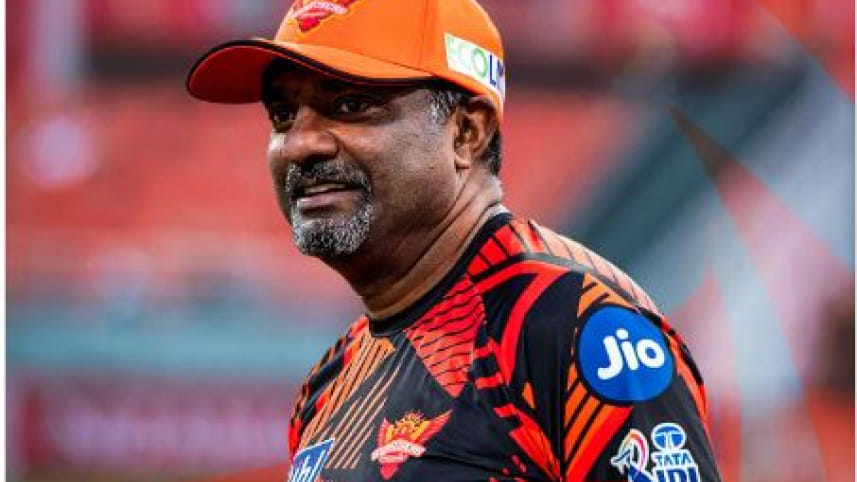
Sri Lanka great Muthiah Muralidaran said the Indian Premier League (IPL) has become a “big business” driven by entertainment, and that is why the balance has tilted heavily towards batters in recent years.
"It's very difficult for a bowler because these days, because of every team, not only us [SRH], has an opening [pair] that doesn't care about in or out, they just go after the bowling," Muralidaran said, as quoted in ESPNCricinfo.
 For all latest news, follow The Daily Star's Google News channel.
 "When we used to play, about 40 to 50 runs was a good score with one wicket lost in six overs, now the average is 70 to 80."
Batting records continue to tumble, with even imposing targets proving insufficient. The trend was evident again when Sunrisers Hyderabad (SRH) made light work of a 244-run chase against Mumbai Indians (MI), underlining how difficult life has become for bowlers.
The changing approach, he noted, is driven by a new generation of fearless batters. He highlighted uncapped 23-year-old Salil Arora’s audacious no-look six off Jasprit Bumrah as a defining example.
"Even a good bowler goes for a six, [even] Bumrah goes for one or two balls. Abhishek [Sharma], the way he hits, it's unbelievable, but when a new boy Salil hits a six, it's unbelievable - you don't think [someone with] the calibre of Bumrah comes and a young boy will hit a six [off him] because he will think about how am I going to survive [Bumrah]," SRH spin-bowling coach Muralidaran said.
"But nowadays, no, [it's about] how am I going to hit a six - that's their approach. Confidence levels have gone up because people have showed this is the way to play the modern game and youngsters are following that.
"So, for bowlers, there is not much to say; they have to practise a lot and be [as] accurate as possible. On your day, you might do well, even if you do well sometimes you are in the receiving end because of the wicket and the conditions."
He also expressed concern over the evolution of spin bowling, arguing that fewer young players are developing the ability to turn the ball effectively.
"Now the bowlers will go back [from] this tournament, [and figure out] how we can contain. They will come up with something, and the batsmen will find something else - this is the way the modern cricketers are going," he said.
"[Spinners] only try to bowl quicker, and not try to spin it [the ball]," he said. "Because they are not getting that ability from a younger age - you can't come to [Under-19s] and try to spin the ball because their muscle memory is already there, so you can't get that. So when you are at the age of 10, 11, 12, try to spin - we need to spin to beat the bat. But if you can't spin, you see in training, how batters [face] throwdowns and hit sixers. So it looks like a throwdown bowler bowling at you, and batters are getting into the line and hitting."
"So if you spin, their [batters'] eyes also open and they say 'oh it's spinning, so I'm missing it', [and they think about] which way it's going to spin."
Reflecting on how past greats might fare in today’s conditions, Muralidaran acknowledged the difficulty even elite bowlers would face.
Asked how he or Shane Warne would have fared on today's pitches, Muralidaran said: "We would have turned [the ball], but we would have not made a big dent. We would have turned [the ball], we could have got like one or two wickets, maybe they would have scored 40 runs easily, because wickets are so good and you need about three-four bowlers like that to contain [the total] to less than 200.
"I have played about 170 T20 games, but because at that time the power [hitting] wasn't as great as now, when we bowled, I would have got hammered only two times over 60-odd games, maybe more than 40 runs, and Shane also same. Nowadays, [conceding] 50 runs is a great deal for a spinner, 40 runs means you've bowled well. The game has changed, we can't compare eras."
Despite concerns over the imbalance, Muralidaran believes structural changes are unlikely, given the commercial nature of the tournament.
"I don't think pushing the boundary [ropes], when the ball is flying over the ropes everywhere, [will change things]," he said. "I think if we give fair wickets, the spectators will say it's become boring because the T20 followers want entertainment, so they want to see the fours and sixes. That's why the tournament is built like that - an extra player to come and bat [impact player]. It is a big business at the moment, sponsors and everything, so you will lose the sponsors and interest of the people [if you change it].
"I think this will continue, but over a period, bowlers will try to adapt, it will take some time. Sunrisers started this [power-hitting] and now everyone is adapting, so now the bowlers will go back [from] this tournament, [and figure out] how we can contain. They will come up with something, and the batsmen will find something else - this is the way the modern cricketers are going."
Comments