


Beyond compliance, towards care

Thirteen years ago, the Rana Plaza disaster claimed over 1,100 lives and injured thousands, exposing the deadly costs of neglecting occupational safety. That tragedy sparked global reforms to workplace physical standards. While the tragedy prompted significant reforms in structural and building safety within the Ready-Made Garments (RMG) sector, it also underscored the need to look beyond physical compliance. Ensuring a healthy psychosocial working environment is the OSH Day (World Day for Safety and Health at Work) 2026 slogan. The psychosocial working environment encompasses the social, psychological, and organisational aspects of a workplace affecting employees' mental health, well-being, and performance. It goes beyond physical conditions to focus on how work is designed, managed, and experienced. Examples include work pressure, support from managers, job security, recognition, and work-life balance.
In a research project on declining female garment workers, initiated by GIZ, we used psychological insecurity—excessive work-related stress—to measure job insecurity. A woman worker, overwhelmed by responsibilities, may perceive inefficiency as a threat to her employment. We found that about 79% of women garment workers experienced psychological insecurity by the time they left garment factories. We asked whether they felt the workload was too much, and most responded affirmatively, highlighting the role of workload in their decision to leave. Overtime led to shifts into the night, creating social barriers.
Furthermore, the factories placed extra pressure on workers by requiring production of over 180 to 200 units per hour, while workers could only produce around 100 to 150 units. They were asked to double their output, which was impossible to manage. Under this pressure, workers were not even allowed to leave for family or medical emergencies.
In another study supported by STITCH, workers were asked about changes in their workload following the new minimum wage announcement in December 2023. According to the survey, 65.68% of workers reported an increased workload in 2024 compared to 2023. This was due to rising hourly production targets. In this context, a union leader who participated as a KII noted, "Factories manage wage hikes by increasing individual production targets, causing worker stress and reduced job security."
This highlights how cost-cutting measures, such as higher targets, burden the remaining workforce, increasing physical and mental strain. Rights-based organisations raised concerns about the long-term sustainability of these practices, which compromise workers' well-being to accommodate wage hikes. Despite a wage increase, inflation harms workers' well-being, as one worker remarked, "We can barely live 15 days comfortably with such wages."
This statement illustrates the perceived inadequacy of wage adjustments and failure to keep pace with inflation and living costs. Under these circumstances, the concept of a living wage entered discussion, not without debate. From a poverty line perspective, an academic insightfully pointed out, "For a four-person family, 12,500 taka divided per head is below the poverty line even in Bangladesh. If someone works 10 hours a day and his family's earnings per head are below the poverty line, this is an unsustainable model." This reflects how wage adjustments, while significant in percentage terms, fail to bring meaningful improvements in workers' lives and end in unhealthy mental conditions.
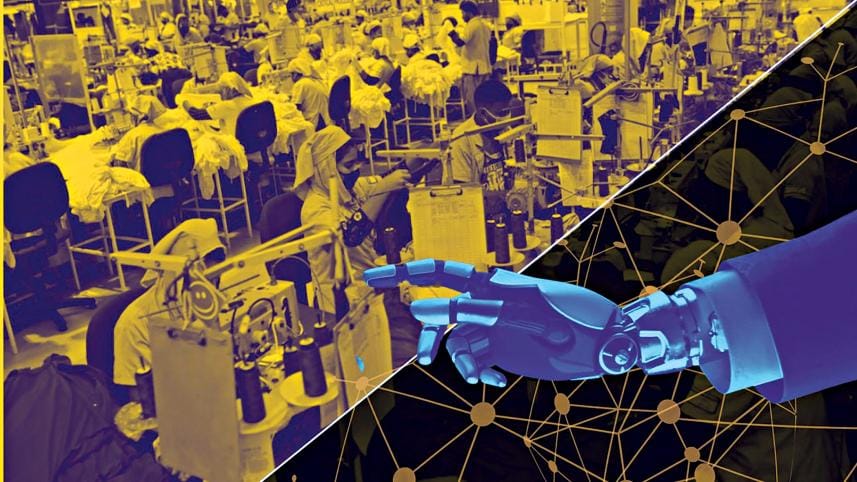
Aside from fair wages, automation introduced new types of psychological and emotional stress. Integrating automated systems raises productivity goals and stricter performance monitoring, creating an environment of pressure and anxiety. Workers report feeling overwhelmed by the need to meet unrealistic expectations while adapting to new technologies. Additionally, while automation reduced manual workload for some tasks, it increased the intensity of others. Workers operating automated knitting machines must remain constantly vigilant to ensure smooth operation, which leads to fatigue and mental strain. Fear of being replaced by machines also contributes to job insecurity, hurting workers' morale and motivation.
One of the biggest impacts of automation has been a decrease in overtime hours. Weekly overtime dropped from an average of 20 hours to 11 hours, mainly due to faster production cycles enabled by automated machines. While this allows workers more time for personal and family responsibilities, it significantly lowers take-home pay, as overtime bonuses often made up a large part of income. This is supported by the worker survey in my study, conducted by BLF, which found 88% agreed that since automation was introduced, they needed fewer overtime hours than before. Fewer overtime opportunities mean less financial security for those who depend on extra hours to support families. This trade-off between income and work-life balance remains a key concern. However, job losses to automation are also an important issue for psychosocial well-being. To address this, Sarah Krasly, CEO of Shimmy Technology, argued that digital literacy should focus on digital skills such as reading, changing, evaluating, troubleshooting, and, at the highest level, creating.
Education is essential for digital literacy. The benefits of educated workers who quickly understand English-language instructions and machine guidelines include reduced dependence on supervisors to operate machines. Reflecting this, a worker said, "The new machines show errors on the display. Even if a needle is broken, you can see it on the display; you don't have to search for everything manually. If someone doesn't understand English, they can't read the display. If I had a better education, I could easily read and understand the functions. Even if I don't have experience, I might learn quickly if I am educated. Otherwise, I will have to learn by experience, which takes time."
The Rana Plaza tragedy remains a powerful reminder that worker safety cannot be reduced to mere structural compliance.
To upskill workers, the Asian University for Women in Bangladesh initiated a program to provide primary education in English, Math, and computers to women garment workers. The former president of BGMEA argues that this education is essential for participating in digital-based training on tablets, understanding machine instructions, and absorbing training effectively. The trade representative also believes that workers with 11-12 years of education are better positioned to use changing machines and technologies.
The final concern is the connection between mental health and the negative effects of climate change on the workplace, based on research on ETI's efforts to promote a just transition. Rising temperatures pose a significant problem for factory workers. The ILO (2019) estimates that by 2030, 4.84 per cent of working hours in Bangladesh will be lost due to heat stress, equivalent to 3,833,000 full-time jobs. Women bear the brunt of these issues, as they are more likely to miss work due to disproportionate caregiving duties at home (ILO, 2019).
Green buildings can help reduce problems caused by climate change. There is a legal requirement to display a thermometer on every floor to monitor room temperature. Ideal settings are 30 °C, with humidity maintained between 55-65%. If anything unusual is detected, staff alert owners. Auditors check for worker suffocation during site visits, as it is not always visible on the thermometer. If the brand finds the work environment unusual, they inform factory management. One brand noted that workers sometimes express needs directly to management. In sections prohibiting cooling systems, factory management provides workers with saline at intervals and a separate heat allowance.
Factories address worker issues through various committees, including health and safety, participation committees, and anti-harassment bodies. These platforms help brands understand worker needs and gather suggestions, particularly on environmental concerns.
"The health and safety committee plays a significant role in this aspect," one brand stated.
Programmes focusing on worker awareness remain the most effective approach. According to a buyer, "When management imposes things upon workers without teaching them, it gives us the required KPI, but in the long run, it does not sustain as the workers are not aware."
It illustrates how the psychosocial work environment links to fair wages, automation, and climate change, each of which generates stress due to the evolving nature of work. The Rana Plaza tragedy remains a powerful reminder that worker safety cannot be reduced to mere structural compliance.
On this 13th anniversary, Bangladesh must confront less visible risks shaping workers' lives: unrealistic workloads, inadequate wages, technological insecurity, and climate-related stress. The government, trade associations, factories, and labour organisations must monitor workloads and address mental stress through effective counselling and training.
Dr Shahidur Rahman is a Professor at BRAC University.
Send your articles for Slow Reads to slowreads@thedailystar.net. Check out our submission guidelines for details.