


How the Kabinnama can protect Bangladeshi Muslim women’s rights


Last year, a legal controversy arose regarding “a Muslim wife’s approval to second marriage” flooding social media, creating confusion, uncertainty, and agitation among the netizens. Some of the social media posts speculated ideas such as “wife’s approval is no longer required for second marriage” or “the High Court allows second marriage without wife’s approval,” among others. This led to the question of whether Muslim men in Bangladesh has ever needed to obtain the consent of their first wives before contracting a second marriage. Here’s what the Bangladeshi law says about this issue.
Section 6 (1) of the Muslim Family Laws Ordinance, 1961 (MFLO) says that a married Muslim man cannot remarry while he is already in a marriage unless he seeks written permission from the Arbitration Council. Also, any marriage conducted without such permission will not be registered under the Muslim Marriages and Divorces (Registration) Act, 1974. There is no provision regarding a wife’s consent to her husband’s second marriage in any law in the country. This raises the question as to what led to those posts on social media.
 For all latest news, follow The Daily Star's Google News channel.
 Back in 2021, a Supreme Court lawyer challenged the validity of Section 6 of MFLO in a writ petition, saying that this section is arbitrary and discriminatory towards both men and women. She argued that Muslim family law allows a man to have four wives at a time, but simultaneously asks a man to ensure justice and equal rights for all wives. But the Arbitration Council does not have the capacity to ensure that the wives are getting proper maintenance and equal rights; rather, it permits polygamy without ensuring justice for the wives.
In December 2025, the High Court gave its final verdict rejecting the writ petition. The judgment states that Section 6 of MFLO is neither discriminatory, arbitrary, nor unconstitutional. Hence, the authority of permitting a second marriage still lies with the Arbitration Council. However, netizens misunderstood the judgment and flooded social media with posts, creating confusion.
Here’s why the power to give permission lies exclusively with the Arbitration Council.
Practically speaking, in most cases, the wife’s permission might not be free from undue influence. A husband could coerce his wife to give permission. She might also not permit a second marriage simply because of jealousy, even if the husband has enough grounds to remarry. The council may allow the husband to remarry on specific grounds like sterility, sickness, physical incapacity to establish conjugal relations, mental illness of the current wife, or if the husband gets a decree for restitution of conjugal rights and the wife refuses to resume conjugal relations. Simply put, there is a significant possibility of misapplication of power in this regard. That is why the permission lies with the Arbitration Council.
The council, if deemed fit, will record its reasons and grant permission to the remarriage. However, to obtain permission, the husband must apply to the chairman, justifying his intention and providing information about his wife’s consent in the first place.
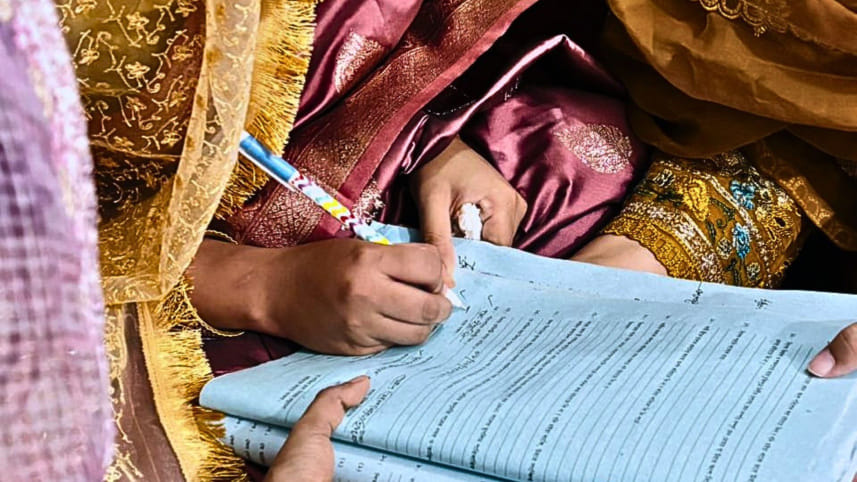
From a feminist standpoint, this is obviously not enough. It portrays blind adherence to century-old patriarchal customs. This is where the long-standing debate and muted conversations regarding stipulations in Muslim marriage come. Muslim marriage, being of a contractual nature, provides the scope for inserting stipulations. Many Muslim countries such as Qatar, Kuwait and UAE have made provisions for inserting stipulations. In Bangladesh, there is no specific provision for inserting stipulations in Muslim marriage apart from Section 17 of the Kabinnama, which reads “Special Conditions if any,” and leaves only three lines to insert the conditions, which is barely sufficient.
More importantly, people are not aware of the rights that Shariah as well as Bangladeshi law have given them. Sometimes, even the Kazi himself does not know the purpose of Section 17. Typically, they write something that reinforces the normal events of a marriage, such as “Agreed to maintain the conjugal life as per Islamic ideals and shall abide by the rules and regulations of the Muslim family laws.” Most women are not aware that they can put stipulations regarding completion of their education, continuation of a job after marriage, etc in the Kabinnama. A woman can even put a stipulation that the husband cannot remarry without her consent. If the husband breaks any stipulation, the wife has the right to seek divorce. Thus, an absolute and exclusive marital power has been given to women; however, very few of them have actually exercised it in reality.
It brings us to the question: should we then change the law or bridge the gap between knowledge and ignorance? We believe the latter is more effective, given the current legal system of our country. Also, getting anxious by reading clickbait news that many online media are selling these days does not do anyone any good.
Mayesha Afia Jarin is lecturer in the Department of Law at International Standard University.
Pinak Sarkar is lecturer in the Department of Law at International Standard University.
Views expressed in this article are the author's own.
Follow The Daily Star Opinion on Facebook for the latest opinions, commentaries, and analyses by experts and professionals. To contribute your article or letter to The Daily Star Opinion, see our guidelines for submission.
Comments