


How Bangladesh can give its women migrants a real edge

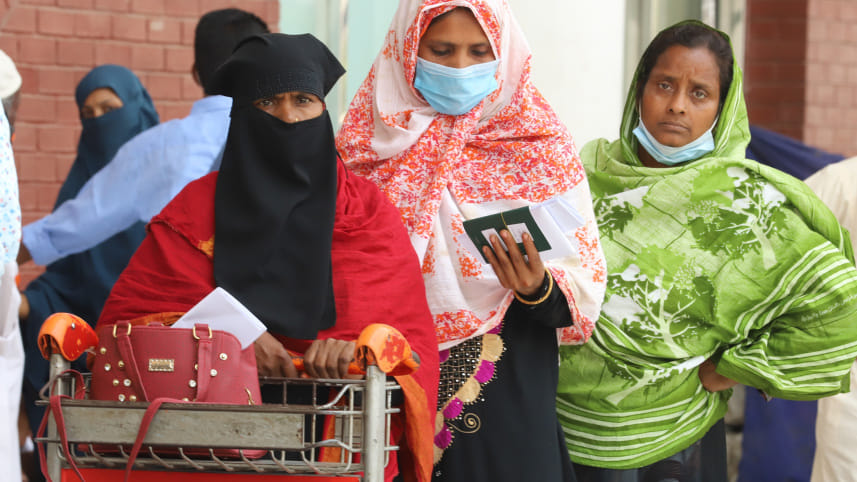
Moksuda Begum left Narayanganj with a dream and a promise. A widow raising her two children, Moksuda had been told she would earn Tk 22,000 a month as a domestic worker in Saudi Arabia. But upon arriving there, she found something very different: waking up at 4am, she worked continuously until midnight while her wages went to an agent in Riyadh instead of into her own pocket. She endured this for months before finally reaching out to the Bangladesh embassy.
Her story, reported by The Business Standard in late 2025, is far from an isolated case. BRAC Migration Programme data from 2025 shows that more than 470,000 Bangladeshi migrant workers returned home over the past six years after facing exploitation or abuse. At least 67,199 of those who returned were women who reported physical or sexual violence; many returning, traumatised and stigmatised, to a reintegration system ill-equipped to help them.
 For all latest news, follow The Daily Star's Google News channel.
 In 2024, only about 61,158 women officially migrated for work from Bangladesh, and by the end of 2025, the figure stood at 62,353, according to the Overseas Employment Platform (OEP) under the Bureau of Manpower Employment and Training (BMET). This marks a 41-percent decline from the 2022 total of 105,466. Bangladesh’s gender gap in migration is among the most pronounced in Asia, and it is not a matter of culture alone. It reflects deliberate policy choices and structural failures that have long treated women as a risk category rather than an economic asset.
In 2024, women accounted for just 6.03 percent of Bangladesh’s officially deployed migrant workforce. A 2025 report by the Asian Development Bank Institute (ADBI), International Labour Organization (ILO), and Organisation for Economic Co-operation and Development (OECD) highlights that, by contrast, women comprised 68 percent of migrants from Indonesia, 52 percent from the Philippines, and 41 percent from Cambodia. Even Pakistan, with socioeconomic conditions not too dissimilar to that of Bangladesh, recorded a more balanced share across several corridors. This disparity also reflects a broader global pattern: an ILO policy brief notes that some 70.8 crore women were outside the global labour force in 2023 due to care responsibilities, an exclusion that Bangladesh’s migration system reflects and reinforces.
For much of its history, Bangladesh managed female migration through fairly restrictive policies. Women seeking to work abroad in domestic service faced age minimums, mandatory spousal consent, and periodic destination bans imposed after high-profile abuse cases. These were consistently framed in terms of protection. In reality, these measures pushed desperate women into irregular channels that offered no safeguards at all.
According to BMET, Saudi Arabia is the single largest destination for Bangladeshi women migrant workers. However, there has been a sharp decline in the figures since 2016. Shifting official policies, changes in destination-country demand, and a self-reinforced negative public narrative around Bangladeshi female domestic workers all played a role.
BRAC Migration Programme and The Business Standard’s 2025 report identified a critical structural flaw: Bangladeshi women who migrate are overwhelmingly sent as domestic workers into private households, with about a month’s housekeeping training, limited pre-departure orientation, and near-total isolation once abroad. Researchers explained the problem plainly: Bangladesh hardly diversified beyond domestic work for women, while countries like the Philippines now send women into hotels, care facilities, and skilled professional roles. In Bangladesh, women from rural areas, often with limited education, are sent abroad without adequate preparation. This contributes to increased abuse rates. A negative narrative also sets in and that narrative ends up discouraging both skilled women from migrating and employers from considering Bangladeshi women for higher-level roles.
Bangladesh’s mandatory 30-day housekeeping training for domestic workers covers basic household tasks and some cultural orientation. It rarely addresses recognition of labour rights violations, how to contact an embassy safely, elder care protocols, or financial literacy, whereas the Philippines’ nationally accredited Domestic Work NC II Certificate covers practical skills, rights education, and financial planning as minimum requirements.
The Bangladesh Labour Act (Amendment) Ordinance, 2025 marked a significant legislative milestone by formally recognising domestic workers as workers under law, following Bangladesh’s ratification of three key ILO conventions related to occupational safety, health, and freedom from workplace violence. The country also became the first in Asia to ratify all 11 fundamental ILO instruments.
A February 2026 analysis in the Dhaka Tribune highlighted that Bangladesh is still in the process of developing a comprehensive national database on domestic workers, including their contact numbers, wages, and vulnerabilities. While this gap presents challenges for evidence-based policymaking and effective monitoring, there are emerging signs of progress.
The OEP system of BMET is now systematically preserving trainee data across genders, offering a strong foundation for building an integrated and responsive database in the near future. Strengthening such systems, alongside expanding the capacity of labour inspection, can significantly enhance accountability and ensure that legal recognition translates to meaningful protection for workers.
Ageing populations across the Gulf, East Asia, and Europe are generating sustained demand for skilled care workers. The Philippines has built its female migrant workforce around this opportunity: Filipina care workers earn more, remit more, and carry far less recruitment debt than their Bangladeshi counterparts. But with its large young female population and established bilateral ties with major destination countries, Bangladesh is well placed to compete in the global care economy, if it builds the necessary training infrastructure, credential pathways, bilateral protections, social support systems, etc. None of this requires starting from scratch. It requires adapting what already works in Manila, Colombo, and Kathmandu, and doing so with urgency.
The BNP-led government’s stated commitment to sending one crore workers abroad within five years will fall short of its potential unless women are an equal part of that vision, not as a category to be managed, but as skilled workers to be championed.
Moksuda Begum eventually came home. She lost months of wages, her savings, and a year she cannot reclaim. Her willingness to try, to cross an ocean alone, to endure what no one should, for the chance to feed her children—is precisely the kind of human capital Bangladesh keeps failing to protect. Recognising this, the way forward lies in strengthening pathways for skilled, safe, and lawful migration, ensuring that such courage is met with systems that safeguard dignity, rights, and opportunity.
Mohibbullah Al Maruf works at Bangladesh Association of International Recruiting Agencies (BAIRA). He can be reached at mohibbullah96@yahoo.com.
Views expressed in this article are the author's own.
Follow The Daily Star Opinion on Facebook for the latest opinions, commentaries, and analyses by experts and professionals. To contribute your article or letter to The Daily Star Opinion, see our guidelines for submission.
Comments