


Decorating a dying tree: The illusion of education reform in Bangladesh
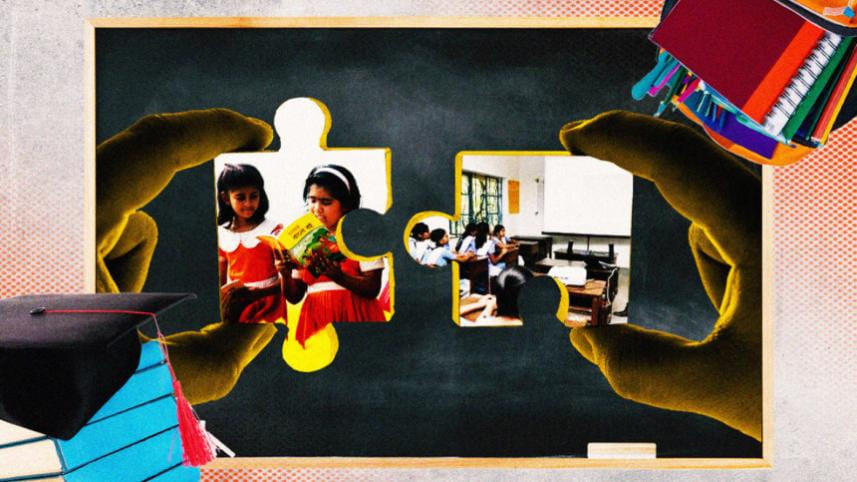
There is a particular disease that afflicts policymakers in developing democracies, and Bangladesh's education establishment has a textbook example for it. Let’s call it “instant applause syndrome” where a person does performative things to look good on paper regardless of the said work’s long-term impact. For example, a video recently circulated on social media that captures this pathology perfectly. The education minister steps out of a car in a village, microphone clipped to his collar, and poses a question to a group of schoolchildren with theatrical flair: "There will be no more cheating in exams. You are studying properly, aren't you?" It might have seemed like a charming moment of grassroots engagement. But pause and ask yourself: when a minister's primary talking point—at field visits, board meetings, and education seminars alike—is exam hall discipline, what does that tell us about the ceiling of our ambitions?
The fact that the minister considers cheating prevention a selling point is not merely disappointing. It announces, loudly and without irony, that we have set the bar at administrative adequacy, calling it reform. The minister’s agenda, as it has emerged in public, reads like a checklist of procedural anxieties: preventing cheating in exam halls, drafting new legislation to criminalise digital fraud in examinations, and overhauling how answer scripts are evaluated and marked. These are not unimportant matters, but obsessing over how strictly we mark a test tells us nothing about whether the test is worth taking. Criminalising digital cheating does not produce a single curious, capable, or creative mind. These are the concerns of an administrator trying to plug leaks in a sinking ship, not of a visionary trying to build a better vessel.
 For all latest news, follow The Daily Star's Google News channel.
 Compare this with what policymakers in high-performing education systems actually discuss. In Finland, South Korea, or Singapore, the national conversation in education circles revolves around cultivating creativity, building research capacity, redesigning curricula to address 21st-century skills, and preparing students for labour markets that will look radically different in twenty years. Their ministers are not photographed asking children if they're copying off each other. They are being asked hard questions about learning outcomes, teacher development pipelines, and whether their systems are producing thinkers or test-takers.
Bangladesh, meanwhile, remains imprisoned in a conversation about exam centres and grade sheets. And this is not simply the minister's personal failing. It is a structural one, rooted in how our political economy works. When a party comes to power with a five-year mandate, its core incentive is to produce visible wins before the next ballot. A shiny new school building can be photographed. Distributing devices to thousands of students generates a front-page headline and gives the impression of a country going digital overnight. But no one can photograph the quality of a lesson. There is no ribbon-cutting ceremony for a genuinely improved curriculum. You cannot put a better-trained teacher on a campaign leaflet.
So, we get buildings instead of learning, gadgets without pedagogy, and policy announcements without institutional follow-through. The new policy announcements popping up in recent months—mandatory third languages and vocational training—follow exactly this pattern. They are presented as forward-thinking reforms, but without the foundational structural work that any serious curricular overhaul requires: teacher retraining at scale, assessment reform, coherent implementation frameworks, and a willingness to sit with complexity for years before results arrive. Instead, these initiatives feel scattered and performative, sewn onto a system whose foundations remain unaddressed. You cannot decorate a tree whose roots are being eaten through; you can only delay the moment it falls.
The tablets would be distributed; whether teachers could use them, whether the curriculum would be compatible with digital learning, whether students in those schools even would have reliable electricity—these questions often dissolve into the background noise of governance. The GPA-5 count swells year on year, pass rates reach improbable heights, and yet we continue producing graduates who are uncompetitive in the global workforce. We are measuring performance while avoiding the harder question of whether any real education is happening.
The real tragedy is that the reforms which would actually matter are both obvious and achievable. Teacher dignity is one of them. In most countries where education genuinely works, the teaching profession carries social prestige and financial security. In Bangladesh, we have systematically undermined both. A teacher who is poorly paid, professionally unsupported, and socially marginalised is not going to transform classrooms no matter how many syllabi we redesign above their heads. Investing in teachers—their training, salaries, working conditions, professional identity—yields no photographs. It yields no statistic that mounts impressively in a five-year report. But it is the single most powerful lever any education system has. We have spent decades pretending otherwise.
The curriculum problem is similarly neglected. We live in an era of rapid technological disruption, where artificial intelligence is reshaping white-collar work, where the skills that will matter most to today's schoolchildren are adaptability, critical reasoning, and comfort with ambiguity. Our curriculum barely asks students to think. It asks them to remember, to reproduce, to perform at narrow cognitive tasks under timed pressure. The result is young people who are technically literate on paper and practically unprepared for the world they are entering.
None of this is secret knowledge. Our policymakers know it. The problem is that fixing it takes a decade, requires political courage, and none of it offers any easy win. It requires a government to plant trees it will never see bearing fruit to trust that doing the right unglamorous thing today will matter enormously to a generation of children who cannot yet vote. We must be clear about what we are asking for. Not dramatic gestures. Not more gadgets or more slogans. We are asking for the boring, difficult, unphotographable work of building a real education system: rigorous curriculum reform, investment in assessment quality, and a political culture that treats long-term outcomes as worth more than short-term optics.
A nation's true development cannot be measured by the height of its buildings. It must be measured by the depth of its people's thinking. Our ministers can choose to be remembered as the generation that fixed exam hall conduct, or as the generation that finally decided to build something that lasts. So far, they are choosing the wrong thing to be proud of.
Md Reza E Rabbi is research associate at the BRAC James P Grant School of Public Health, BRAC University.
Views expressed in this article are the author's own.
Follow The Daily Star Opinion on Facebook for the latest opinions, commentaries, and analyses by experts and professionals. To contribute your article or letter to The Daily Star Opinion, see our guidelines for submission.
Comments