


A bizarre mission to restore the Madhupur Sal forest

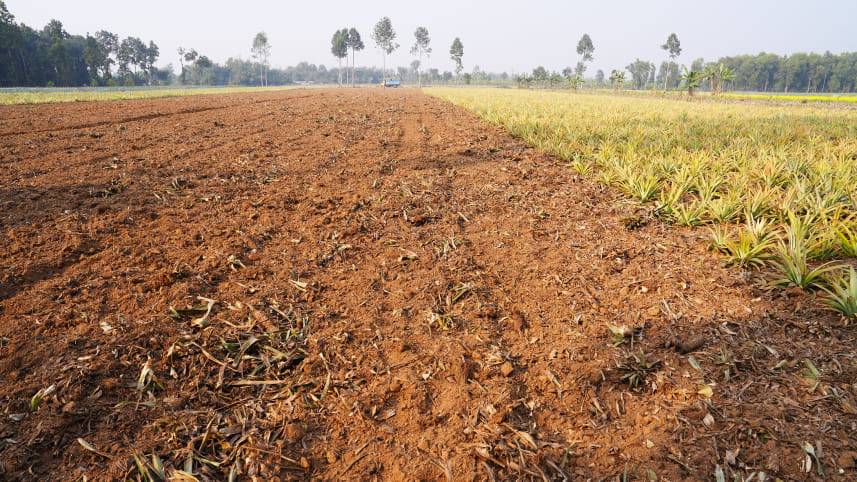
The interim government set an ambitious goal to restore the Madhupur Sal forest in Tangail. Once a legendary habitat of tigers, elephants, peacocks, bears, golden langurs, hundreds of bird species, and rich biodiversity, the forest today bears little resemblance to its past. Vast stretches have been converted into commercial plantations of exotic acacia, pineapple, banana, and spices. Only fragments of the original Sal forest remain.
The principal cause of this ecological devastation—both in Madhupur and in other Sal forest patches in Tangail, Gazipur and Mymensingh—is the social forestry programme introduced in 1989, along with the rubber plantation initiated in 1986. Industrial establishments, roads, highways, and expanding settlements have further accelerated forest loss.
 For all latest news, follow The Daily Star's Google News channel.
 The most recent Sal forest restoration drive by the government was ceremonially launched on October 18 last year. Acacia saplings were felled at the social forestry plot of Md Aminul in the Dhorung Par Tilertal area of the Dokhla Range. Some indigenous fruit and medicinal tree saplings were planted in their place. “When the trees mature, they will be auctioned in accordance with the social forestry rules. A valuation will be fixed, but the trees will not be cut. Only the valuation will be determined, and dividends will be distributed under the social forestry framework. The Forest Department will inform us what percentage will be allocated from carbon trading,” said Md Aminul, secretary of the Forest Co-Management Committee of the Dokhla Range, at that time.
When I visited Aminul’s 2.5-acre plot again on January 16 this year, it was densely covered with acacia and pineapple. Of the native saplings planted in October, only two or three were visible, covered in dust. In an adjoining area, a vast tract of land was cleared of acacia at the end of its third rotation of plantation. Acacia logs were still being loaded onto a truck. One corner of the large plot was covered with mustard plants in yellow bloom, while pineapple saplings had just been planted in some sections. Elsewhere, acacia stumps had recently been uprooted, and the land was tilled with tractors—an activity prohibited on forest land.
If the Forest Department were genuinely committed to restoring natural forests, it could have easily stopped such practices. Instead, it allows the destruction to continue. Official statistics show that social forestry covers about 4,551 acres in the Madhupur Sal forest area, according to the 2025 Restoration Plan of the Madhupur Sal Forest (2025-26 to 2027-28) of the Forest Department. The department now acknowledges that plantations of exotic species have had profound, destructive impacts. In response, the environment ministry issued a gazette notification on May 15, 2025 banning the plantation, extraction, and sale of eucalyptus and acacia seedlings.
According to the ministry plans, about 3,401 acres of land under social forestry in Madhupur are to be restored as Sal forest. An additional 3,210 acres of illegally occupied land are to be planted with Sal and Sal-compatible species. Together with surviving forest patches, these efforts aim to expand Sal forest to nearly 20,000 acres by 2028, according to the restoration plan.
Yet, official rhetoric clashes with reality. In Jhatarbaid of South Jangalia under Beribaid mouza, a Forest Department signboard reads that five hectares have been planted with native species. In fact, the area is scattered across three locations several kilometres apart. In one such plot, the Forest Department abruptly cut down some 30 self-regenerating (apanjala) acacia trees and planted native saplings without consulting the landholders, some of whom were not participants in any social forestry programme.
Md Munaf Munna, who jointly owns 2.4 acres of the land, has lived there for decades. I visited his plot on December 16, 2025 and found piles of pineapple saplings. When I returned on January 16 this year, pineapple plants covered the entire area. His wife, Shirina Begum, said their family had farmed the land since before 1971, growing rice, ginger, pineapple, turmeric, wheat, and mustard. “When people cleared the forest and built homes, the Forest Department said nothing,” she said. “Now they plant trees without informing us.”
Another local, Md Ruhul Amin, fears losing land for which his father once paid tax. Although invasive acacia trees dominate the site, most are self-generated. Elsewhere in Uttar Jangalia and Gubudia, forest officials planted native saplings inside banana and pineapple plantations without consultation, leaving landowners confused about how such actions could restore the natural forest.
Former Chief Conservator of Forests Md Yunus Ali has also said, unequivocally, that restoring the Sal forest in this manner is impossible. Pineapple cultivation, he explains, makes the soil highly acidic, preventing Sal saplings from surviving. Restoration requires preparatory species, soil conditioning, and careful sequencing. “Madhupur is an extremely sensitive area,” he notes. “Its challenges are social and political. You cannot act without considering local interests.”
Further evidence of recklessness can be seen in roadside social forestry plots in the Gachhabari Beat, where two participants in social forestry were pressured to plant thousands of saplings during the peak of winter. Most saplings died within weeks. Meanwhile, participants have yet to receive their full share of proceeds from harvested acacia, raising serious questions about fund misuse under the Tk 14-crore Madhupur Sal Forest Regeneration Project.
During recent visits, I found that most saplings planted in the name of restoring natural forest, particularly Sal, have died. Although project guidelines stipulate that 70 percent of plantings should be Sal, very few Sal saplings remain. By contrast, wherever social forestry continues, vast plantations of acacia, pineapple, banana, papaya, turmeric, and spices dominate the landscape.
In 2007, during the emergency rule, Sal saplings were planted across several hundred acres under the leadership of the then adviser CS Karim. During that phase, with the support of the joint forces, the Forest Department cut down banana plants on roughly 5,000 acres of forest land as part of an operation to reclaim encroached areas. However, they failed to recover the forest land.
It is still too soon to say if the restoration of the forest will fail again. However, what has been done so far in the name of restoring can only be described as bizarre. By destroying some acacia saplings, the Forest Department’s efforts to bring back the Sal forest amount to little more than putting up signboards and empty fanfare. Moreover, there appear to be no restrictions on cultivating pineapple, banana, papaya, and spices.
Restoring the Madhupur Sal forest is a commendable goal. But success will require genuine consultation with local communities, transparency, and trust. Powerful vested interests profit from forest land. Without confronting these interests, restoration will remain illusory. A possible way forward would be an independent legal body to develop a shared framework, review former donor-funded projects, and ensure accountability without becoming another bureaucratic burden.
Turning the Madhupur Sal forest back from its current state will be extraordinarily difficult. Only integrity, long-term commitment, and the meaningful participation of local communities can yield positive outcomes, even if limited. We hope that the current government, which emerged after a long struggle for democracy, will pay careful attention to the Madhupur Sal forest, the third-largest one in the country.
Philip Gain is researcher and director at the Society for Environment and Human Development (SEHD).
Views expressed in this article are the author's own.
Follow The Daily Star Opinion on Facebook for the latest opinions, commentaries, and analyses by experts and professionals. To contribute your article or letter to The Daily Star Opinion, see our guidelines for submission.
Comments