


Enforce noise pollution rules strictly
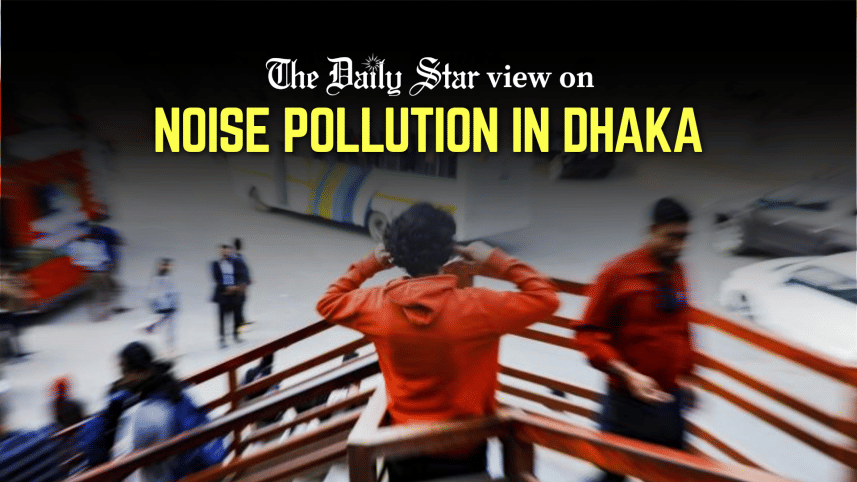
According to the World Health Organization (WHO), sound pollution is the second most significant health hazard globally, following air pollution. One need only stand by any major road in Dhaka to experience this reality. And, as a report by this daily details, noise pollution impacts our children more than adults, who have already learnt to live with our chaotic traffic situation. Not only is the degree of vehicular honking unbearable at the busiest intersections, but most areas in the capital are riddled with noise pollution. Contributing factors include traffic congestion, building construction, and industrial operations. Meanwhile, the Noise Pollution (Control) Rules, 2025 remains largely unenforced.


As per the law, the sound level should be contained within 50 decibels (dB) in designated silent zones, 55 dB in residential areas, and 70 dB in commercial zones. However, research has found that noise levels in Dhaka exceed these limits by far. Monitoring data collected in 2024 by the Centre for Atmospheric Pollution Studies (CAPS) at Stamford University Bangladesh showed that sudden, short bursts of sound reached as high as 130 decibels in parts of the capital. That is only 10-30 dB below the sound level of a gunshot. This is the environment that our children inhabit and are expected to thrive in. Ironically, noise pollution is a huge problem near schools in Dhaka, due to persistent gridlocks during student drop-off and pick-up hours.
Unfortunately, the lack of law enforcement is made worse by our culture of polluting sound. Drivers of all sorts of vehicles seem uninterested in following any rules or etiquette when driving, and the goal of each seems to be to get ahead of the red light, rather than to operate safely and responsibly. This means honking incessantly and without any sensibility towards the surrounding environment and people. In children, besides a possibility of long-term hearing damage, such noise exposure causes anxiety, stress, headaches, sleep disturbance, irritability, and behavioural changes. How do we expect to develop a strong, intelligent, and skilled generation in such an environment? Moreover, how can children be developed to become good citizens if they witness adults around them being anything but?

Whether it's the lack of rules enforcement or simply a behavioural characteristic that makes Dhaka a noise pollution hub, it's everyone's responsibility to ensure cleaner air and a better sound environment for the next generation. Just as an AI-based system has been used to ensure better traffic signal behaviour, efforts must be made to improve Dhaka’s noise pollution situation. It is reassuring that the government’s environmental arm is planning to launch a public awareness campaign on noise pollution and also introduce automated cameras to detect vehicles honking at intersections. We hope that funding these efforts will be prioritised as they can directly improve citizens’ quality of life in the long run. The gift of hearing in our children must not be sacrificed to a cacophony of preventable high-decibel noise.
 For all latest news, follow The Daily Star's Google News channel.


Comments