

A city undone by decades of neglect
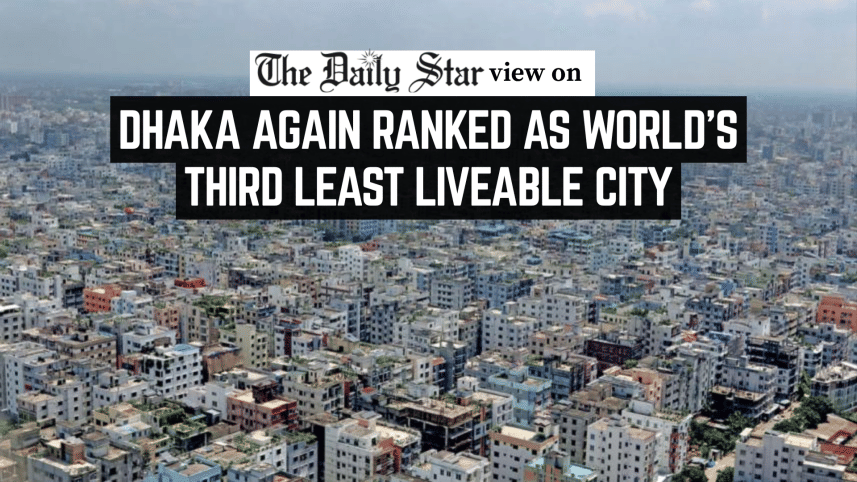
The Economist Intelligence Unit’s 2026 Global Liveability Index has ranked Dhaka as the third least liveable city in the world. The survey, conducted in May, assessed 173 cities against 30 indicators grouped under the categories of stability, healthcare, culture and environment, education, and infrastructure. Such a ranking may bruise our ego, but should also be seen as a red alert for major policy changes.
Those who have lived in Dhaka even in the 1980s and 1990s can attest to the dramatic decline of this once-beautiful city. The degradation can be attributed to consecutive governments never giving any thought to keeping Dhaka functional and efficient. Instead, our past governments have made sure everything is Dhaka-centric with little or no attempt at decentralisation, which could have solved many of the problems our capital faces today.

Dhaka has become the world’s second most populous city (after Jakarta) with about 3.6 crore people, according to a UN study. It is one of the fastest growing cities in South Asia, as all major manufacturing industries are concentrated here, attracting thousands of migrant workers. But the city’s infrastructure was not built for such a huge population, resulting in major gaps in basic amenities such as healthcare, housing, public transport, safe drinking water, electricity, and infrastructure. The pressure of this burgeoning population has weighed heavily on the city resulting in these depressing rankings.
There are an estimated 40 lakh people living in slums in Dhaka. Most families live in one room, lacking access to clean water, safe sanitation, and waste management. They also face eviction threats and often have to bear the brunt of disasters such as floods and fires. Meanwhile, unplanned urbanisation has eaten up all open spaces and much of the greenery that once provided relief to city dwellers. For the middle class, life in Dhaka means constant struggle—overpriced housing, inadequate public transport, poorly maintained roads, and frequent gridlocks. Dhaka’s air quality is also one of the worst in the world—a consequence of pollution from constant construction work and fumes from unfit vehicles.
In the EIU’s index, the category of stability includes measures of petty and violent crime. According to Police Headquarters data, in the first four months of this year, 265 murder cases were recorded under the Dhaka Range—the highest out of all ranges.
The government must first try to “repair” the city by maintaining the roads, clearing footpaths, getting unfit vehicles permanently off the roads, ensuring better policing, and putting an end to any construction that violates environmental or other laws. Parks and the water bodies we have left have to be freed from grabbers. Public institutions that provide basic services must function without “speed money.” Ultimately, however, the government must prioritise decentralisation. This will require the vision and commitment to develop cities across the country by creating jobs and ensuring access to quality healthcare and education beyond Dhaka. Only then can pressure on the capital be eased and the city finally be allowed to recover.
 For all latest news, follow The Daily Star's Google News channel.


Comments