


Gulf states ‘dragging their feet’ as migrant workers face deadly heat: HRW
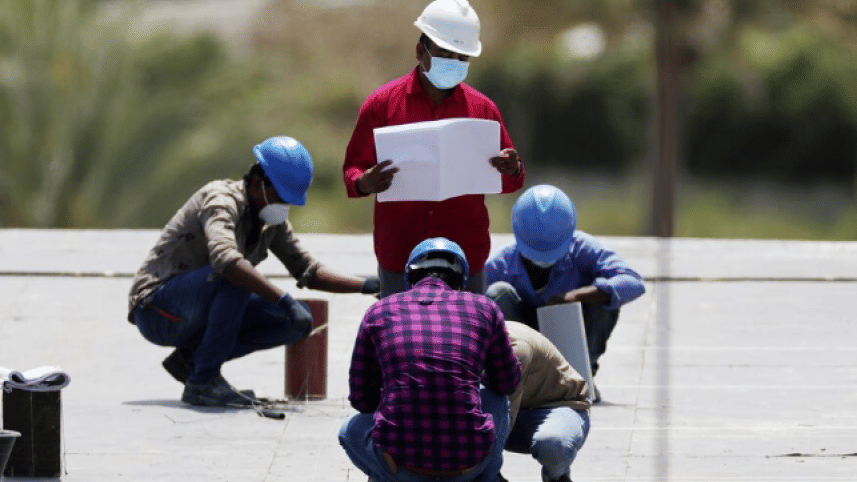
Gulf countries are failing to adequately protect migrant workers from deadly summer heat, said the Human Rights Watch (HRW), warning that millions of South Asian labourers continue to endure hazardous working conditions despite growing scientific evidence on the health risks of extreme temperatures.
In a statement released today, the New York-based rights organisation said Gulf Cooperation Council (GCC) states were exposing migrant workers to “yet another deadly summer” without sufficient occupational safety safeguards.
 For all latest news, follow The Daily Star's Google News channel.
 The statement comes as temperatures across the Gulf region continue to rise sharply amid intensifying climate change.
“Despite a wealth of evidence on both global temperature increases and the severe health risks extreme heat exposure poses, Gulf states are dragging their feet on adopting adequate protections,” said Michael Page, deputy Middle East director at HRW.
“Gulf states have the means and capacity to adopt these protections, including restricting working hours based on actual temperature thresholds rather than fixed schedules,” he added.
Between February and May this year, HRW interviewed 20 migrant workers from Bangladesh, Nepal and Pakistan employed in construction and app-based delivery services in Kuwait, Qatar, Saudi Arabia and the United Arab Emirates.
Many described extreme heat conditions, inadequate rest facilities, and pressure from employers to continue working despite clear health risks.
A UAE-based road construction worker told HRW that temperatures often reached 48 degrees Celsius.
“During summer, it becomes difficult to work by 7:30 or 8:00am, but we have to work until 11:30am no matter what,” the worker said.
Another worker said fear of heat-related deaths among labourers was constant.
“Sometimes we hear news that someone in another company collapsed from the heat and died,” he said. “We think, ‘Maybe tomorrow it will be our turn.’”
According to HRW, exposure to extreme heat can cause heat stroke, kidney failure, cognitive impairment, workplace injuries and even death.
The rights group criticised Gulf states for relying mainly on fixed midday work bans during summer months instead of adopting more scientific heat protection systems.
Several Gulf countries prohibit outdoor work during certain daytime hours between June and August or September. However, HRW said scientific evidence increasingly shows that time-based restrictions alone are insufficient.
It urged Gulf states to adopt evidence-based protections using the Wet Bulb Globe Temperature (WBGT) index, which measures heat stress based on temperature and humidity.
Only Qatar has introduced a WBGT-based threshold for halting outdoor work, though HRW said enforcement gaps remain.
The report also highlighted difficult conditions faced by app-based delivery riders.
HRW also referred to a new International Labour Organisation convention adopted on June 12 that sets labour standards for gig workers, including occupational safety protections.
The organisation urged Gulf governments to ratify the convention and strengthen domestic labour laws to address growing heat risks linked to climate change.


Comments