

‘Afraid to sleep every time it rains’

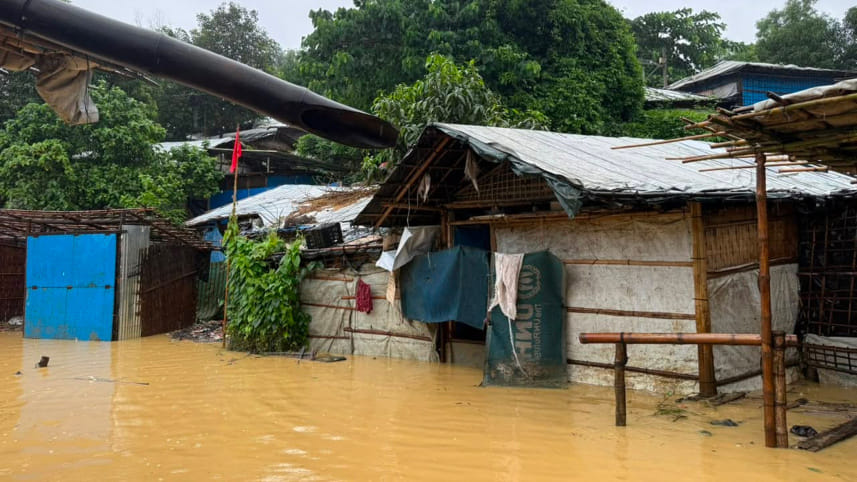
Days of relentless monsoon rain have left hundreds of thousands of Rohingya refugees in Cox’s Bazar fearing more landslides and flooding after at least 13 people were killed in rain-related disasters in the camps this week.
Among those living in fear is Ehsanullah, a Rohingya refugee in Camp-6 of Ukhiya, whose family’s shelter sits below a weakened retaining wall.

“We are afraid to sleep whenever it rains,” he told The Daily Star. “If the [nearby] hill collapses, many people will die. The houses below us are at even greater risk. We have nowhere else to go because there is no empty land in the camps. We can only pray that Allah protects us.”
He said residents had repeatedly requested authorities to reinforce the retaining wall, but no work had begun.
On Wednesday, five females -- four students and a teacher -- were killed when a hillside collapsed onto a madrasa in Camp-6.
Earlier, on Monday night, eight refugees died in three landslide incidents.
While refugees living on hillsides fear landslides, those in low-lying camps are struggling with floodwater that has inundated homes, damaged shops and made roads muddy and slippery, disrupting daily life.
According to the UN Refugee Agency, around 3,71,334 Rohingya refugees continue to live in areas highly vulnerable to floods and landslides.
Refugee Relief and Repatriation Commissioner Mohammad Mizanur Rahman said relocation efforts had begun before the monsoon, but authorities could not secure enough safe land for nearly 1,50,000 refugees who had arrived over the past two years.
As a result, many families remain on steep slopes and other hazardous locations, he said.
“The biggest challenge is the shortage of safe land. Because of this limitation, many families are still forced to live under the constant threat of landslides.”
He said learning and community centres were being used as temporary shelters for displaced families. He added that repeated announcements had urged residents in high-risk areas to move to safer locations, although many were reluctant to leave.
UNHCR yesterday expressed condolences to the families of those killed in the recent landslides and flash floods.
UNHCR Representative in Bangladesh Ivo Freijsen said the deaths show the vulnerability of the 1.2 million Rohingya refugees living in one of the world’s most densely populated refugee settlements.
He said funding shortages and the lack of available land had hampered long-term measures such as slope stabilisation, safer infrastructure, and relocation from high-risk areas, forcing humanitarian agencies to prioritise emergency response over preventive interventions.
Assistant Meteorologist Abdul Hannan said Cox’s Bazar recorded 604 millimetres of rainfall between 6:00am on Sunday and 6:00pm yesterday, and heavy to very heavy rainfall is likely to continue until tomorrow.
According to the Rohingya Coordination Platform, heavy rain and strong winds triggered 224 weather-related incidents across the camps between July 4 and July 8, affecting 20,448 people from 4,344 households and damaging around 2,200 shelters, as well as schools, water and sanitation facilities, retaining walls, roads and other infrastructure.
 For all latest news, follow The Daily Star's Google News channel.


Comments