


China-Russia ties ‘stabilising global force’
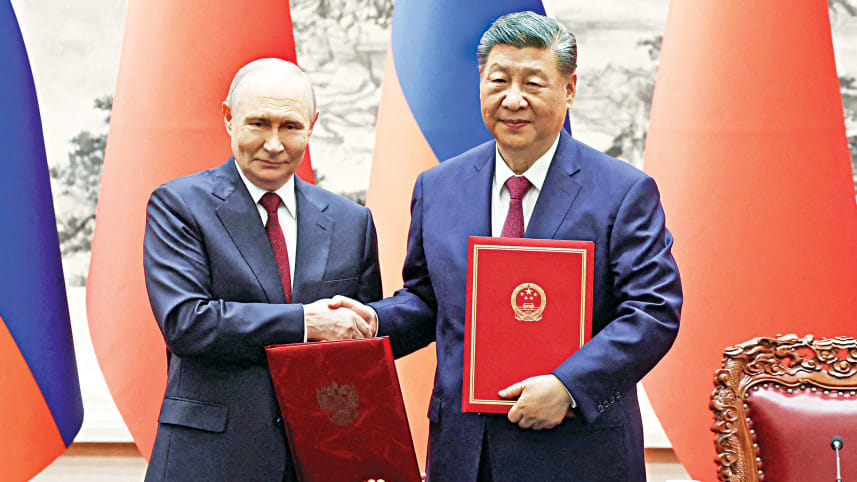
Xi Jinping said the world was at risk of regressing into the “law of the jungle” and hailed the China-Russia relationship as a stabilising global force as he hosted Vladimir Putin in Beijing yesterday, just days after hosting Donald Trump.
The Chinese leader welcomed the Russian president with pomp and pageantry as the pair began talks in the Great Hall of the People.
 For all latest news, follow The Daily Star's Google News channel.
 Chinese soldiers stood in position as a military band played the Russian and Chinese national anthems for the leaders in central Beijing. Children waved Russian and Chinese flags and cheered: “Welcome, welcome!” in Chinese before the pair entered the Great Hall.
The scene was reminiscent of Trump’s high-profile meeting with Xi in Beijing last week, when the leaders of the world’s two largest economies discussed issues from trade and investment to the Iran conflict and Taiwan.
Talks between Xi and Putin began with a shorter “narrow format meeting”, featuring fewer delegates to discuss sensitive issues. The leaders then held a “wide format meeting” with their delegations that ended at about 2:00pm local time.
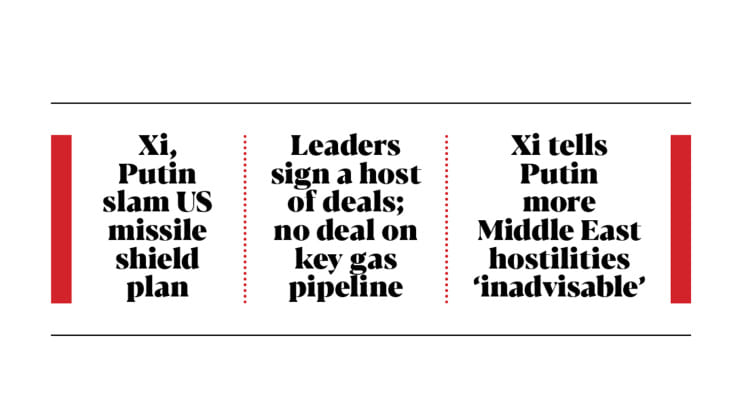
Xi and Putin then attended a signing ceremony for numerous documents spanning technology, trade, scientific research, and intellectual property. Among the documents, according to Chinese state media, was an extension of the “China-Russia treaty of good neighbourliness and friendly cooperation”, first signed 25 years ago.
In comments after the signing ceremony, Xi said relations between Beijing and Moscow were at “the highest level of comprehensive strategic partnership”, as he called on both countries to oppose “all unilateral bullying” in the international arena.
Xi’s sentiments echoed his opening remarks, in which he said the world was in danger of reverting back to the “law of the jungle”. He added that further hostilities in the Middle East were “inadvisable”, and a “comprehensive ceasefire is of utmost urgency”, state media reported.
In his opening remarks, Putin hailed the countries’ relationship as being at an “unprecedentedly high level”, as he said Moscow remained a “reliable energy supplier” amid the ongoing Middle East crisis. Putin also invited Xi to visit Russia next year.
Later, Russia and China, in a joint declaration, reiterated Xi’s remarks and said that attempts by some countries to dominate global affairs in the spirit of the colonial era had failed but that the world was in danger of a return to the “law of the jungle”.
“The global situation is becoming more complex,” they said in a declaration released by the Kremlin in Russian. “The global peace and development agenda is facing new risks and challenges, and there is a danger of fragmentation of the international community and a return to the ‘law of the jungle’.”
“Attempts by a number of states to unilaterally manage global affairs, impose their interests on the entire world, and limit the sovereign development of other countries, in the spirit of the colonial era, have failed.”
The statement also criticised the Golden Dome missile defence shield plans and Washington’s “irresponsible” nuclear policy.
It said Trump’s plan for a ground- and space-based missile interceptor system threatened global strategic stability and criticised Washington over the expiry of the treaty restricting US and Russian nuclear arsenals.
The treaty lapsed in February, and Trump did not respond to Moscow’s proposal to extend it by a year, after some US politicians argued that Washington needed to grow its arsenal to counter China, which says its buildup is far smaller.
Xi later hosted Putin for tea in Zhongnanhai, the former imperial garden that now houses the Chinese Communist party’s headquarters. When the Chinese leader hosted his Russian counterpart in May 2024, the pair did the same, appearing at ease as they ditched their ties while chatting.
China’s foreign minister, Wang Yi, who greeted Putin when he landed in Beijing on Tuesday evening, is also expected to hold talks with his Russian counterpart, Sergei Lavrov.
Reciprocal trade and investment are likely to be top of the agenda for Putin as his sanctions-hit economy suffers under the growing cost of Moscow’s war in Ukraine. China, Russia’s largest trading partner, buys almost half of Moscow’s oil exports.
In contrast to the adversarial nature of Washington and Beijing’s relationship, Putin and Xi have signalled an increasingly warm bond over recent years, with the leaders labelling one another “dear” and “old” friends. The warm greetings once again flowed on Wednesday, as Putin recalled a Chinese proverb marking his eager anticipation of their reunion: “Even if we haven’t seen each other for a day, it feels like three autumns have passed.”
As Xi was preparing to welcome Putin, the Chinese commerce ministry confirmed China would buy 200 Boeing jets and seek an extension of the trade agreement with the US that was reached in Kuala Lumpur last year. The statement marked Beijing’s first confirmation of the Boeing order, which Trump alluded to last week.
The Russian news agency Interfax said Peskov did not rule out a meeting between Putin and Trump in November, when both leaders could attend the Apec summit in China.
Comments