


All the President’s Men: When journalism became cinema and cinema became history

There is a particular genre of cinema that trades in revelation -- the kind that does not merely entertain but instructs, indicts, and implores.
"All the President's Men", released on April 9, 1976, is an epitome of that.
 For all latest news, follow The Daily Star's Google News channel.
 It belongs to a rare category of films that are not commentary upon history but, disconcertingly, a constitutive part of it.
When Alan J. Pakula adapted Carl Bernstein and Bob Woodward's epoch-defining account of the Watergate investigation for the screen, he was not fictionalising the past so much as consecrating it -- pressing the scandal's most treacherous contours into permanent cultural memory while the constitutional ink was barely dry.
Anchored by the tensile performances of Robert Redford and Dustin Hoffman, the film reconstructs the dogged investigation but resists the temptation of grandiosity.
There are no soaring speeches, no melodramatic crescendos. Instead, there is process -- meticulous, methodical, maddeningly slow.
Fifty years on, its pulse has not dimmed; if anything, it feels uncannily contemporary, like a dispatch smuggled out of our own age of suspicion.
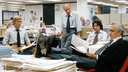
The film transforms the newsroom into a theatre of war, though the weapons are typewriters and telephones rather than guns. The Washington Post is rendered as both sanctuary and crucible, a place where truth is not proclaimed but painstakingly assembled, line by line, source by source.
Pakula’s camera lingers on the banal -- a reporter knocking on yet another reluctant door, the whir of machines, the hum of fluorescent lights. This aesthetic austerity is deliberate. It underscores a crucial proposition -- that democracy is not defended in moments of theatrical heroism, but in the quotidian grind of verification.

The now-legendary parking garage meetings with “Deep Throat” -- embodied with spectral restraint by Hal Holbrook -- are not merely plot devices. They are metaphors for journalism itself: murky, uncertain, conducted in the half-light between knowledge and doubt.
What the film captures with unnerving acuity is the architecture of power -- its opacity, its instinct for self-preservation, its quiet coercions. The shadow of Richard Nixon looms large, though he is barely seen. Power here is not a person; it is a system, deeply entrenched.
Equally striking is the culture of fear. Doors close. Phones hang up. Voices drop to whispers. Truth, the film suggests, is not merely hidden; it is actively suppressed, often by those too frightened to speak.
In this sense, "All the President’s Men" is less about uncovering a scandal than about confronting a climate -- one where silence is safer than speech, and complicity easier than courage.
At its core, the film is an ode to verification.
It fetishises the double-source rule, the careful corroboration, the relentless cross-checking. In an era now saturated with instant opinion and algorithmic amplification, this devotion to rigour feels almost monastic.
Woodward and Bernstein are not portrayed as infallible crusaders. They are fallible, occasionally reckless, often uncertain. Their triumph lies not in brilliance, but in persistence. They do not break the story in a single stroke; they inch towards it, often blindfolded.
This narrative choice is quietly radical. It demystifies journalism, presenting it not as a vocation of genius, but of discipline.
Over the years, the film’s relevance has only sharpened.
In an age of disinformation, contested truths, and institutional distrust, its themes resonate with disquieting clarity. The questions it raises feel less historical than immediate.
The answers, the film implies, are neither simple nor assured.
Perhaps the film’s most enduring contribution is its ethos, distilled into a single, oft-quoted admonition -- Follow the money.
It is a phrase that has transcended its cinematic origins to become a heuristic of scepticism.
But the film’s deeper lesson is more nuanced. It is not merely about where to look, but how to look -- patiently, sceptically…and ethically.
In a world that moves faster than facts can be verified, this film lingers, deliberate and unhurried, insisting that some things -- accuracy, integrity, courage -- cannot be rushed.
Half a century later, its message endures, not as a shout, but as a steady, insistent whisper.