


The voice that reimagined itself in every era: Asha Bhosle (1933-2026)

Born in the last decade before the new millennium, my upbringing was steeped not in the immediacy of the new, but in the sonorous remnants of what had already been -- from vinyl records, radio, cassettes, CDs, and later the infinite scroll of digital archives.
Few artistes have so completely inhabited the sonic imagination of multiple generations of South Asians as Asha Bhosle.
 For all latest news, follow The Daily Star's Google News channel.
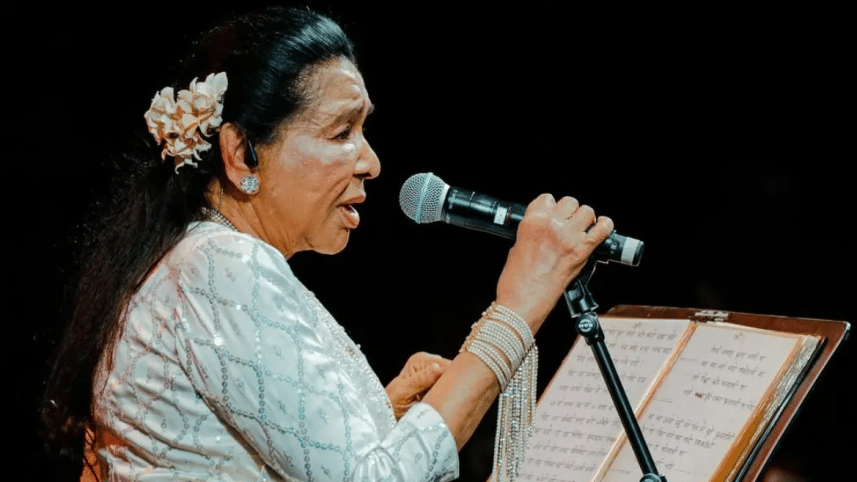
Her voice, at once agile and assured, possessed an uncommon elasticity -- capable of traversing the intricate grammar of classical compositions, the languorous melancholy of ghazals, and the buoyant modernity of popular film music with equal conviction.
She has been a phenomenon that reshaped the contours of playback singing in the subcontinent.
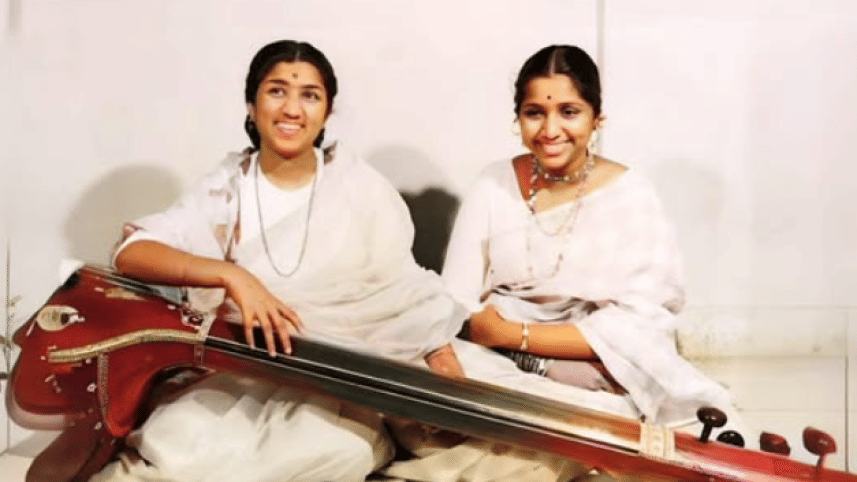
Across decades of artistic flux, she remained not only relevant but frequently definitive, imprinting her tonal signature upon the evolving soundscape of the world.
Her passing today at the age of 92 is more than the loss of an individual of great importance; it marks the quiet denouement of an epoch in which her voice functioned as both accompaniment and anchor to public sentiment.
Born in 1933 into a family steeped in music, Asha Bhosle’s early years were shaped as much by promise as by precarity.
The death of her father, the noted classical vocalist Dinanath Mangeshkar, compelled the young Asha into the world of playback singing at an age when most are still discovering their voices.
Her journey unfolded in the long shadow of her elder sister, Lata Mangeshkar, whose mythic stature in Bollywood music often led to facile comparisons.

Yet Asha Bhosle’s genius lay precisely in her divergence. Where Lata embodied ethereal purity, Asha revelled in texture, mischief and earthiness.
Her career was not without turbulence -- personal upheavals, professional struggles, and the early typecasting into “second-tier” songs.
But adversity proved an unlikely muse. It honed her adaptability and sharpened her appetite for risk.
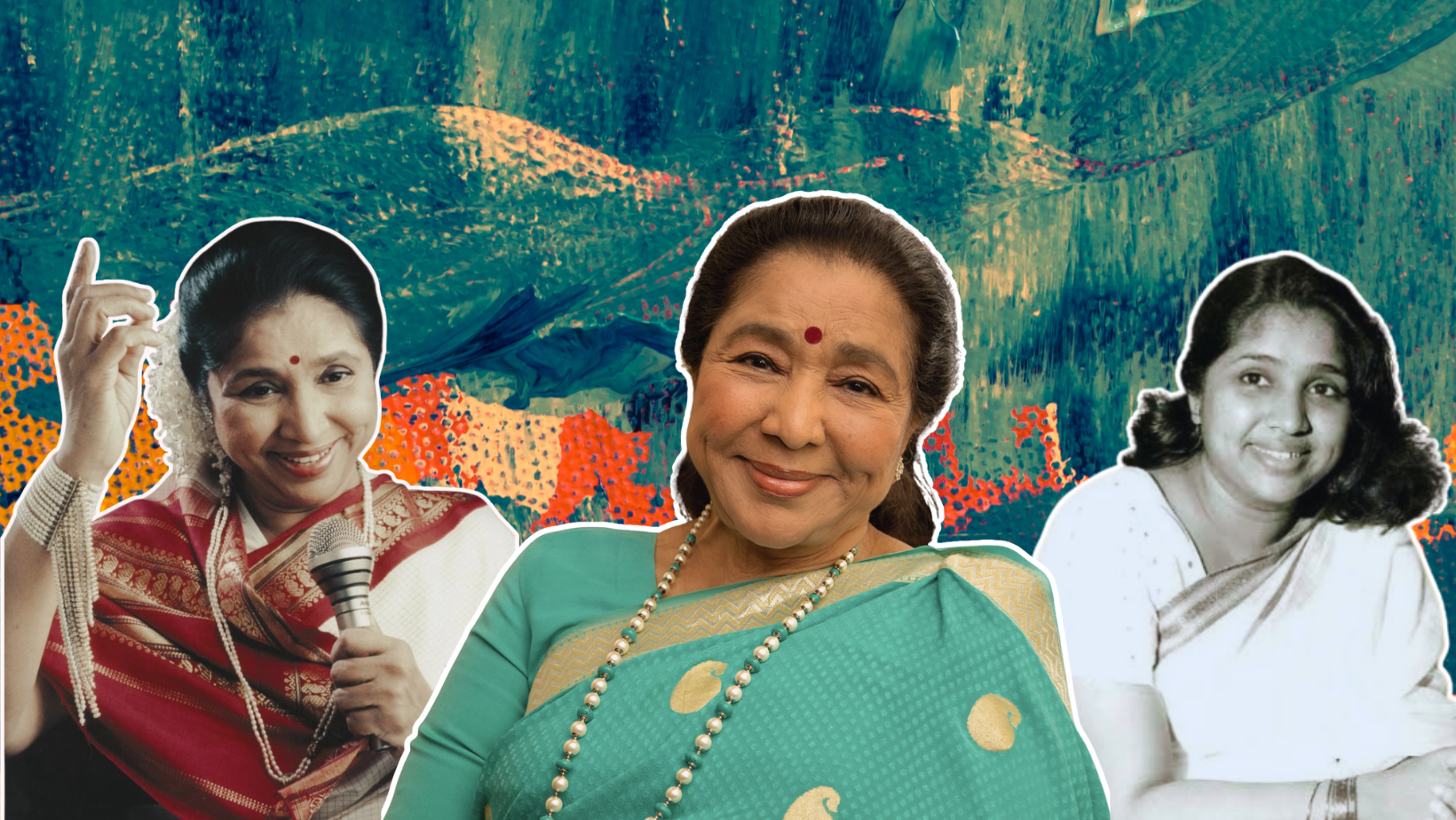
To catalogue Asha Bhosle’s repertoire is to confront a near-impossible diversity.
She moved effortlessly from classical-based compositions to the effervescent pulse of cabaret numbers, from the sultry cadences of ghazals to the buoyant rhythms of pop-inflected tracks.
Her creative alliances were as significant as her voice itself, each composer drawing out a different facet of her artistry.

With OP Nayyar, she found her first major ascent in the 1950s and 60s -- a partnership that crafted breezy, rhythm-driven songs infused with an almost irrepressible swing, establishing her as a distinctive voice apart from prevailing conventions.
Her work with Sachin Dev Burman revealed a more nuanced sensibility, where restraint and melody intertwined with quiet sophistication.
It was, however, her long professional and personal relationship with RD Burman that took it to another level.
Over roughly a quarter of a century, the two forged a soundscape that was at once modern and deeply rooted -- an intoxicating blend of jazz, rock, Latin rhythms and Indian melodic traditions. In RD’s musicscape, Asha explored tonalities that were playful, sensuous, and daringly experimental, producing hit after hit that recalibrated the grammar of Bollywood music.
With Khayyam, she delivered the hauntingly restrained ghazals of “Umrao Jaan”, where each note seemed steeped in longing. With Madan Mohan, she lent voice to compositions marked by melodic richness and emotional depth.
In later decades, she adapted seamlessly to changing sonic landscapes, working with Bappi Lahiri in the disco-inflected exuberance of the 1980s, and in the ‘90s with AR Rahman, whose globalised sounds found in her an interpreter still willing to evolve.
Her engagement with the ghazal form also blossomed through collaborations with stalwarts such as Ghulam Ali, Jagjit Singh and Hariharan, where her voice adopted an altogether different temperament -- intimate, unhurried and steeped in poetic suggestion.
To Bengali listeners, Asha Bhosle was never an outsider to be admired from afar; she was, in many ways, a familiar presence within the cultural bloodstream.
Her Bengali renditions carried a rare sensitivity to diction and mood, eschewing affectation in favour of an almost native ease.
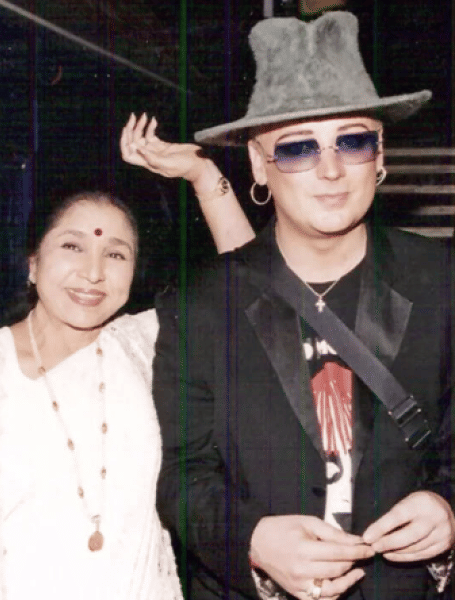
Whether interpreting modern Bangla songs or lending her voice to film music, she absorbed the linguistic cadence with striking fidelity.
Longevity in the arts often breeds repetition. Asha Bhosle defied this gravitational pull. Well into her later decades, she embraced new idioms, collaborated with younger composers and even ventured into global crossover projects.
Her voice aged, certainly, but it did not wither.
Instead, it acquired the pizzazz of patina -- a lived-in quality that lent depth to her later recordings. Where youth offered sparkle, age bestowed gravitas.
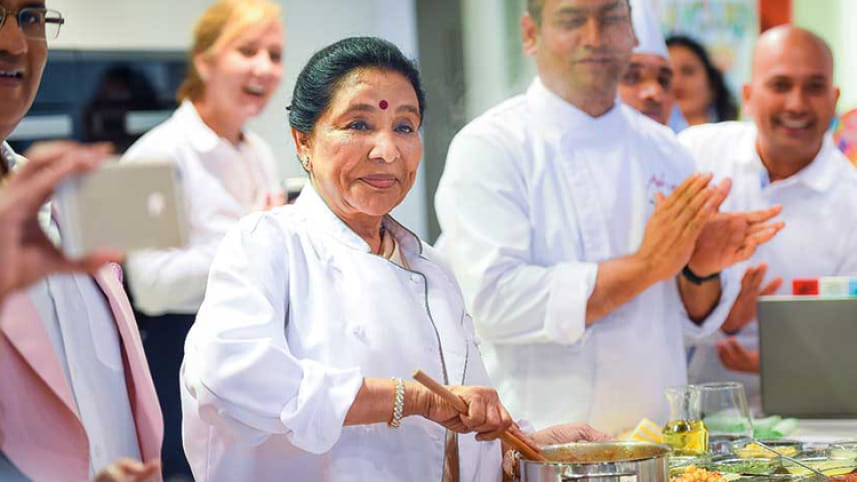
An accomplished cook, she translated her culinary passion into a chain of restaurants that bore her name.
These establishments, spread across cities in different continents, offered not merely food but an extension of her persona -- eclectic and attentive to detail.
In an interview with The Times of India, she was asked what she would have done if her singing career had not taken off. “I would have become a cook,” she replied. “I’d have cooked in four houses and made money.”
There was an almost performative joy in her approach to cooking, a sense that flavour, like melody, was to be orchestrated rather than assembled.
Even in death she lives on through echoes of a voice that refused to be pinned down, that danced across genres and generations with irrepressible vitality.
Asha Bhosle does not fade into memory; her voice creates it.