


The human texture of July
History rarely remembers how revolutionary times actually feel. It remembers slogans but forgets the trembling hands that first held the placards. It records the fall of governments but not the quiet phone calls between comrades deciding whether to return to the streets the next morning. What it rarely preserves is the human texture of those fevered days.
And yet revolutions are lived through emotions and everyday actions before they are recorded in history. They begin not in declarations but in small shifts of courage, when fear loosens its grip and a shared resolve begins to move through a crowd. A whisper becomes a chant. A protest becomes a gathering. A gathering becomes a movement. And suddenly the impossible begins to look fragile. When such moments pass, their human texture risks being compressed into statistics and official narratives.
 For all latest news, follow The Daily Star's Google News channel.
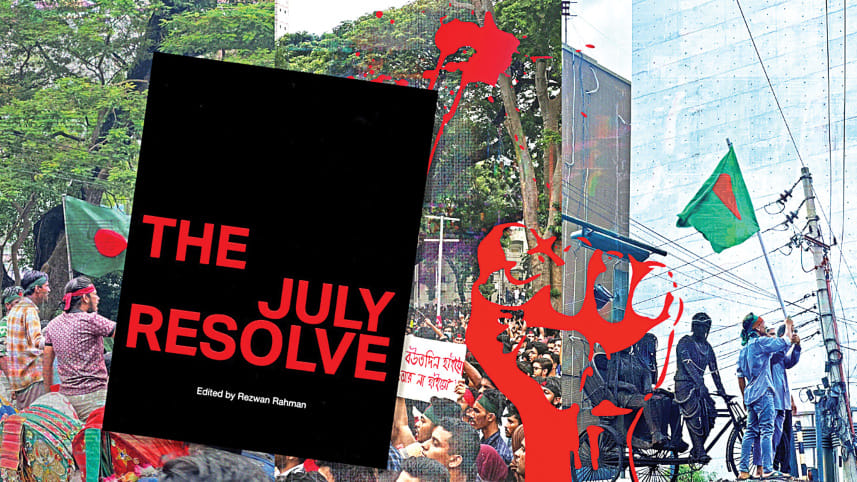
 This is why The July Resolve, edited by Rezwan Rahman, matters. Aptly subtitled ‘Hidden Faces of a Nation’s Uprising’, it preserves the voices of those who lived through the July Uprising. 36 testimonials from students, teachers, journalists, activists, doctors, artists, family members of martyrs, and ordinary citizens form a living archive of courage, grief, anger, and hope. Reading them brings the uprising back into focus, not as an event, but as something lived, and still unresolved.
Several testimonies describe the atmosphere that settled over Dhaka and other cities during those weeks. Streets that normally felt fragmented carried a different energy. People from different walks of life occupied the same spaces with a shared sense of urgency.
One of the most powerful themes running through these testimonies is the moment when fear began to recede. For years, political life in Bangladesh had been shaped by an unspoken understanding of limits: things that could not be said, protests that could not be organised, lines that could not be crossed. The first days of the July movement did not dissolve that fear. They exposed it.
Musharrat Hossain Sharmee, a senior lecturer at North South University, said she watched events unfold with growing disbelief. What began as a protest over quotas quickly escalated into something far more profound. When the killings began, she writes, the moral foundation of the regime collapsed. “I expected students to rise as a pressure group,” Sharmee reflects, “but after the killing started, I felt this government had lost all moral ground, and it couldn’t stay in power any longer.”
Political regimes can survive criticism; they rarely survive the loss of moral legitimacy. What began as a demand for reform became a confrontation with a system unwilling to tolerate dissent. Mahfujul Islam Megh, a student leader at Jahangirnagar University, captures the moment the movement expanded beyond its origins. As protests spread beyond campuses, workers, parents, and ordinary citizens joined in. “It was then that we realised,” he reminisces, “that the movement was no longer ours alone. It has become a collective voice of resistance.” What followed was not the mobilisation of a hierarchy, but the expansion of courage.
Several testimonies describe the atmosphere that settled over Dhaka and other cities during those weeks. Streets that normally felt fragmented carried a different energy. People from different walks of life occupied the same spaces with a shared sense of urgency. The protests became contagious, spreading beyond campuses into neighbourhoods, markets, hospitals, and factories.
What emerged was a shift in how people saw one another. Frustrations once felt privately began to surface collectively. In crowded streets and marches, strangers recognised something familiar in each other’s anger and hope. As Md Rafij Khan, a Dhaka University student and journalist, recalls: “I witnessed both the elites at university and the labourers in Mirpur standing shoulder to shoulder. This movement was not about political divides. It was a collective uprising against years of injustice.”
For a time, the streets seemed to dissolve all social and class divides. Each act of defiance made the next one easier. And in that collective experience, many discovered, often for the first time, that they were not alone.
Yet the book never lets the reader forget the price of that courage. Behind every act of defiance lay the constant possibility of violence. The testimonies return to the sounds of those days: sirens, gunfire, the constant chatter of rumours, the sudden chaos as protesters scattered from the police. Courage, here, is never romanticised. It is inseparable from risk.
Some of the most devastating passages come from those who were injured. Md Kawsar Khandaker, a 22-year-old student from Barguna who spent months confined to a hospital bed, reflects on the uneasy aftermath of the regime’s fall. While others celebrated, he remained suspended between hope and loss. “I haven’t even seen the sky of this new country.” Uprisings do not distribute their rewards equally. Some celebrate freedom in the streets. Others encounter it from hospital beds, carrying wounds that will outlast the moment. Yet even here, solidarity persists. “We fought like blood brothers,” Khandaker mentions, recalling how strangers shielded one another from police attacks.
Across the testimonies, this quiet courage appears in many forms: doctors treating the injured without payment, neighbours opening their homes, strangers risking their safety to help others escape. As Priya Khan, a transgender community organiser with Brihonnola, recollects from inside Dhaka Medical College Hospital, “The amount of blood, the injuries, and the shrieks of pain were almost impossible to bear. But I didn’t stop.” The movement demanded not only visible defiance but also acts of endurance and care.
Another striking feature of the collection is the diversity of voices it brings together. These testimonies emerge from classrooms, hospital corridors, neighbourhood streets, and protest marches, forming not a single narrative, but a chorus of witnesses. Some are expressed with anger still close to the surface, others with quieter reflection. What unites them is a recognition that there came a point when watching was no longer enough.
For activist Warda Ashraf, that turning point came with violence against young women. “When girls were being beaten,” she recalls, “I felt it was now or never.” Later, under curfew and fear—the choice became stark: “If we don’t speak now, then when?” The question echoes across the collection—not only about protest, but about what remains of one’s conscience when silence becomes complicity.
For Dhaka University Fine Arts alumna Munmun Alam Khan, witnessing became a form of duty. “I wanted to be a witness. My own eyes would bear witness. If I survived, I’d tell people the truth.” This is not memory for its own sake, but memory as an obligation. Her testimony binds terror and transformation together. “After July 30, I discovered a new me,” she recalls. “So much blood had liberated me, made me fearless, instilled courage in me.” Yet she insists on remembering those often pushed to the margins: “There were so many girls,” she reflects. “They weren’t there for credit or publicity. They stood for a cause.” The uprising did not simply produce protesters. It produced witnesses.
The book resists presenting the uprising as a simple story of victory. The testimonies return to the uneasy silence that followed. The fall of a regime did not resolve the questions that brought people into the streets; it sharpened them. Political change had come, but the future remained fragile and contested. Some express cautious hope. Others are more unsettled, aware of how easily the language of change can be absorbed or redirected. What unites them is a recognition that transformation does not end with the fall of power, but begins there.
For Dr Saiful Islam, professor of architecture at North South University, the aftermath is marked by a quiet shift: “The campus will never be the same.” The sentence carries a deliberate ambiguity: something has changed, but its meaning remains open. That uncertainty sharpens in the testimony of SM Monjur Morshed Shunnoo: “We achieved that one goal. Sheikh Hasina is gone. But fascism is still alive and well.” The clarity of the statement cuts through any easy sense of closure.
The testimonies do not offer a finished story. They leave behind a harder truth: what comes after may matter even more than what came before.
Years from now, historians will debate the political consequences of the July uprising. But the voices preserved here will remain essential to how it is remembered: the student who felt fear break, the teacher who watched a generation step forward, the protester who still waits to see the sky of the country he helped create.
Among them is Mosharaf Hossen, a 40-year-old fuel seller from Kishoreganj: “People say that you lost your hand but brought us freedom. That means the world to me.” In that sentence, freedom returns to the body—to what was given, what was lost, and how meaning is made from that loss. A different register appears in the reflection of Ayatullah Hasnat Behesti, a 28-year-old student coordinator from North South University: “We showed that students can bring about change without political affiliation. We made that history.” The claim may be aspirational, yet it reveals how many understood the movement as something that briefly seemed to rise beyond party politics.
For those who lived through July, this book reads not like history but like a mirror. These voices echo conversations that filled homes and tea stalls, recall nights when the future felt uncertain, and when courage carried people back into the streets. This is the enduring power of the collection. History is made by ordinary people who decide, collectively, that fear will no longer govern their lives. The streets return to their rhythms, the chants fade, the banners come down. What remains are the voices, and through them, the resolve of July endures.
Adnan M. S. Fakir is an associate professor in economics at the University of Sussex, UK.


Comments