


Six new rice varieties approved for nationwide cultivation
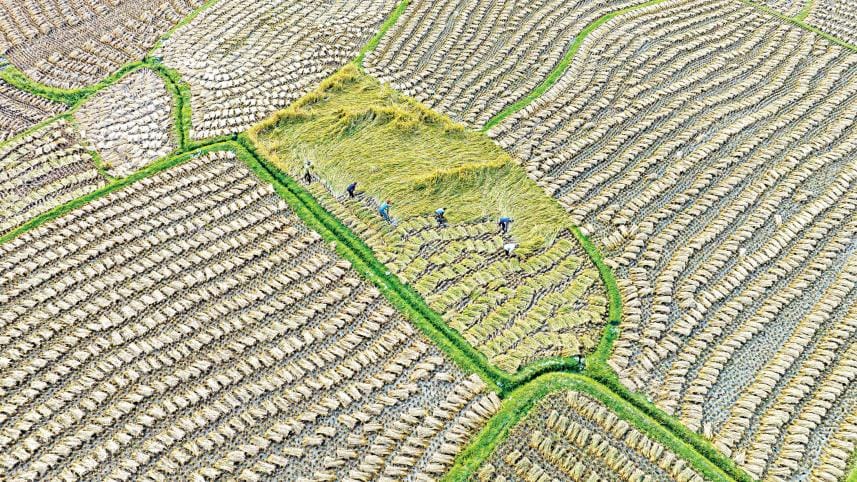
The Ministry of Agriculture has approved six new rice varieties, including two hybrids, for nationwide cultivation, aiming to boost production and strengthen food security for a growing population.
Developed by the Bangladesh Rice Research Institute (BRRI), the newly approved rice varieties include one enriched with vitamin E, another tolerant to salinity, and one resistant to blast disease.
 For all latest news, follow The Daily Star's Google News channel.
 Three other varieties include a cold-tolerant strain for haor regions and two hybrid strains designed to withstand lodging, according to a press release.
With the approval, the total number of rice varieties developed by BRRI rises to 127.
The newly developed BRRI Dhan 115 is a vitamin E– and antioxidant-rich variety. It is Bangladesh’s first high-yielding black rice variety, developed using the anther culture method. The average yield of this variety is 7.4 tonnes per hectare. Its amylose content is 23 percent, the statement said.
BRRI Dhan 116 is a high-yielding late-maturing variety for the Boro season. The grain size and shape are medium-slender and narrower than those of BRRI Dhan 92. The plant is strong and sturdy, making it resistant to lodging.
In yield trials across ten regions, this variety produced about 13.75 percent higher yields than BRRI Dhan 92. The average yield is 8.59 tonnes per hectare, and with proper management under suitable conditions, it can produce up to 10.36 tonnes per hectare.
BRRI Dhan 117 is a short-duration, salt-tolerant, and blast disease-resistant variety for the Boro season. Its average yield is 8.6 tonnes per hectare, which can increase to as much as 9.90 tonnes per hectare with proper care. The grains are medium, bold, and golden in colour. The amylose content is 24.2 percent, and the protein content is 9.3 percent.
BRRI Dhan 118 is a cold-tolerant rice variety suitable for haor regions. Because it is cold-tolerant at the reproductive stage, this variety can be sown early to avoid the risk of crop loss from sudden flooding in haor areas, where rice may otherwise be submerged during the semi-mature to mature stage. Early sowing does not result in sterility, and the variety can yield at least 6.0 tonnes per hectare. The grain size is medium-bold, with an amylose content of 28.3 percent and aprotein content of 9.1 percent.
BRRI Hybrid Dhan 9 is lodging-tolerant and moderately salt-tolerant. From seedling to maturity, it can tolerate salinity levels of 4–8 dS/m. The grains are medium in size, with an amylose content of 23.6 percent. The weight of one thousand grains is 25.5 grams, and the protein content is 9.3 percent. In coastal regions, the yield is 6.5–7.0 tonnes per hectare.
BRRI Hybrid Dhan 10 is also lodging-tolerant.
The grains are slender, with an amylose content of 23.5 percent. The weight of one thousand grains is 23.7 grams, and the protein content is 9.1 percent. Under normal field conditions, farmers can obtain yields of 9.7–10.7 tonnes per hectare.
Including the newly developed varieties, BRRI has developed 39 rice varieties that are tolerant to adverse conditions such as floods, drought, salinity, and waterlogging, the statement said.
Comments