


Cashless Bangladesh begins with Bangla QR

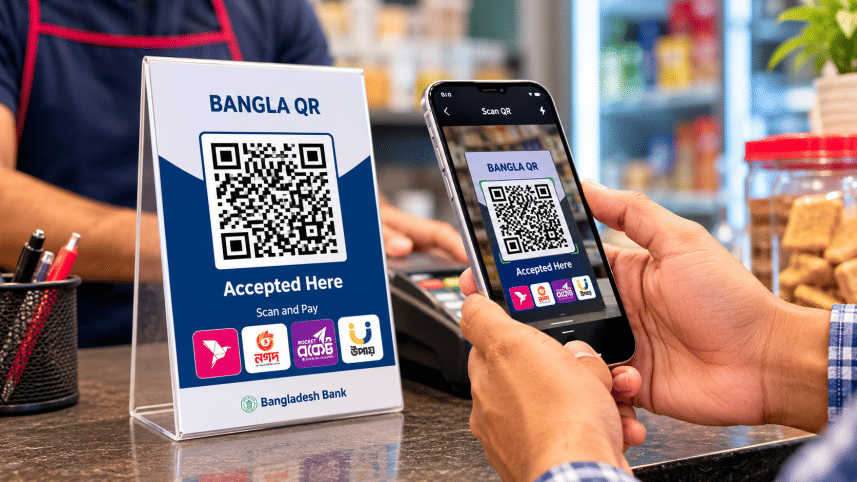
Bangladesh’s transition to a digital economy is no longer a distant ambition. Mobile financial services, internet banking, e-commerce and instant payments are already changing how millions of people conduct everyday transactions. The introduction of Bangla QR is another important step towards a cash-lite, inclusive and interoperable payment system.
Since July 1, 2026, Bangladesh Bank has pushed for the wider use of Bangla QR across businesses, from shopping centres to roadside tea stalls. In its first 48 hours, the system reportedly processed more than 77,000 transactions worth over Tk 22 crore. For a country where cash still dominates daily commerce, this is an encouraging beginning.

The initiative has received broad support. However, concerns have emerged over the 1 percent merchant discount rate (MDR) charged by banks and mobile financial service providers on digital transactions.
For small businesses operating on narrow margins, even a modest fee can feel burdensome. However, digital payment systems also offer important benefits, including a lower risk of theft or loss and fewer hassles associated with handling cash.
The concerns of small businesses deserve careful attention. At the same time, the debate should recognise that maintaining a secure, reliable and efficient digital payment system involves real operating costs.
Bangla QR offers a simple solution to a longstanding problem. It is a single interoperable QR code that can accept payments from participating banks, mobile financial service providers such as bKash and Nagad, and other payment service providers.
Customers no longer need to search for a QR code that matches a particular app. One code can serve users of different financial institutions.
Until now, many merchants displayed several QR codes at the counter, one for each bank or payment platform. This created confusion for customers and inconvenience for businesses.
Bangla QR replaces that fragmented system with a common standard: one code, multiple apps and multiple financial institutions. This may appear to be a minor technical improvement, but interoperability is essential to a modern digital economy. When separate financial platforms can communicate with one another, payment services become easier to use, more competitive and more scalable. A common payment infrastructure can also help bring more individuals and businesses into the formal financial system.
Some critics compare Bangla QR with India's unified payments interface (UPI), where many merchant payments are processed without direct charges to users, and ask why Bangladesh cannot adopt the same model.
The question is reasonable, but the comparison requires context. India's UPI developed through years of public investment, policy support, financial incentives and enormous transaction volumes. Its low-cost model is supported by government subsidies to banks and payment providers. Other systems, including Brazil's Pix and Pakistan's Raast, have also benefited from sustained central bank investment and long-term institutional support.
Bangladesh is at an earlier stage. Its digital payment market is smaller, transaction volumes are lower, and further investment is required in technology, merchant onboarding, consumer protection and system resilience. Expecting Bangladesh to offer the same pricing structure as much larger and more mature markets from the outset may therefore be unrealistic.
Digital payments are not cost-free simply because physical cash is absent. Payment providers must invest in cybersecurity, fraud prevention, settlement infrastructure, regulatory compliance, customer service, dispute resolution and continuous technology upgrades. A system that cannot recover its operating costs may struggle to remain secure, dependable and innovative.
However, this does not mean the current MDR should remain unchanged indefinitely. Bangladesh Bank should review the rate regularly as adoption grows, transaction volumes increase and operating costs fall. Competition among banks, mobile financial service providers and payment companies should also help reduce fees over time. The goal should be a pricing model that is affordable for merchants while keeping the system financially sustainable.
Comparing Bangla QR transactions with mobile financial service cash-out volumes is also misleading. Cash-out converts digital money into physical cash, whereas Bangla QR enables money to remain digital throughout the transaction. The two services perform different functions and should not be judged by the same measure.
Digital payment systems also require time to mature. India's UPI, Brazil's Pix, Singapore's SGQR and Thailand's PromptPay did not achieve widespread adoption overnight. Their growth depended on gradual consumer acceptance, merchant participation, public policy and trust. Payment networks become more useful as more people join them, but those network effects take time.
The value of Bangla QR extends well beyond convenience. Wider acceptance of digital payments can bring micro and small businesses into the formal financial system. It can reduce cash-handling costs and security risks, improve business records, increase transparency and support better tax compliance.
More importantly, digital transaction histories can help small businesses gain access to finance. Consider a tea stall in a local bazar that begins accepting Bangla QR. Each payment creates a verifiable record of sales. Over time, a bank or financial institution may use that history to assess cash flow and creditworthiness. For entrepreneurs without property, formal accounts or conventional collateral, digital payment data could become a pathway to working-capital loans.
Bangla QR should eventually expand beyond merchant payments. An interoperable QR system that also supports person-to-person transfers could make it easier for individuals to send and receive money across banks and mobile financial service providers. Such a facility would be especially valuable for rural households, low-income communities and people underserved by traditional banking channels.
Policymakers should also consider targeted support during the early stages of adoption. Temporary incentives for micro-merchants, simplified onboarding, tax benefits, public awareness campaigns and lower fees for small-value transactions could encourage participation without undermining the financial viability of the system. A tiered MDR structure, based on transaction size or merchant category, may also deserve consideration.
 For all latest news, follow The Daily Star's Google News channel.
 Bangla QR should be viewed as national economic infrastructure, not merely another payment product. Like roads, electricity networks and telecommunications systems, digital payment infrastructure requires investment, maintenance and sound governance. It must be secure, affordable and reliable.
The real debate, therefore, is not whether Bangla QR has value. It is how to balance merchant affordability, provider competition, consumer convenience and long-term sustainability. Public scrutiny is necessary, but it should be directed towards improving the system rather than dismissing its potential.
Under the prudent leadership of its current governor, Bangladesh Bank has taken an important step towards creating a unified payment ecosystem. As adoption expands, the pricing model should evolve in response to evidence, market competition and the needs of small businesses. Bangla QR should not be judged solely by today's merchant discount rate. Rather, it should be assessed by its potential to build a more inclusive, transparent and digitally connected economy for future generations.
The writer is a financial sector analyst. He can be reached at faysal.aqc@gmail.com.



Comments