


Bangladesh seeks LDC graduation deferment at UN hearing

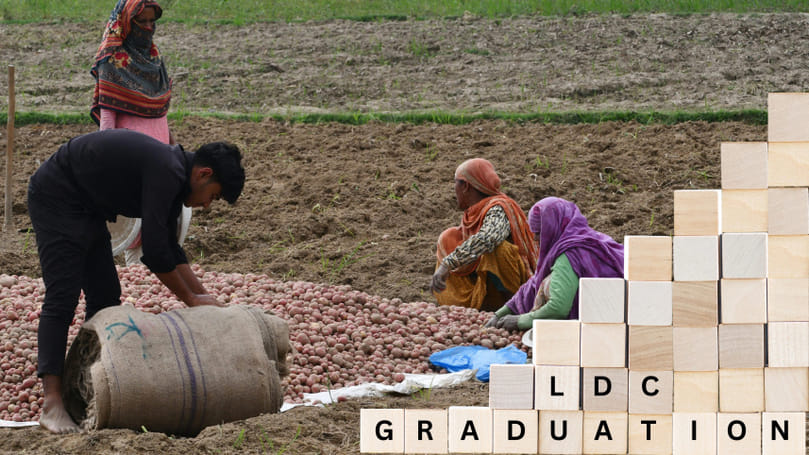
Bangladesh cited gaps in readiness, incomplete core reforms, and economic fallouts from the Iran war as reasons for seeking an extension of the transition period for graduation from the least developed country (LDC) category by three more years at the public hearing of the UNCDP on April 29.
Commerce Minister Khandakar Abdul Muktadir attended the virtual hearing with Chair of the United Nations Committee for Development Policy (UNCDP) José Antonio Ocampo, Additional Commerce Secretary Md Abdur Rahim Khan told The Daily Star.
 For all latest news, follow The Daily Star's Google News channel.
 Khan also said the UNCDP wanted to know the reasons why Bangladesh is seeking an extension of the transition period for LDC graduation.
Bangladesh mainly cited the country’s gap in preparedness, lower implementation of core reforms, and the fallouts of the war between the USA and Israel on Iran as the main reasons for the requested extension, the additional secretary said.
Apart from these three main reasons, Bangladesh also mentioned vulnerabilities in the financial sector, weaknesses in the banking system, an export slowdown due to volatile global supply chains, high interest rates, and an uncertain business and investment climate in support of the extension, he said.
Bangladesh is scheduled to graduate from LDC status on November 24 this year, but it has sought to delay the transition until 2029, citing domestic and external economic pressures.
The UNCDP will prepare a report on Bangladesh’s hearing and submit its recommendations to the United Nations Economic and Social Council (ECOSOC) in June.
The ECOSOC will then forward its assessment to the United Nations General Assembly (UNGA), which is scheduled to meet in September. The final decision on the deferment will be taken through a vote at the UNGA.
Earlier, on February 19, the newly elected government sent a letter to the chair of the UNCDP, requesting that the preparatory period be extended until November 24, 2029, mentioning that more time is needed to ensure readiness.
Following Bangladesh’s request, the UNCDP discussed the issue at its annual meeting in February and agreed on a process to assess the proposal.
The business community of the country has also been requesting both the incumbent government and the immediate past interim government to delay the LDC graduation, as they need more time to prepare adequately. They said higher bank interest rates and political transition in the country, following massive unrest and political upheaval, have also affected the economy significantly.
A UN assessment report in March stated that Bangladesh still faces serious gaps in its readiness for graduation, as its economy continues to be affected by both domestic and international shocks, including the US-Israel war on Iran.
The report highlighted a series of disruptions between 2017 and 2026, including climate vulnerability, the Rohingya crisis, a prolonged macroeconomic slowdown that predated the regime change, the Covid-19 pandemic, the Russia-Ukraine war, inflation, and pressure on the balance of payments.
It also noted that while Bangladesh meets all three criteria for graduation, significant risks persist, including the loss of trade preferences, fiscal and financial vulnerabilities, and weak institutional coordination.
Rising import costs for fossil fuels have created operational constraints, with gas shortages worsening due to the Middle East conflict, the report said.
Economic growth slowed from 7.1 percent in FY22 to 3.5 percent in FY25, weakening momentum ahead of graduation.
Inflation has outpaced wages, pushing millions into hardship and vulnerability.
A recent UN Trade and Development assessment estimated that Bangladesh could lose more than $17.5 billion in annual exports after graduation.
Comments