


Taka gains as dollar demand softens on US-Iran truce
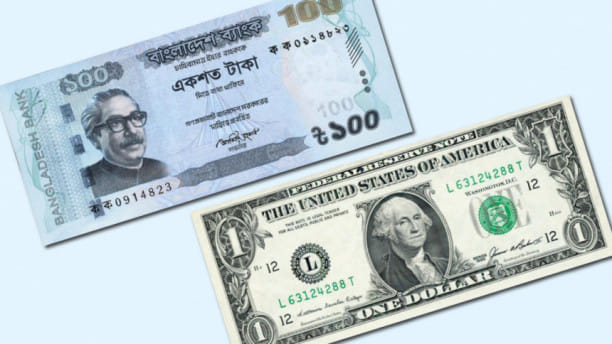
The taka edged up against the US dollar yesterday, buoyed by a two-week ceasefire between the United States and Iran that eased pressure on the foreign exchange market.
The weighted average exchange rate stood at Tk 122.75 per dollar, down from Tk 122.84 the previous day, according to Bangladesh Bank (BB) data.
 For all latest news, follow The Daily Star's Google News channel.
 A senior treasury official at a private commercial bank said the market turned volatile in recent weeks as importers rushed to buy dollars amid fears of a prolonged war. That anxiety appears to have subsided following the ceasefire.
When importers scramble for forward buying, rates tend to climb. As tensions cool, demand for forward trading of US dollars is expected to ease, he said.
Forward buying means agreeing today to purchase dollars at a fixed rate on a future date. Forward trading refers to buying or selling dollars now at a pre-agreed rate for delivery later, usually to hedge against exchange rate swings.
In its Bangladesh Bank Quarterly published yesterday, the central bank, however, cautioned that the economy remains exposed to external oil price shocks and currency depreciation.
“A sharp increase in global oil prices, particularly when combined with exchange rate depreciation, could exert significant upward pressure on inflation and lead to a decline in foreign exchange reserves,” it said.
The BB report said that allowing some exchange rate flexibility could help ease pressure on reserves. At the same time, balancing fiscal costs and inflationary pressures may require a partial adjustment to global oil prices.
“Rising geopolitical tensions -- particularly the Iran-Israel-USA conflict -- have already disrupted global energy and food supply chains and may exert additional pressure on both the external balance and domestic inflation. These developments pose near-term risks to price stability, export demand, and import costs,” said the report.
Mirza Elias Uddin Ahmed, managing director of Jamuna Bank, told The Daily Star that Bangladesh’s external position has not fundamentally weakened, although panic driven demand had unsettled the market.
The country’s gross foreign exchange reserves stand at about $34.35 billion, which the central bank described as a strong buffer for external trade payments. Usable reserves were $29.81 billion on April 2, enough to cover more than five months of imports.
The BB report said the central bank has maintained monetary tightening in response to stubbornly high inflation.
“However, inflation remains above the comfort threshold, disproportionately affecting low- and middle-income households,” it said, adding that the government and the central bank have taken several steps to rein in price pressures.
The BB has withdrawn LC margin requirements for imports of essential commodities, including rice, onions, dates, sugar, pulses and edible oil, it added.
Alongside truck sales by the Trading Corporation of Bangladesh (TCB), relevant agencies are working to curb hoarding, syndication and other illegal practices to ease supply bottlenecks.
On money and credit markets, the report said the near-term outlook depends on striking a balance between maintaining adequate liquidity, containing inflation and reviving private sector credit growth.
It said that public sector credit is likely to remain the main driver of overall credit expansion in the short term, potentially crowding out private investment and complicating efforts to sustain growth.
“A recovery in private-sector credit will depend on further moderation of lending rates, improved investor confidence, and greater political stability,” said the BB.
Comments