


Power, fuel price hikes to intensify inflation pressure
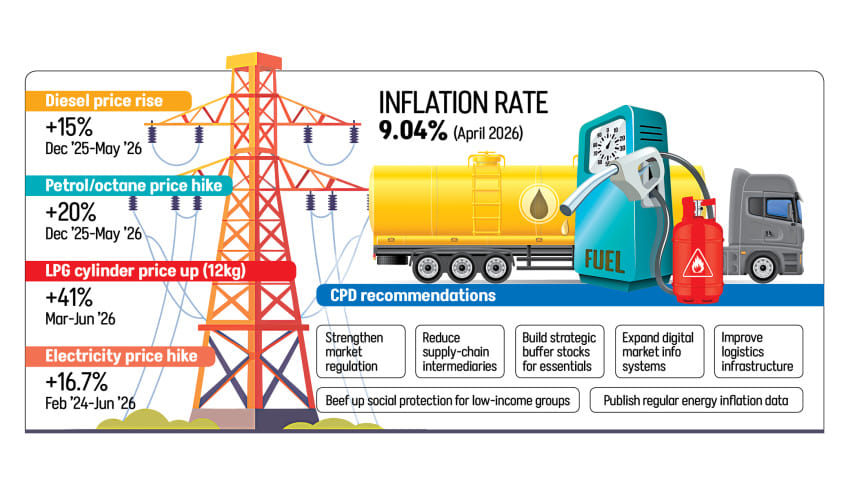
With fuel prices increased in two rounds, the latest power tariff hike will add to the already high inflationary pressure, according to the Centre for Policy Dialogue (CPD).
As a result, the local think tank says it will become more difficult for ordinary people to manage household expenses.
 For all latest news, follow The Daily Star's Google News channel.
 At a press briefing at its office yesterday, CPD said the economy remains in a vulnerable state due to the country’s structural weaknesses and various global shocks.
Ahead of the next national budget, the think tank said high inflation remains one of the major challenges facing the economy.
The authorities on Wednesday raised electricity tariffs at the wholesale, transmission and retail levels. On average, electricity bills have increased by 16.7 percent, effective from the current month.
On June 1, retail petroleum prices were raised for the second time in just six weeks. The government on April 18 made upward adjustments to fuel prices to a record high. In April, the price of liquefied petroleum gas (LPG), which is widely used for cooking, was also increased twice to cushion energy market volatility caused by the Iran war.
These upward price adjustments came at a time when the country has been experiencing inflation above 8 percent since August 2022. It rose to 9.04 percent in April this year, driven largely by higher fuel, transport and service costs.
Regarding the latest electricity price hike, CPD said some tariff adjustments were certainly necessary given global price movements.
“The reality is that there was little alternative to increasing electricity tariffs. Given the way global prices have risen, some level of adjustment was necessary,” said Helen Mashiyat Preoty, senior research associate at CPD.
However, prices should be adjusted only to the extent required by global market movements, and that level of increase would be acceptable, she added.
Preoty criticised the second round of fuel price increases, arguing that recent international market trends did not justify the move. “Fuel prices have been increased for a second time, which was unnecessary.”
The CPD senior research associate said, “If you look at international markets, fuel oil prices have recently been on a downward trend. Under such circumstances, the government could have avoided raising fuel prices and allowed the Bangladesh Petroleum Corporation to absorb the adjustment through its own financing.”
Linking energy prices with inflation, CPD called for structural reforms in the energy sector.
At the event, CPD Executive Director Fahmida Khatun said the Bangladesh economy was facing challenges on multiple fronts and remained vulnerable to both domestic structural weaknesses and external shocks.
She said elevated inflation, driven largely by higher fuel, transport and service costs, remained one of the key concerns.
Wage growth continued to lag behind inflation, eroding household purchasing power, particularly among low and fixed-income groups, Fahmida said.
Apart from rising energy costs, CPD identified weaknesses in the supply chain for essential commodities as another major factor behind inflation.
According to a CPD market survey, a long chain of intermediaries dominated by urban wholesalers is helping keep food prices high in Bangladesh.
The survey, which covered around 1,000 market participants across 10 essential commodities, found that multiple layers of traders significantly increased prices before goods reached consumers.
It found a strong correlation between the number of intermediaries and retail prices. Green chilli recorded the highest farm-to-retail markup at 116 percent, followed by onions at 87 percent, pulses at 78 percent and brinjal at 72 percent.
By contrast, products with shorter supply chains, including eggs, broiler chicken, beef and fish, recorded relatively smaller price increases.
“The findings suggest that inefficiencies within the marketing system, rather than production shortages alone, are contributing significantly to inflationary pressure,” CPD said, adding that market concentration among urban aratdars weakens competition and enables excessive intermediary profits.
CPD recommended stronger regulatory oversight of wholesale markets to curb oligopolistic behaviour, improve price transparency and strengthen direct links between producers and retailers.
It also called for supply chains to be streamlined by reducing unnecessary intermediaries, expanding digital market systems and improving logistics infrastructure.
To help stabilise prices, the think tank suggested maintaining strategic buffer stocks of essential commodities and releasing those during supply disruptions, alongside stronger market surveillance.
Comments