


Betting on growth revival
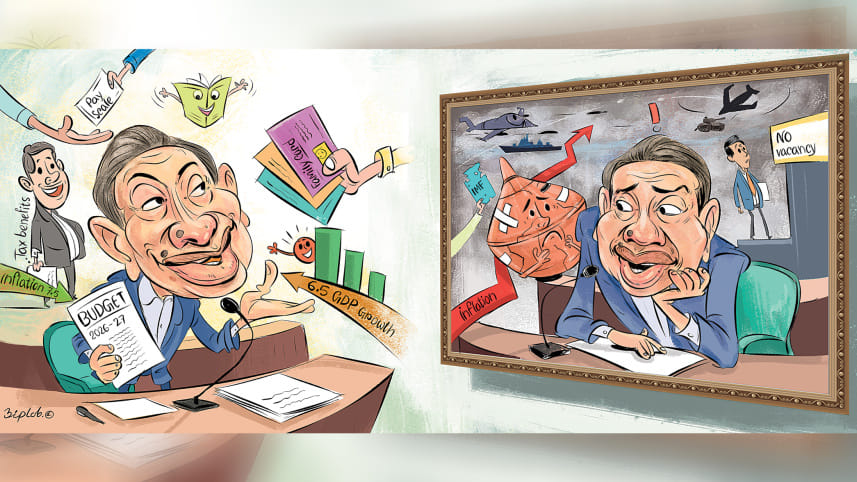
Amir Khosru Mahmud Chowdhury’s first budget speech as finance minister performed a delicate, dual function: it read as an indictment of the old economic order, and served as a blueprint for its replacement. Come July 1, Khosru will have to fix the system -- and run his own playbook.
What the finance minister told parliament, in myriad ways, was that Bangladesh had been growing the wrong way. For years, the nation’s economic expansion was built on borrowed money, negotiated behind closed doors, and engineered for the benefit of whoever happened to hold the keys. This budget, Khosru argued, is the first instalment of growing differently.
 For all latest news, follow The Daily Star's Google News channel.
 To understand this budget, one must realise it is not entirely about next year. Yes, there is a staggering topline number -- Tk 9,38,000 crore, the largest in the country’s history -- and the usual columns of revenue and expenditure marching down the page. But the true subject is the next five years.
Khosru has formalised this vision into what he calls the 3R Strategy: one year of recovery and stabilisation, up to three years of restoration, and a five-year horizon for reconstruction and acceleration. The budget currently before parliament is merely R1 -- the year the bleeding stops and the patient is stabilised.
The economic growth target for the coming fiscal year is pegged at 6.5 percent -- an optimistic acceleration after years of sluggishness. It is a high-stakes wager that the government’s deregulation push, a hoped-for revival in investment, and the clearing of political skies will rapidly translate into economic momentum. Meanwhile, the goal of containing inflation at 7.5 percent should be read as a sober admission, not a promise of relief.

The targets set for 2031 are highly specific and fiercely ambitious. The government aims for 8.5 percent growth, 5 percent inflation, and total investment reaching 40 percent of GDP. Most daunting of all, the plan seeks to quadruple foreign direct investment to 2.7 percent of GDP -- a steep hurdle for a nation that has historically struggled to attract foreign capital.
“The time has come to discard the debt-driven growth model of the past and build a self-sustaining economy driven by production, employment, and private investment,” Khosru told parliament.
Whether any of this grand vision materialises depends entirely on the most stubborn metric in national life: the tax line.
The government aims to collect Tk 6,95,000 crore in revenue, requiring an 18 percent jump from the outgoing fiscal year’s revised target. For a country with the lowest tax collection rate in the region, this is a Herculean goal. The history of revenue in Bangladesh is, overwhelmingly, a history of targets missed.
Yet, counterintuitively, the government shied away from raising tax rates. Corporate taxes remain frozen, and the personal exemption threshold actually rises. The strategy relies instead on collecting tax from those who currently pay nothing at all.
Tax refunds are slated to become “automated and faceless”. This is not merely a bureaucratic upgrade; it is an anti-corruption measure designed to end the across-the-desk negotiations where bribes traditionally change hands. Audits will now be triggered by risk algorithms rather than an assessor’s intuition about who can afford to settle. Small traders will receive a simplified, flat-rate tax. Crucially, the entire tax schedule will be published five years forward, allowing a businessperson to finally plan past the next June surprise.
Will the government be able to raise enough money in a mere 12 months? Almost certainly not. Compliance reforms pay dividends over years, while budget goals are relentlessly assessed in quarters. Still, there is a flicker of hope: the outgoing fiscal year’s collections were revised upward, actually beating the original target.
Then there is the deficit, and the question of who fills it. Equivalent to 3.6 percent of GDP -- a figure certain to please the International Monetary Fund -- the deficit will be financed by domestic and foreign loans in roughly equal halves. Here, the budget performs its trickiest balancing act.
The same finance minister promising to discard the debt-driven model is simultaneously asking foreign lenders for Tk 1,09,850 crore. That is nearly double what the government managed to mobilise this year, largely because foreign money is vastly easier to budget than to disburse. Coupled with grants, external sources are projected to cover nearly half the deficit.
Khosru did not miss the opportunity to offer a pointed history lesson: foreign debt, he noted, grew sixfold between 2006 and 2024. The dates were not chosen by accident -- they neatly bracket his predecessors’ years in power. The new government, he vowed, will walk the country’s debt-risk rating back from “moderate” to “low”.
But sometimes, a government must borrow in order to stop borrowing.
To avoid crowding out private enterprise, the state is deliberately dialling back its reliance on local banks. Domestic bank borrowing is capped at Tk 1,12,000 crore, a calculated cut designed to free up credit for businesses.
For a deeper fix, Khosru turned his attention to the stock market. The bourse, he said, has been “systematically devastated” by mismanagement, scams, and flawed policy, culminating in the “absolute erasure of investor confidence”. It was a formal acknowledgement of what every small investor in Dhaka has muttered since the floor-price era trapped their savings and sent foreign funds fleeing.
To boost trade, the minister is also prying open doors that have long been shut to foreign capital. He proposed scrapping the 49 percent cap on foreign ownership of private off-docks and inland container depots, opening the sector fully to overseas investors. The bonded warehouse -- for decades the jealously guarded privilege of the garment industry -- will be thrown open to leather, electronics, and light engineering. Company registration in 48 hours; every licence processed through a single window in seven days. None of it is glamorous. But all of it is deregulation with a measuring tape.
While the government ultimately aims to boost healthcare spending to 5 percent of GDP, the next year’s budget allocates 1.01 percent, leaving a steep climb for the years ahead. Education, however, sees a significant philosophical shift. The state is explicitly deprioritising “infrastructure-centred investment” in favour of teachers, research, and a technology-driven framework it calls “joyful education”.
Woven into the fiscal math is a renewed pledge to honour the 2024 uprising that brought the new government to power. Families of martyrs will continue to receive Tk 20,000 a month, and injured fighters Tk 10,000 to Tk 20,000 depending on severity. The rolls are expanding to 16,513 beneficiaries, with Tk 300 crore set aside for housing the families of the dead and permanently disabled.
For the elderly, the gestures are smaller but targeted. The Old Age Allowance adds 1,00,000 beneficiaries to reach 62 lakh people, while seniors over 65 will receive free travel on state-owned trains and a 25 percent discount on the metro.
Khosru’s most immediate challenge is execution. The IMF’s next review will judge him purely on numbers -- revenue mobilisation, reserve accumulation, bank restructuring -- that no finance minister in Bangladesh has reliably delivered in the past.
Behind the fiscal challenge lurks a financial system in acute distress. By the government’s own admission, the banking sector’s capital buffers have eroded into negative territory, and depositors have struggled to access their own savings. The stock market has shed value even as the political clouds have lifted, with market capitalisation down nearly 9 percent since January 2024. Khosru has promised to fix the banks and revive the bourse simultaneously. Achieving either would be a monumental first-year triumph.
Yet, looming over every spreadsheet and policy initiative is a problem no budget line can solve: expectations.
This is the first budget of the first elected government since the 2024 uprising. It is being presented by a party returning to power after two decades, to a public that was promised not just economic growth, but justice -- an economy fundamentally cleansed of the looting they rose up against.
Even if the government achieves its goal of holding inflation to 7.5 percent, prices will still rise faster than most wages. The pledge of a trillion-dollar economy is dated 2034, but rice must be purchased today.
Furthermore, Khosru must navigate a gauntlet of external threats his speech only obliquely flags: a Middle East crisis pressuring energy prices, a depreciating taka inflating foreign-debt repayments, and the looming graduation from Least Developed Country (LDC) status, which will begin eroding the trade preferences and tariff revenues that the old economic model leaned on.
For the past four months, the finance minister has enjoyed the political luxury of blaming the nation’s troubles on his predecessors. And justifiably so. Come July 1, those troubles belong to him.
Comments