|
location > dulahazra safari park/cox's bazar category > family
Call of the Wild-1
While you are in wilderness, whether in forests or wetlands, you expect to see birds and animals in abundance. In the East African Savannah or in the Indian plains, large herds of animals and flock of birds can be seen in their natural surroundings in the reserves. But Southeast Asian nature reserves, especially rainforests, do not offer a tourist much of its wildlife in big groups. It is not that the rainforests do not harbour a good number of wildlife. But watching them is a bit difficult in these forests.
These forests can be described as closed high forest, having evergreen and deciduous trees, with dense undergrowth and a copious 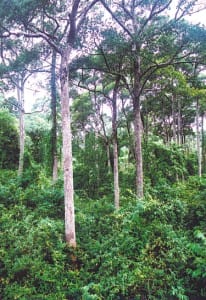 growth of climbers and epiphytes and usually their zone extends to the altitude of 200 to 2,500 feet. While the dense vegetation restricts vision, uneven and rugged land equally obstructs to getting close to the animals. Elephants, pigs and some species of monkeys congregate in big numbers, but other mammals such as Samber deer, Serow goat antelope, rhino, Goyal and bears form small groups of three to five. The barking deer, the most common animal of the area, lives a solitary and night-active life like that of a tiger and other flesh eating civets -- leopard, clouded leopard, fishing cats, jungle cats and leopard cats. growth of climbers and epiphytes and usually their zone extends to the altitude of 200 to 2,500 feet. While the dense vegetation restricts vision, uneven and rugged land equally obstructs to getting close to the animals. Elephants, pigs and some species of monkeys congregate in big numbers, but other mammals such as Samber deer, Serow goat antelope, rhino, Goyal and bears form small groups of three to five. The barking deer, the most common animal of the area, lives a solitary and night-active life like that of a tiger and other flesh eating civets -- leopard, clouded leopard, fishing cats, jungle cats and leopard cats.
For the birders rainforest offers amazing variety of birdlife. They are strikingly coloured and are of various shapes. Biologists believe that at least one third of all plant species exist only in the tropical rainforest which harbour a variety of insects, and a considerable number of them are not known to the scientists. So when we came to know that the Dulahazra deer breeding centre have been transformed into a Safari Park, first of this kind in the country, we decided to visit the rainforest to see its tourism potential.
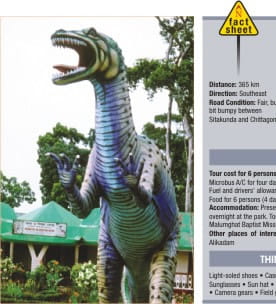
It took around nine hours' drive to reach the spot. We were a bit sceptic al about our adventure as it was raining almost all the way from Dhaka. But the morning that greeted us from Chittagong eased our anxiety and at Dulahazra brilliant sunlight and humidity made us sweating and tired. The headquarter premises of the park is decorated with concrete decoys of animals -- from Jurassic age to modern day. An assistant conservator of forests welcomed us to visit the park's collections of preserved dead animals. We were so tired that we needed rest, so we could not honour his request. Led by a forest ranger, we toiled up to the park's bungalow. Standing on a gentle slope the tin-shed bungalow looked more of a small tea garden bungalow; as the typical forest bungalow are usually built on stilts.
Anyway, we were quite happy to see the moderately wide veranda extended to a lounge with cushioned chairs and tables. Changing clothes and having a splash on our faces we sat and watched the magnificent surroundings with long drink of water and tea beside us. On our left a new forest bungalow with more accommodations is awaiting inauguration. In front of us a strip of ringle-thicket intersperse with tall trees separating us from the crowded administrative area. On our right we found ourselves at the edge of a real jangle -- a solid green wall of towering trees densely interwoven with impenetrable vines which cascaded in vivid green right down to the forest floor.
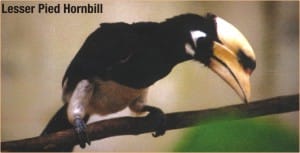 While the accompanying ranger enlightened us about the caged animals brought there, we craned our necks to see any sign of wildlife on the higher canopies with the help of field glasses, within no time we spotted a flock of yellow-legged green pigeons, a pair of purple-rumped sunbirds, a Malkoha and some glided butterflies. While the accompanying ranger enlightened us about the caged animals brought there, we craned our necks to see any sign of wildlife on the higher canopies with the help of field glasses, within no time we spotted a flock of yellow-legged green pigeons, a pair of purple-rumped sunbirds, a Malkoha and some glided butterflies.
Our leisure broke down as we heard the howling of a gibbon from the zoo area. The ranger promised us that there are some interesting animals in the temporary cages, which will be let loose later on. We picked our heavy camera gears and entered the zoo. Just beyond the entrance to the park we found the cages. The bird and animal handler kindly allowed us to take snaps of the animals.
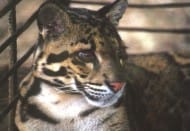
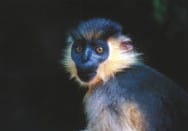
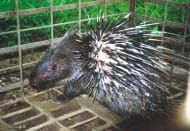
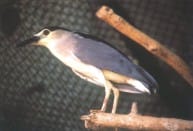
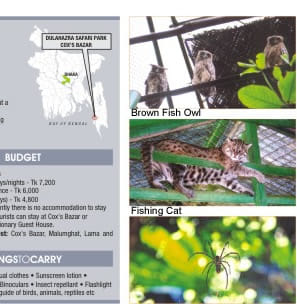
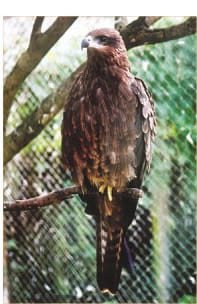
We devoted our first phase of the trip to shooting the caged life. Along with some common birds and animals we took snaps of some rare species such as bronze-winged dove, night heron, purple moorhen, painted stork, fishing cat, Asian black bear, capped langur, rock python, leopard cat, porcupine, slow loris and fine specimen of friendly mannered clouded leopard. This beautiful animal is essentially arboreal, with short strong limbs and very long tail. They are only about half the weight of a full grown leopard, its powerfully built and enormous canine teeth which are closest among the present cats of the world to those of the long extinct sabre-toothed tiger, enable it to kill large deer such as the Samber with apparent ease.
While we were busy dealing with caged animals, suddenly we heard the thud of a hoofed animal and shouting of some excited people. What's that! As me and Bishawjit were curiously looked at the direction of the sound we found a beautiful Samber stag in velvet
struggling out through the visitors. As it succeeded, it rushed into the nearby forest.
The heat became unbearable and we thought an attempt to photograph birds in the wild might be foiled by the brilliant sunlight. So we stayed at the bungalow. To our chagrin, the ranger told us that they will let loose a pair of newly-acquired tiger from their cage to the hundred-acre forest enclosure enabling us to photograph them in their natural surrounding. What more of an excitement one can expect on the first day's trip!
.......................................................
Story: Khasru Chowdhury
Photo: Bishawjit Das
|