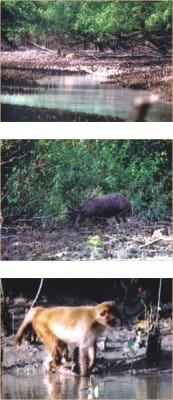
 Guy Mountfort, one of the trustees of the World Wildlife Fund, made an expedition to the forests of the Sundarbans in 1967. In his inventory report presented to the then Pakistan Wildlife Appeal, he suggested three sea facing areas of the Sundarbans to be declared as wildlife sanctuaries where all forestry operation should be suspended; shooting, trapping and catching of any form of life must be prohibited by law. After the independence of the country a wildlife law (1974) passed by parliament declared three areas of the Sundarbans, as suggested by Mountfort, as wildlife sanctuaries. These areas are Sundarban east (Katka-Kachikhali plain area, 5,439 ha), Sundarbans south (Nilkamal-Hiron point area, 1,987 ha) and Sundarbans west (Madarbaria area, 9,069 ha). These three areas have a good population of wild animals and birds, scenic beauty, meadows and sandy beaches. Because of easy access, tourists regularly visit Katka and Hiron Point sanctuary. A very few adventurous tourists have visited the wilderness of the Madarbaria sanctuary. I myself had visited Madarbaria on three occasions. I found that this area offers almost the same attractions as the other two sanctuaries. Other than Kewra trees, most of the plants of the island grows in thicker density. Seattered forest clearings are also found, beaches are more gentle and sandy there. Deer, pigs, monkeys can be spotted in abundance and on rare occasions tigers too. The range of birds is fascinating and one can approach the birds quite closely. In his famous novel Lost Horizon, James Hilton had imagined such a place; his name for it -- Shangri-la -- has become a synonym for such places of retreat, peace and beauty. For me, the closest thing to a real Sangri-la exists in the exact setting of Matharbaria island. There are some interesting islands close to the sanctuary which are also worth exploring. Kalir Char is one of the islands famous for its dense deer population. The deltaic Putney island situated at the month of Malancha river was mentioned by 'Man eaters of Sundarbans'-famed author-cum-hunter Tahawar Ali Khan as the island of no return for its aggressive tigers during early the 1960s. Putny island is only two kilometre off to the Madarbaria.
Recently a group of dolphene watchers discovered a rich congregation of different species of whales and dolpenes at the Swatch of No Ground, a submarine hollow in the Bay of Bengal. The area is about 40 Kilometre south of Madarbaria sanctuary. The concentration of the marine mammals at the swatch is believed to be unique in the world. Strong winds from the sea, a vast tract of dark forest and long stretches of shoreline make the place one of the most challenging and thrilling places on earth.
How to get there: Madarbaria sanctuary is administered by the Sundarbans West Forest Division. The Divisional headquarter is situated at Khulna. To visit the area, you have to apply for entry permission by paying fees for visitors, the boat and two armed forest guards. The easiest way to reach Madarbaria is via Hiron Point, a three-hour cruise through creeks and rivers. You can also reach the sanctuary from Burigoalni forest range office by cruising towards south for between six to eight hours according to the tide.
The sanctuary is situated on the west bank of the Malancha river, which is about six kilometre wide at the mouth. To avoid sandbanks you have to cross the river during high tide. There is no berthing place for boats. Boats have to be moored far from the shore by dropping heavy anchors to stop them from being drifted away by strong current and wind. A speedboat or a dinghy is very handy for plying from the shore to the boat. Dinghy is also helpful for venturing into the small creeks. You must calculate such ventures according to the tide timings. As tigers roam through the area, it is wise to be accompanied by forest guards. A local personnel who is familiar with the place is always very helpful.
The area is prone to river pirates, but so far no tourist boat has been attacked.
........................................
Story & Photo: Khasru Chowdhury
Trip Cost from Khulna for 10 persons.
Boat Rent Tk. 8,000 per day
For four days Tk. 32,000
Forest permission, Food and others Tk. 15,000
Dinghy boat for 4 day Tk. 4,000
Guide Tours Ltd and Bengal Tour Ltd made tailor made trips for the interested tourists
Seoson: Between November to mid February.
 Bird watching with Dr Reza Khan
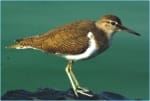
Common Sandpiper Actitis hypoleucos
Possibly the most common small migratory wader in the country. It can be found in the pond in Curzon Hall at Dhaka City to the Soondarban or the Kaptai Lake. This is not only a migratory bird during winter but also a common passage migrant. A few could be seen in the coastal areas all year round. The bird that is found near water and actively bobs its tail has plump body, greenish or greenish-yellow shortish legs, broad dusky broken or complete breast band and horizontal posturing would be none other than a Common Sandpiper. In addition to insects and worms it also takes tidbits thrown by people.
Actual size ±21cm with a bill of ±2.6cm.
© thedailystar.net 2006









































