Dhaka, Sunday December 4, 2005
Watching butterflies in the wild
 Indian mythology has it that Lord Shiva became furious on hearing the death news of his beloved wife Sati at her father's residence. Shiva went to the spot, took the corpse of Sati on his lap and started dancing 'Proloy Nritya' -- the dance that could destroy the whole creation. Fearing the consequence, Brahma the creator ordered one of his follower to throw 'Sudarsan Chakra' (a spinning cutting disk) to cut Sati's corpse into pieces, which he did accordingly. The corpse was fragmented into 51 pieces and fell in several places of the Indian mythology has it that Lord Shiva became furious on hearing the death news of his beloved wife Sati at her father's residence. Shiva went to the spot, took the corpse of Sati on his lap and started dancing 'Proloy Nritya' -- the dance that could destroy the whole creation. Fearing the consequence, Brahma the creator ordered one of his follower to throw 'Sudarsan Chakra' (a spinning cutting disk) to cut Sati's corpse into pieces, which he did accordingly. The corpse was fragmented into 51 pieces and fell in several places of the 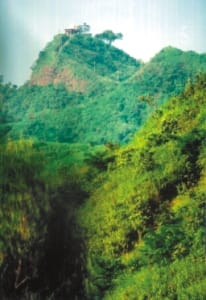 subcontinent -- and the places are worship by the Hindu community as 'Pithostan' or holy places. subcontinent -- and the places are worship by the Hindu community as 'Pithostan' or holy places.
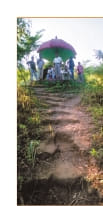
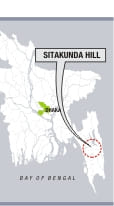
It is believed that one of the pieces dropped at the highest peak (1,335 feet) of the Sitakunda hill ranges, popularly known as Chandranath peak where the Maharaja of Tripura built a temple and a long stircase of 252 steps leading towards the temple complex. Our destination of this trip was the Sitakunda Botanical Garden and eco-park situated close to the Chandranath peak.
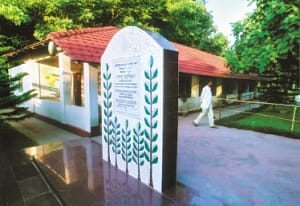
Early in the morning we started from Dhaka to avoid traffic. On the Chittagong highway, we saw the signboard of the park and a metal approach road on our left leading towards the hills. We took the road and reached the park headquarters in ten minutes. The single-storey buildings looked picturesque against the background of green hills.
A forest ranger greeted us at the park's gate and invited us to the make-shift single-room guesthouse. The solitude of the area impressed us. I asked the ranger why the forest department did not build any rest house here for overnight tourists.
"We built one on top of a hill, but we could not provide electricity and water supply due to shortage of budget," the reply came.
After a tea-break we once again rode on the vehicle along with the ranger and a forest guard. The park authorities have built a metal road through the hill ridges of the park interconnecting the potential spots. We drove through green undergrowth of ringle and other plants and within no time found ourselves in the typical tropical semi-evergreen forest. Most of the primary trees have been felled over time, leaving small patches in the valleys. But the undergrowth of impenetrable flowering vines has saved the area from a total disaster. Some of the vines, especially strongly odoured 'Jarmani lota' reminded us of the true feeling of a jungle. After a while we stopped our vehicle on a slope and got down from the car. On our left through the vegetation we had a fantastic view of the hills and its valleys. On the top of the highest peak we saw the lone Chandranath temple.
The park authorities have planted some exotic flower plants which attract hundreds of butterflies of different species. On the way we met some Rab members returning after a bath in the park's spring.
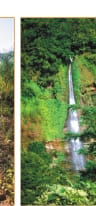
The most fascistic attraction of the park, as it appeared to us, is the hill spring, locally known as 'Sahasra Dhara'. I have seen our springs of Madhabkunda and others but none of them were placed in such a scenic surrounding. We spent some time on the roofed basement close to the spring. The ranger informed us that wild animals like barking deer, porcupines, rhesus monkeys and squirrels are still plentiful in the valleys. Recently a rare hogbadger was caught by villagers.
I found this place a heaven for the entomologists specially butterfly collectors. But trekkers and birders would also not be disappointed.
...................................
Story & Photo:
Khasru Chowdhury
© thedailystar.net 2005 |