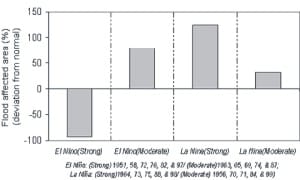
ENSO and deviations of flood affected areas in Bangladesh
Dr. Md. Rashed Chowdhury
The atmospheric component of El Niño-Southern Oscillation (ENSO) climate cycle is the Southern Oscillation Index (SOI). The SOI is calculated from the monthly or seasonal fluctuations in the air pressure difference between Tahiti and Darwin. Sustained negative values of the SOI often indicate El Niño episodes. These negative values are usually accompanied by sustained warming of the central and eastern tropical Pacific Ocean, a decrease in the strength of the Pacific Trade Winds, and a reduction in rainfall over eastern and northern Australia.The most recent strong El Niño was in 1997-98. On the other hand Sustained positive values of the SOI often indicate La Niña episodes. This positive value of the SOI is associated with stronger Pacific trade winds and warmer sea temperatures to the north of Australia. Waters in the central and eastern tropical Pacific Ocean become cooler during this time. From a historical perspective, La Niña provides an increased probability that the greater Ganges-Brahmaputra-Meghna (GBM) basin areas will be wetter than normal. The most recent strong La Niña was in 1988-89 and 1998-99; a moderate La Niña event occurred in 1984-85. This last event finished in 2000-2001. The SOI and rainfall relation in the greater GBM basin systems shows strong casual connection indicating negative SOI value to dry and positive SOI value to wet. Therefore, when SOI is negative (i.e. strong El Niño years) the whole basin experiences less rainfall. The deficiency of rainfall causes Bangladesh rivers to be drying because of low-flow and, as a result, the country faces severe drought (see Fig. 1: minus 90% deviation of FAA from the normal). On the other hand, when SOI is positive (both in strong and moderate La Niña years) there is significant increase of rainfall along the greater GBM basins causing flooding along the whole catchments. This, in turn, severely floods Bangladesh, as it is the lowest riparian country in these basins (Fig. 1: plus110% deviation of FAA from the normal). However, in case of moderate El Niño years, the basin-wide rainfall picture in the downstream Bangladesh is relatively different from the upstream India. With marginal deficit of rainfall in Meghna basin, Bangladesh experiences high rainfall along the Ganges and Brahmaputra basins. Although the upstream rainfall is not very dominant, the exceptionally high and prolonged local rainfall contributes to flooding in Bangladesh (Fig. 1: plus 60% deviation of FAA from the normal). On contrary, the excessive rainfall in the upstream and downstream of greater GBM basins during the moderate La Niña years causes flooding inside Bangladesh (Fig.1 : plus 24% deviation from the normal). Dr. Md Rashed Chowdhury is Research Scientist of the Pacific ENSO Applications Centre and an Affiliate Faculty of the University of Hawaii,USA.
|