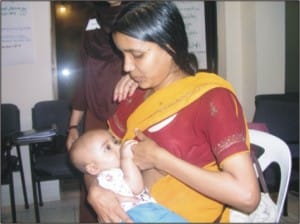
World breastfeeding week
Breastmilk can save millions of lives
Parvez Babul
Breast milk is a unique, God-given food for infants and young children. Every year August 1-8 is observed as World Breastfeeding Week worldwide. The slogan for this year is "Breastfeeding: Initiation in the first hour can save more than one million newborn babies." The World Breastfeeding Alliance sets aside this week to raise awareness that breastfeeding is the optimal nutrient for the health of growing infants. It is natural, safe, and life-saving. Everyone who is committed to child health and wellbeing should encourage mothers to initiate breastfeeding in the first hour of the infant's life, and to give their infants breastmilk during the first six months, known as exclusive breastfeeding. They should continue to breastfeed until the child is two years old. The theme of World Health Day (April 07) this year was: "Invest in breastfeeding: build a safer future." It addressed the need for increasing global security by strengthening global health. The theme also highlighted that a healthy, strong, child was one of the most important building blocks of a secure future in all communities throughout the world. About 29,000 children below five years of age die worldwide everyday, which means one child dies every three seconds. Most of these deaths could have been prevented. Mother's milk can prevent these deaths, and build a strong base so that diseases can be prevented. Breast milk contains all the necessary nutrients for disease prevention and is life saving, unlike formula milk and food. According to the Annual Report (2005) of the Nutrition Surveillance Project (NSP) of Helen Keller International (HKI), Bangladesh, and Institute of Public Health Nutrition (IPHN), the three measures of malnutrition are very high in Bangladesh. They are wasting (too thin) at 11.4 percent, stunting (low height for age) at 39.3 percent and underweight (low weight for age) at 46 percent. Poor breastfeeding practices and insufficient and inappropriate feeding of infants and young children cause these high rates of malnutrition. One of the Millennium Development Goals (MDG-4) is to reduce child death rates. The infant and child mortality rate is still alarmingly high in Bangladesh. The infant mortality rate in Bangladesh is 41/1000 births, and under-five mortality rate is 77/1000 births. In Bangladesh, one hundred thousands children die due to diarrhoea every year. Children under two years of age are most vulnerable to diarrhoea and malnutrition. Currently, in Bangladesh only 36 percent of mothers are practicing exclusive breastfeeding and only 23 percent initiated breastfeeding within the first year. Helen Keller International (HKI), Bangladesh has called on all health and nutrition practitioners to encourage mothers to breastfeed their infants. And, through the Essential Nutrition Actions (ENA) training, HKI teaches technical skills to health and nutrition practitioners to share this information and practice these skills correctly. Breastfeeding and gender
Breastfeeding is a biological function, and the issue of gender is at the heart of mothers' ability to practice breastfeeding. It offers biological and social benefits to women and their infants. The Convention on the Elimination of all Forms of Discrimination against Women (CEDAW) and the Convention on the Rights of the Child (CRC) have asked Bangladesh to ensure that women have the right to breastfeed their children. Men's involvement and cooperation are needed to raise awareness, and to support and encourage women to breastfeed their children. Men can promote breastfeeding by helping women with chores so as to allow them time to breastfeed their children. Men may also be in a position to challenge misconceptions and poor advice from family members. Every parent wants the best for his beloved child. So, let us start saving the lives of our children within the first hour of birth with the God-given, healthy, and life-saving breast milk, and tell mothers to continue breastfeeding for up to two years. Parvez Babul is Information and Advocacy Officer of Helen Keller International, Bangladesh.
|