Bitter truth
Fish crisis looming large
Md. Asadullah Khan
Perhaps the only reason that governments around the world have been slow to respond to environmental crisis is that the earth is still producing plenty of goods -- enough fibre, grain and fish to support six billion plus people. Many are malnourished, of course, but that's primarily a matter of bad distribution. However a closer look at the trend is disturbing. There is a difference between current production and capacity. Undeniably true, Bangladesh now faces worst ever fish crisis because of environmental degradation mostly caused by humans.According to FAO (Food and Agriculture Organisation) statistics, the world's fish harvest has now risen from 49 million tons in 1965 to over 110 million tons today. FAO statistics also indicates that, around 60% of the world's various commercial fish stocks are now being harvested near or beyond sustainable levels. Judging from the seafood sections of the western supermarkets, there would seem to be plenty of fish left in the oceans, but this appearance of abundance is an illusion, says Sylvia Earle, former chief scientist for the US National Oceanic and Atmospheric Administration. Earle fears that an international armada of fishing vessels is on the verge of exhausting a store house of protein. Appeared to be infinite. Giant high-tech vessels roam the world's waters, scooping up their once bottomless bounty. Environmentalists call the vessels the “strip miners of the sea”. Spanish-owned ships are most often accused of using illegal, fine-mesh “wall of death" nets that capture anything above fingerling size, much of which is thrown overboard. Nearly every trawler crew, even the most conscientious, disposes of unwanted species by throwing them back into the sea. The rejected fish called "by-catch" amount to an estimated 27 million tons a year, more than 25 percent of the total caught worldwide. Reports indicate that by-catch is the main cause of depletion of the sea population, which has fallen so precipitously that the European Union in the recent past cut the annual catch quota by half, from 314,000 tons to 156,000 tons. It is reportedly learnt that European fishermen operate so-called beam trawler using a net arrangement that is devastating in the shallow waters they usually fish. In this kind of trawling, heavy chains are dragged over the sea bed to drive fish into the nets, destroying shellfish, worms, sea urchins and other bottom dwelling creatures. Precisely speaking, these boats have “transformed fishing into an ocean-going strip-mining industry”. Consequently, if overfishing continues, it could hurt poor countries, because their people rely more heavily on fish for protein than do rich world dwellers. Overfishing is not the only human activity that is jeopardizing life in the oceans. Coastal pollution, habitat destruction, filling in wetland and building dams are adding to the crisis. But it is overfishing, the NDRC (Natural Resource Defence Council) report says, that constitutes the most urgent threat and demands the most immediate action. Shockingly, the economic and technological barriers that have kept overfishing within bounds appear increasingly shaky. Should these barriers collapse, commercial extinction would escalate into biological catastrophe. Some of the world's most demanding and prized fish are already on the verge of extinction. Leaving aside the sea wealth that hardly came up to meet the protein demand of our (Bangladesh) populace, people in the country feel increasingly alarmed at gradual depletion of the indigenous species of fish that were once raised in ponds, haors and beels.. Aquaculture in the country could put food on many tables but poor management has produced ecological devastation. Our rivers, haors, beels and ponds had an abundance of fish and these have either dried up or have been seriously devastated by several factors, namely silting of the river bed, contamination of water bodies by toxic chemicals, unplanned use of insecticide on crop fields, to name a few. Compounding the crisis is the aggressive practice of shrimp farming especially in the south western part of the country, through intrusion of saltwater in the once known sweet water ponds and water bodies that were used for raising indigenous species. Worse, some kinds of pond and river fishery now face total obliteration and as one statistics indicate some 52 kinds of indigenous varieties out of 120 have, in the meantime, been extinct. Many of the country's formerly productive fisheries, namely Halda river in Chittagong, haors in the Sylhet region and Cholon beel in the northern region are seriously depleted. Some rivers and water bodies in Chittagong region that could once boast of having 70 varieties of fish are now almost depleted with extinction of 54 species in the meantime because of heavy concentration of toxic chemicals discharged into the Karnaphuli and adjoining rivers by Karnaphuli Paper Mill (KPM), Karnaphuli Rayon Mill, Karnaphuli Ceramic. Karnaphuli Jute Mill and Karnaphuli Forat Carpet Mill. KPM, it is learnt, discharges about 70 tons of toxic chemicals in the river every day. Though less familiar but the havoc wreaked on the nitrogen cycle is worth recounting here. Through the use of fertilizers, the burning of fossil fuels and land clearing, humanity has doubled the level of nitrogen compounds that can be used by living things. But this is much more than can be efficiently absorbed by plants and animals in land and water and recycled into the atmosphere. These excess nitrogen compounds wash into fresh -- and saltwater systems, where they produce dead zones by stimulating suffocating growths of algae. Even more devastating is what we have done to the water cycle. So large is the human demand for fresh water for different purposes that many great rivers like the Yellow River in China, the Nile in Egypt and in Bangladesh rivers like the Padma, Meghna, Dhalewshari, Madhumati and old Brahmaputra partially dried up or lost original course because of formation of sandbars on course before getting to the sea. Moreover, building of dams, small and large in the country and elsewhere in the world has played a role in creating water stress. Many such obstructions for flood protection, road construction and shrimp culture have converted many of our rivers into a series of interconnected lakes. Such a water system has dire consequences for thousands of species adapted to free-flowing water. People in large numbers have gone to fish farming as a solution to meet the dwindling stock of fish either in rivers, haors or in the coastal off shore lands. Shrimp farming is particularly damaging to the tropical world's mangrove forests, coastal necklaces of dense low-lying trees that nurture marine life, filter water and soften the sea's constant battering of the shoreline. Much of the world's shrimp is raised in ponds gouged out of these thick mangroves. It would be fine if growers could use a pond over and over again. But the population density eventually fosters diseases that can knock out a shrimp population in a matter of days. So after a pond has exhausted its usefulness, usually within three to six years, growers move along the coast, further destroying mangrove forests and rice fields to make room for more ponds. Large-scale shrimping hurts people as well as the environment. To avoid becoming just another environmental headache, aquaculture needs standards. Raising fish species alien to the local habitat should be discouraged, since escapees drive out native fish or infect them with disease. Tilapia or African Magur or alien Pangas variety has upset our system because many of them are carnivorous. Without the fingerling size fish moving up and down the lake or any water body and mixing the waters, some layers of the water body are becoming stratified and depleted of oxygen. The biologically richest stretches of oceans are more disrupted than the richest places on land. Continents still have roadless wilderness areas where motorised vehicles have never gone. But on the world's continental shelves it is hard to find places where boats dragging nets haven't etched tracks into sea-floor habitats. However, there are countries that have established reserves in which fish are actually left alone. Marine life tends to recover in these areas, then disperse beyond them, providing cheap insurance against overfishing outside the reserves. But they are not many in number. It is true that because of excessive use of fertilizers and pesticides in the agricultural lands in the country food production has trebled but the harmful silt and run off from the high land streaming into rivers namely the Padma, Meghna, Rupsha, Buriganga, Shitalakhya and a host of other rivers have created spreading dead zones -- devoid of fish or any marine life. Because of the alarming nature of river pollution, there has been a precipitous decline in Hilsa fish catches from the Padma and Meghna. The country of rivers, haors and baors, once an abundant store-house of silvery protein is now facing acute fish crisis and we have to import fish from Myanmar and India. The country's vast majority of the poor people are starved of the most essential but cheap protein. Isn't it high time to think of immediate measures to check this depletion? Md. Asadullah Khan can be reached over email : [email protected]
|
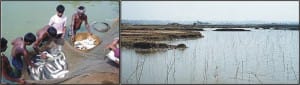
(L)Availability of fish is not as abundant as before. (R) Not so environment-friendly shrimpculture at estuaries. |

