Mining with a vision for people's benefit, ecological safety
Bangladesh can learn a lot from German open pit coal extraction
Sharier Khan, back from Cologne, Germany
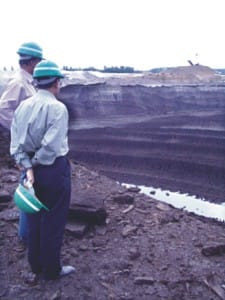
There is a lot that Bangladesh can learn from German experience in maximum utilisation of coal resources through maintaining environmental balance, efficiently handling human displacements, agricultural land replacement and maintaining political soundness.With a tradition of more than 100 years of open pit coal mining, Germany produces 33,000 megawatt or one third of its power from lignite coal and another 25,000 megawatt from hard coal ensuring minimum damage to the environment, thanks to strict monitoring by the government and pressure groups. A visit to the mines and coal-fired power plants in the North Rhine Westfalia zone around the German city of Cologne demonstrates that mining is just not a profit making business for a company, rather it is a national affair. Mining in Germany is based on sensible politics and a vision to ensure benefit for its people and entrepreneurs, and minimise environmental hazards. A mining company cannot just do whatever it wishes but when it has a government nod, its mining plan cannot be hindered. The Daily Star correspondent visited the mines and coal power plant installations near Cologne at the invitation of Asia Energy Bangladesh between July 25 and 28. The Daily Star covered the travel and hotel costs of its correspondent while Asia Energy that has stakes in the Phulbari Coal Mine facilitated the visit in collaboration with Germany's biggest mining and power company RWE. Also one of the top European power and gas companies, RWE is a consultant company for Asia Energy for handling Phulbari project's most sensitive area-- water table. Germany's vast "lignite" coal mines are mainly located in agricultural lands and villages near Cologne, and therefore, the home-grown mining companies work with the government and communities to ensure fair resettlement and compensation, according to executives of Germany's leading coal mine and power developer RWE GmbH. From the fifties, about 50,000 people have been resettled to facilitate large scale open-pit mining. Of them, 10 per cent resisted resettlement. But relevant German laws demand that individuals must give up their lands for the greater benefit of the nation. Therefore, they lost legal battles and had to settle with their compensation. The vast open-cast mining areas, where miners have completed mining and filled up 300 to 400 metre voids with soil, have now been converted into deep forests and agricultural lands. The country annually produces 100,000 million tonnes of 'lignite' coal. Some of its open-cast mines can be as big as 20 square kilometers. The country still has a reserve of 50 billion tonnes of lignite, of which 10 billion tonnes can be commercially mined. With an annual turnover of Euro 6574 million, RWE is 18,467-strong and it alone produces 11,000 megawatt power from lignite coal. It also generates power from hard coal, nuclear fuels, gas and renewables. In addition to Germany, RWE also sells power to UK and central and east European countries. MINING IS NOT A PRIVATE AFFAIR
Acquiring mining approval in Germany is based not just on profit returns. The government approves mining based on its political impact as well as profit and other benefits, and also assessing adverse effects. For instance, approval for the Garzweiler 2 mine had to wait 10 years. The German Green Party had been opposing the mine on environmental ground and the project had to accommodate handling many issues before its approval. "RWE is a responsible partner in politics," says RWE's senior hydro-geologist Dr Thomas Von Schwarzenberg. "Politics is very important and RWE plays a role in the relevant decision making. For instance, the government has signed the Kyoto Protocol and it has committed to reduce CO2 (harmful gas from coal burning) emission. RWE discusses such matters with the government through its Strategy Department," he added. The RWE group that deals not just with coal mine and power but also with power distribution, upstream oil and gas, trading etc is a stock holding company with 10 per cent government shares, 44 per cent institutional shares, 14 per cent private, 2 percent employees' and 21 percent municipalities' shares. In the past, municipalities held larger shares of the mines. Such a combination makes the company more national than just a private body. "Fifty to 60 percent power in Germany is based on coal," Schwarzenberg notes, "CO2 emission level is one of the highest in the European Union. The German government has taken its responsibility and is spending a lot of money. This is also affecting the RWE, so we are holding dialogues." Consequently, RWE has developed methods to reduce CO2 emission. One tonne lignite coal emits one tonne CO2, and its new power plant that is expected to be launched in 2014 would have zero emission. In this technology, CO2 is separated at the plant and it must be dumped carefully in designated land areas so that it does not contaminate water tables, and this issue is awaiting government approval now. HUMAN SETTLEMENT AND LAND REHABILITATION
As large-scale mining requires takeover of villages and agricultural land, human resettlement is one of the major political issues in Germany, just as it is in Bangladesh. The North Rhine Westfalia (NRW) coal mining zone covers an area of 282 square kilometres. Of this, 196 sqkm area has already been mined and completely reclaimed. The most interesting aspect of such a mining region is that it is one of the most populated areas in Germany, which can be an example for Bangladesh where presence of community is a big political issue in considering mining schemes. According to government data, the NRW has a population density of 529 per sqkm, while the nearby city of Cologne has 2,443 per sqkm. At a smaller level, the Inden coal mine is located in an area with two counties -- one having a population density of 555 per sqkm and the other 290 per sqkm. Germany sets the example of how large-scale open-pit mining can be done by simultaneously protecting environmental balance and communities. The 2005 records show that the 282 sqkm NRW area now has 12.5 per cent of it for buildings and open spaces, 1.05 percent for plant area, 0.6 percent for mines, 6.8 percent for traffic movement, 1.6 percent recovery phase area, 49.6 percent for agriculture, 1.9 percent for water and 25.2 percent for forest.
|