Wildlife conservation need of the hour
Dr. M. A. Bashar
Conservation is the optimum rational use of natural resources and the environment, having regard to the various demands made upon them and the need to safeguard and maintain them for the future. It is the protection, improvement and use of natural resources according to principles that will assure their highest economic or social benefits. Wildlife may be defined as the community of the non-domesticate species of plants animals and microbes growing under wild conditions, excluding those who have been recently introduced. Wildlife Conservation includes all human efforts to preserve wild animals and plants from extinction. It involves the protection and wise management of wild species and their environment. Man's indifference and ignorance has led him to believe that he is independent of natural laws and of natural environments and to forget that he himself is a biological being and is directly and/or indirectly dependent on the natural resources available to him. He exploits, destroys and reduces the renewable natural resources, eradicates wildlife and leads his own race to levels verging on catastrophe. However, all these can be put to an end by careful, long-range ecological planning and conservation. Ex-situ and in-situ conservation
Ex-situ conservation is the conservation of biodiversity away from its natural habitat. Viable populations of many organisms can be maintained in cultivation or in captivity. Plants may also be maintained in seed banks and germplasm collections; similar techniques are under development for animals (storage of embryos, eggs, sperm) but are more problematic. The maintenance of biological diversity at all levels is fundamentally the maintenance of viable populations of species or identifiable populations. This can be carried out either on site or off site. The maintenance of wildlife diversity on site may be designated as conservation of wildlife diversity in-situ. The maintenance of a significant population of the world's biological diversity at present only appears feasible by maintaining organisms in their wild state and within their existing range. The term wildlife covers all living organisms ranging from microbes to higher animals (microbes, plants and animals), the conservation of wildlife is synonymously used with the conservation of biodiversity. So, some times, the term 'biodiversity conservation' is replaced by the term 'wildlife conservation'. Impact of human actions
The plants are the source of energy for most of the living organisms, especially of the animals. The plants do not provide only the nutritional source for the heterotrophic animals, but suitable shelters and habitats for them which become available in the biosphere because of the plants. The UNDP's 1995 report suggests that time is running out for tackling Bangladesh's environmental problems and it calls for urgent action. The report identified that the growing population demands, along with other related demands of agriculture and industry, are seemingly devouring natural resources at an alarming rate without replenishment. The wildlife depletion is caused by degradation of land, erosion of valuable top soil, creeping salinity, over extraction of ground water, indiscriminate land conservation, declining soil fertility, water logging and destruction of forests. The wholesale change of the country's environment is happening due to both human and natural causes. The country is situated at downstream of major transboundary rivers between India and Bangladesh. The diversion of Ganges water occurs at Farakka point just 10 miles from the north-west border of the country. This is causing severe water shortage and affecting the flora and fauna in the north-west region. To an ecologist it is the question of alteration of natural hydrological phenomenon over a geographical area in the biosphere. Such kind of alteration causes severe climatic changes in an ecological area where it has been functioning since long. This abrupt climatic change creates adverse situation for survival of biological resources (both plants and animals) there. Moreover, not only Farakka barrage over the Ganges, various types of water control structures have been constructed by India on about 50 shared rivers between Bangladesh and India. These water control structures are the major causes for desertification and depletion of wildlife. Exotic species
In Bangladesh, some plant and animal species have been introduced from different countries. These exotic species have hampered endemic species both in their population dynamics and in the position of their trophic levels. At the same time, in many cases the importation has opted for changing ecosystem. In the aquatic ecosystem, the major introduced species those have changed a lot the ecosystem are African magur (Clarias garipinus) and red Pirhanha (Pygocentrus natteri). In the terrestrial ecosystem the species are Tectona grandis (Shegun), Acacia spp. Eucaliptus spp. And Swietenia mahagoni. The introduction of exotic species changes the ecosystem and affects endemic species severely. It is important that how the exotic species cause obstacles for endemic ones and affect the environment and wildlife conservation (both ex-situ and in-situ). For example, the forest area of our country from Karer Hat to Teknaf in the Chittagong division has been dominated by the population of garzon (Dipterocarpus turbinatus) tree as canopy layer since long time; and it is endemically sustained also for long time. The garzon forests have got some important characters for maintaining the three layers of vegetation. These three layers of vegetation are the endemic characteristics of our forest in connection with the typical rain forests of the south Asian region. First layer of vegetation is with the soil surface and does not come up to the height of more than one meter. They are mainly the grasses and the members of Zingiberaceae family. They keep the soil surface wet. This layer is the suitable shelter for microbes' growth and sustainability. It supports the second layer of vegetation and also the third canopy layer. Second layer of vegetation is the vegetation of man height level in the forest. This layer is above the first layer of vegetation. The layer is comprised of vines, grubs, hedges and shrubs plants. These provide enough shades, protection and make favourable conditions for plants and microbes growth in first layer of vegetation. The layer is called “Undergrowth Vegetation” in the forest. Third layer is the canopy layer of typical Garzon population or the population with other related trees. This third layer protects the grubs, vines, shrubs and hedges. During the variation of the seasons in a year or because of seasonality changes, the leaves fall on the ground and the fallen leaves provide enough organic deposition for the growth of both first and second layer of vegetation. In this way the entire typical forest ecosystem in the endemism sustains and survives in a normal and usual situation. If any unusualness appears because of introduction of any exotic species then the change or alter of the ecosystem makes conservation of wildlife vulnerable. The introduced species firstly hampers the phonological stages (for plants) and the stages of life cycle (for animals) of the endemic species. Secondly they reduce the functioning of the organisms in-situ and their respective trophic level. Thirdly, population of endemic species is seriously threatened to extinction. Fourthly, ecosystem of harvouring exotic species becomes weak. Fifthly, alteration of the ecosystem happens and gets established on a permanent pattern. There are obvious short-term consequences, but all too often the long-term effects cause the depletion of wildlife. Deforestation
The Bangladesh forest with its exuberant majesty and biodiversity depleted and shrank to six percent from 20 percent of land area within a time span of 50 years after 1947. This happened due to policy weakness, over-exploitation and law and order failures. It is a fact that there is lack of legislation to provide protection to the national forest but poor implementation mechanism of the existing rules perhaps cause greater damage in this regard. Since the beginning of the British rule, the Indian subcontinent including Bangladesh appeared to hold inexhaustible forest resource base. Rennel's map (1886) indicated that the Sundarbans, sal forest of the Bhawal-Madhupur tracts covered an area several times larger than it is at present. The hill forests of Chittagong, CHT, Sylhet, Mymensingh and Comilla were also densely populated by more than 2000 flowering plant species including 300 tree species. Nearly 30 tree species in hill forest 20 species in plain land forest and 30 species in the littoral forests used to be commercially exploited. For over the centuries the policy pursued was only to expand the agricultural land area by clearing the forests ignoring or underestimating their tangible contributions. The destructive policy, rapid change of society from rural to urban and fast growth of population put extra stress on forests that consequently depleted them to the present level. Environmental Biology and Biodiversity Laboratory (EBBL), University of Dhaka made a study (1999-2003) on the traditional and cultural involvement of local people and the causes of deforestation in some forest areas of Chittagong and Cox's Bazar districts. The local people (because they are poor and illiterate) are culturally habituated to go inside the forest every morning and have some wood or undergrowth plant's cut for selling in the market nearby for a few taka only. Most of the local people were found “governed” by the local leaders and influential men. They were not only illiterate, size of their family was found very large. Out of 351 interviewed individuals, 164 individuals were found with family members varying from seven to 10. This in the forest areas definitely creates high population pressure; and the unwanted and unplanned illiterate people also often become main cause of deforestation. Enactment of appropriate policy and legislation and their proper implementation could probably help to save the country from present precarious situation in respect of forest resources. Bangladesh has got enormous possibility to protect forests and to increase afforestation by adopting some scientific and socio-cultural practices. Vast forest area of Chittagong, Cox's Bazar and Chittagong Hill Tracts could be taken under the programme of ecotourism management. With the implementation of the ecotourism programme, the local people's involvement could be made usual and fruitful. Poverty alleviation of the local and or tribal people could be easily initiated. In many countries ecotourism is helping the local population in this way. If ecotourism management could be made functional in cooperation with local people, then the forests will automatically attain the participatory forest status. In the participatory forest status, the local people will be very much eager to protect the forests for their own interests when they will understand that the forests are essential not only for environmental soundness but also for their economic support. Conservation is imperative
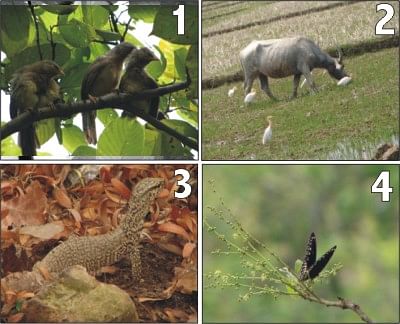
In Bangladesh, we have some important forest areas (Chittagong (Sitakundo, Karaerhat, Chunati), Cox's Bazar (Eidgaon, Eidgar, Fashiakhali), Sylhet (Lawasara and Rama Kalenga), Mymensingh (Sherpur), Tangail (Modhupur), Noakhali (Nijhum Islands) and Khulna (Sundarbans: the largest mangrove) to be treated as ecotourism spots which could be used as the potential tools for the conservation of forests, nature and as well as the beauties of the nation's endemism. In Bangladesh, wildlife may be put under 'double sided' characters. One side is the 'species richness'; another side, the population size of the existing species is very small almost in all cases. This characteristic bears hopefulness in the way that if the species richness is preserved immediately then the biodiversity could be used both for the economic benefit and environmental soundness. But the low population size per species is risky for the species to be extinct. So, maximum species are at the stage of seriously “threatened” status. This is the negative side of the double sided characteristics. It is an imperative that, species conservation strategies must be taken up immediately. Otherwise, species richness will fall very soon and the dwindling forest and aquatic ecosystems in the country will have their negative impact on the human population. Positive side of the characteristics is that, if we can go quick for conserving species and their population size, then still there is high possibility of keeping the ecosystems 'rich in biodiversity'. The gravity of threat to Bangladesh wildlife could be cited with the population size of marsh crocodile (Gravialis gangeticus) in the aquatic ecosystem and bird wing butterfly (Troides spp.) in the forest ecosystem. In both cases population size is very small; if conservation strategies are not attempted immediately the species will be extinct very soon. On the other hand, immediate attempt to protect them will be beneficial for ecotourism industry, earning revenue, sustenance of biodiversity and for nature conservation. Both of the animals are rare species and at the same time very attractive to the tourists. Dr. Bashar is Professor EBBL, Department of Zoology and ex-Dean, Faculty of Biological Sciences, University of Dhaka.
|