Roundtable
Address rural problems first to save Dhaka, say speakers
City Correspondent
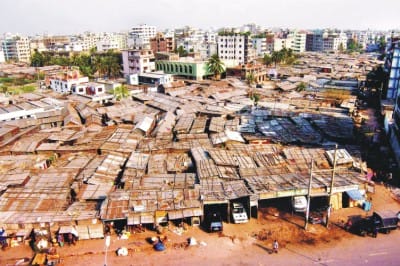
"Prevent Dhaka from becoming a mega city before we are prepared," said MM Akash, professor, Department of Economics, while discussing the conditions of Dhaka as a mega city.He was discussing at a roundtable conference 'Mega City Dhaka: Are the conditions fulfilled?' organised by Department of Population Sciences of Dhaka University (DU) in cooperation with UNFPA. Prof Akash said that national effort should be redirected to reduce rural-urban disparity in distribution of wealth and therefore help curb rural migration. Development of suburbs and planned relocation of important centres are needed. Instead of including suburbs into Dhaka autonomy can be offered to towns like Narayanganj with good transport, he said. "The rich should change their attitude towards the working class because it is the working class that provides drivers, peons, maids, launders and garment workers among others. The affluent section of the society should ensure their social security," he said. The slum dwellers are paying more than the rich and middleclass people for water and electricity through middlemen. Rehabilitation of slum dwellers by the government is needed, he said. Force cannot be used to solve the problem of hawkers. A harmonious coexistence among pedestrians, motorists and hawkers is required because hawkers are sending money to keep their villages running, he said. The pressure of population, waterlogging, water crisis, importance of decentralisation, slum dwellers condition and traffic congestion problem of the city were the most discussed topic among the discussants. Prof KM Maniruzzaman, Department of Urban and Regional Planning, Buet, said that public transport should be developed to solve the traffic congestion problem. "Our transport plan is car-centric. We always think how smoothly I can drive my car to the destination," he said. "In Bogota, capital of Colombia, there is a rule through public voting that cars will not move on the street in peak hours. They have separate lanes and platform for buses. We can follow this kind of rules," he added. Prof AQM Mahbub, Department of Geography, DU, said that the climate of Dhaka city is very favourable but we could not reap its benefit. "We have ruined the rivers surrounding the city and now we cannot use surface water. This has given rise to a serious water crisis," he said. "Waterlogging is a manmade problem. Previously the rivers and canals drained water but now the canals are turned into box culverts, which do not have enough capacity to drain water," he added. He termed the decision to convert canals into box culverts as 'suicidal'. Prof Roxana Hafiz, head, Urban and Regional Planning, Buet, said that all plans must take into account every individual in the city. "We shelved the first DAP [detailed area plan] of the city and the second one is limping. We take so much time in implementing DAP that its deadline expires. DAP becomes outdated before it is implemented," she said. The existing facilities in the city for disabled and elderly people were not enough, she said. "We will have to think about disabled and old people who are absent in our planning. We seldom see a disabled and older person on the street. That does not mean that they do not exist. The reason is the city's planning is not fit for a disabled person to go out," she said. "Why do we want to remove rickshaw which is the favourite transport of most of the city dwellers?," she said. Other discussants dwelled on unplanned urbanisation, housing, education, waste management, environment, crime, lack of open space and recreation. The keynote paper was presented by Prof Mesbah-us-Saleheen, Department of Geography and Environment, Jahangirnagar University. Dr SMA Faiz, vice chancellor, DU, was the chief guest; Dr Harun-or-Rashid, dean, Faculty of Social Sciences, DU and Nurul Ameen, assistant representative, UNFPA Bangladesh were special guests. The roundtable was moderated by Dr AKM Nurun Nabi, project director, Department of Population Sciences and chaired by Tehmina Gafur, chairperson of the same department.
|