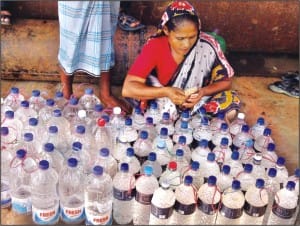
Surviving only on water
Dozens of families with children in Sadarghat area make a living by selling WASA tap water to launch passengers
Shahnaz Parveen
Shohag was only three when he arrived in Dhaka from Bogabodakhali, Barisal twelve years ago. Now 15, Shohag lives on selling water in discarded plastic bottles to southbound travellers at Sadarghat launch terminal. "I arrived at this bustling Sadarghat in Dhaka with my parents without knowing that my fate is locked to this place. Today I earn my living by selling water to the travellers from my home district and other nearby districts," said Shohag. Shohag said his day usually starts early in the morning collecting bottles from the Nimtoli area of Chankharpul in the old part of Dhaka. "Each bottle costs around Tk 1. We later fetch water from a tap near Kotwali thana. We have to stand in line for our turn for the free supply of water," he added. Shohag sells around 60 bottles everyday and sends around Tk 2000 a month to his family back home. Severe crisis of water in passenger launches has ushered in a new breed of traders in Sadarghat terminal -- selling bottles of water to thirsty travellers. Everyday nearly 250 launches operate from the Sadarghat terminal. Except for a few, most of the launches do not provide water for passenger use, let alone safe drinking water for them. The passengers have to bring their own drinking water during their trip. And for use in toilets, they are forced to rely heavily on polluted water collected from river. This water scarcity gave birth to the informal trade of water in discarded bottles. The water traders emerged during the last few years responding to the passenger demands. Previously, people on the go used to buy drinking water out of pitchers carried by the sellers. Water in discarded bottles became more popular after mass marketing of bottled mineral water was introduced in the country. Majority of the launches set off at 5pm with southbound passengers. In the afternoon when passengers begin to arrive at the terminal, young boys, mostly in their early teens, start vending bottles filled with tap water. A two-litre bottle usually costs Tk 5. Most of these water vendors live near the jetty at a place named Balurchar. As the name suggests, the place is in reality a large heap of sand. The vendors live there in a small slum built with tin. A clan of around 12 trader families live in Balurchar. The clan has several 'mahajans' who usually hire young single boys like Shohag to do the water vending. Eleven-year-old Shahin works for Rupban mahajan. "My employer gives me Tk 1 for each bottle I sell," Shahin said. Shahin said besides buying bottles from Nimtoli, they often collect the empty bottles they had just sold. "Often some travellers finish their water before the launch sets off and we sometimes collect the bottles or buy the bottles back from the passengers for Tk 1 or 2. We then refill and sell those," he said. Shahin said that they are not usually authorised to enter the jetty area, but 'arrangement' made with Sadarghat police box personnel makes the job easier. The only water vendor doing business comfortably on the jetty is Firoza. Looking for a better future, she arrived in Dhaka with her husband when she was a newlywed. "It was okay for a few years," said Firoza, adding, "My life was rearranged after three children were born. My husband died after being paralysed for a few years." After her husband's death, Firoza became a water trader. Back then she used to sell water out of pitchers in the jetty for Tk 1 per glass. Firoza now lives in a boat near jetty two. She sells about 100 bottles every day and with the earnings, she sends her children to school. "I fetch the water from nearby WASA pump. I have an arrangement there for an hour everyday. They set the meter when I start and pay on a monthly basis, costing me about Tk 600," Firoza claimed adding that her deal with the WASA is legal. She also claimed that the water she and other vendors sell is hygienic as all of them purify the water with 'chemicals'. When most inter-district bus services have started to provide bottled water to their passengers, the authorities of passenger launches seem to care less about adopting similar measures to ease passenger sufferings. According to Inland Waterways Passenger Carrier Association, around 3000 passenger launches, of which only around 1000 are registered, ply the rivers all around the country. Passengers of these vessels have no way but to rely on the water sold in discarded bottles.
|