Forest crisis and the purpose of forests
Philip Decosse and Ishtiaq Uddin Ahmad
Television scenes of cash found at the chief conservator of forests' home has stimulated a torrent of discussion about corruption in general, and forest corruption in particular. Conversations most often focus on sharing stories heard of how much money has been stolen by this or that official. It would be helpful to get beyond such discussions and look at the causes of forest corruption, and possible remedies.For corruption to occur, a set of conditions must be present. The most immediate and obvious is the personal willingness to break established rules. But this willingness alone does not explain the stories of wide-ranging corruption we have read about in recent weeks. A second, and important, contributor to corrupt practices in the forest sector is the de facto forest policy that has put a high priority on generation of non-tax revenue from forests for the government budget. In the light of this policy, the department has evolved increasingly in ways that ensure that these government targets are met. At the beginning of each year, the government gives the chief conservator of forests (CCF) a target figure for revenue generation from the forest department for the coming fiscal year. In the past five years, this figure has hovered around Taka 100 crore per year. In May, the CCF sits with his conservators and divisional forest officers and divides up the responsibilities to achieve this target. The annual recurrent costs of the forest department happen to be the same as the government revenue targets, or almost Taka 100 crore. The government seems to have set revenue targets so that the forest department would not be an extra burden on the national budget. In essence, the department, as it operates now, pays for itself. This may seem sensible to someone responsible for reducing government expenditure, but the policy has had a strongly negative impact on the forests. Although the figures are not exact, evidence from recent forest inventories conducted by the department suggests that forested areas in reserved lands have decreased precipitously. The fact that higher-level political actors have benefited greatly from this tree felling business explains in part why this revenue generation from timber continues in spite of the dwindling forests. The means of generating this government revenue are well known, and include: (1) proceeds from felling operations; (2) auction revenue of seized timber; and, (3) issuance of permits. While these are legal operations, any forest officer open to corruption will find these processes a perfect means of aligning public and private interest. Permits given for legal felling operations can be abused, as can operations of transit checkpoints. In short, the high priority given to meeting government-fixed revenue targets encourages both, an ever-increased amount of tree felling and the corrupt practices that are so easily associated with it. Cost of revenue-generation focus
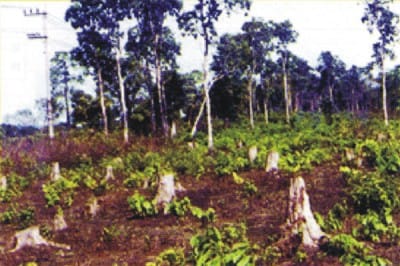
What is the cost to the forest sector, and to society, of this policy and the corrupt practices associated with it? By encouraging legal and illegal tree felling, the policy has contributed to a more rapid loss of the forests of the country than might otherwise have occurred. With the forest department having nominal authority over forests, which once covered 10.1% of the country's area, or 1.53m hectares, this is an enormous resource loss. As forests fall, and are not successfully replanted, other costs follow. Water runoff and topsoil are no longer regulated by the forests; fragile diverse ecosystems are destroyed; the aesthetic and recreational values of forests are lost; and carbon is no longer retained within the living trees. Then there is the opportunity cost to the local level forest official. Because he places such a priority on this generation of legal and illegal revenue, he has little time left for the dialogue with local stakeholders and sustainable forest management practices. Forest and wildlife conservation objectives in particular have suffered from this revenue focus. Since no legal felling operations can be undertaken in lands under the Wildlife Act (all "Protected Areas"), many forest officials see them as "free for the taking" to meet personal need or revenue generation objectives. Although forest lots within the protected areas cannot be sold, the wood that is seized from these areas can be, and is being. The revenue focus has also slowed progress on a forest department proposal that protected area revenue be directly shared with those local stakeholders who are contributing to protection and conservation. This makes sense, the local stakeholders involved in protection of forests should benefit from their efforts. But the proposal has been rejected by the government twice, on the grounds that all revenue must come to the central treasury. The way forward
The National Forest Policy, 1994 (Amended) refers to the importance of managing forests for the people, for economic development, and for wildlife. But the policy is so all-inclusive (it includes 28 different thematic "statements," or recommendations, on widely varying subjects) that it says all things to all people. In the end, the forest policy has had little working impact on the department, because it does not set a clear and unequivocal agenda for ways in which the department can manage forests for the public good. A recent regional forum on "Protecting Forests and Forest Dwellers: Role of Law," organised by the Bangladesh Environmental Lawyers Association (BELA), recommended a more "pro-people" forest policy and legal framework. In his speech at this same forum, Dr. Ainun Nishat of IUCN urged a radical evaluation of the purpose of the forest department, and wondered whether the revenue generation focus was an appropriate one. India, Nepal, and other countries have evaluated their forest policies in recent decades, and explicitly recognised that forests contribute more to society when managed for public service than when managed as revenue generators. The 1988 Indian Forest Policy states categorically that the "local communities have the first charge on forests, followed by ecological functions of forests." Nepal has developed unequivocal policies supporting community management of forests, in ways that go beyond our more narrowly defined social forestry operations. The forest department should play a central role in healthy and sustainable economic development. The government can act today to introduce a new set of priorities for the department, with an explicit shift away from the former revenue focus and a shift towards maximising the ecological and social contributions of forests. By allowing local communities to benefit directly for their work in conserving forests (e.g. through direct sharing in entry and other fees), the government would send a strong message that forest conservation can serve the public good. New models of social forestry and community forestry can be proposed, that would allow for a greater role by neighbouring poor stakeholders. The forest department's work in developing new models for protected area collaborative management under Nishorgo should be extended to other forest areas. As the "house-cleaning" at the forest department takes place, it is now imperative to put this critically important department on a sound footing to serve the nation and our future generations. Ishtiaq U. Ahmad is the Conservator of Forests for Wildlife at the Forest Department. Philip J. DeCosse is Chief-of-Party of the Forest Department's Nishorgo Support Project.
|