Celebrating Historic Santal Upsurge Day
152nd anniversary of Santal Upsurge was celebrated in the country yesterday (June 30). Professor Mesbah Kamal traces the history of the Upsurge and reflects on the celebration.The "Santal Upsurge" of 1855, better known as the "Santal Hool", is one of the most widely known movements in the Subcontinent against the British Raj. It took place in Bihar, Orissa and Bengal; all three being parts of the then undivided Bengal. The so-called elites or intelligentsia did not lead this movement; the indigenous proletariats were the unsung heroes. The upsurge began on June 30 through a mobilisation of 10,000 Santals at Bhagnadihi, who declared a rebellion against the British colonists. It was led by two brothers, Sidhu and Kanhu (hence the event is also referred to as the "Sidhu-Kanhu Day") who led the armed insurrection initially against zamindars and mahajans and subsequently against the police and the British army. The Santals believed that he/she who clears the land first was its master. The Mughal administration honoured this tradition and thus no problem arose then. But the penetration of the colonial state and its consequent imposition of rent and control created problem. In fact, before the advent of the British in India the Santals resided peacefully in the hilly districts of Cuttack, Dhalbhum, Manbhum, Barabhum, Chhotanagpur, Palamau, Hazaribagh, Midnapur, Bankura and Birbhum. But as the agents of the new colonial rule began to claim their rights on the lands of the Santals they gradually shifted to the Rajamahal hills where they cleared large tracts of land, hitherto under forest, for cultivation. Then the colonial state agents, namely zaminders, jotedars and others started claiming their proprietary dues. The Santals were forced to resist the colonial state penetration and uphold their natural rights. Against the encroachment of their natural rights, there were a number of uprisings including those in 1811, 1820 and 1831. But the most organised and extensive was the great rebellion of 1855-56. This movement inspired the famous "Sepoy Mutiny" of 1857 (2007 being the 150th anniversary of that historic event) and many other rebellions during the Raj era in India. The upsurge represented the aspirations of the indigenous people. The Santal Upsurge has become the principal rallying point for the Santals in preserving their distinct identity, which enabled them to acquire a separate state named Jharkhand in Indian Union in the year 2000. The 150th and 151st anniversaries of the Santal Upsurge were observed in 2005 and 2006 in different parts of the Subcontinent. In Bangladesh too, the anniversaries were celebrated with much enthusiasm. The leading civil society members came forward, along with the adivasis, to celebrate the historic event. Rallies were arranged, discussions took place and colourful cultural programmes were organised. The Santals and other adivasi communities of the country, as well as their Bengali counterparts, participated at the programmes. Among others, Justice Habibur Rahman (former chief of Caretaker Government), poet Shamsur Rahman, Professor Sardar Fazlul Karim, Professor Anisuzzaman, Jyotirindro Bodhipriya Larma, author Selina Hossain, Nasreen Huq, Professor Hashem Khan, Mamunur Rashid, Moniswapan Dewan and Promod Mankin attended the programmes. This year programmes are being organised in Santal inhabited areas of the country throughout the month in commemoration of the upsurge. The National Coordination Committee, formed at the initiative of Bangladesh Adivasi Odhikar Andolan, is commemorating the day in Dhaka with a broader vision. The Committee hopes that marking the day on a national level would help to bring the issues of the indigenous communities to the forefront and, in the process the adivasis would be recognised as an integral part of our history and culture. Active participation of representatives of multiple ethnicities of the country including Bengalis on June 30 in Dhaka gave the programme the form of a multi-ethnic celebration. If this celebration can be continued for the next few years consecutively, people at various parts of the country would spontaneously begin to observe the day. This would, in turn, help promote multi-culturalism in the country. The observation will create sensitivity among the people, which will gradually lead to peaceful sharing of emotions and would facilitate harmony among the Bengalis and the indigenous communities. The writer is the General Secretary of Bangladesh Adivasi Odhikar Andolan and Associate Professor, History Department, Dhaka University.
|
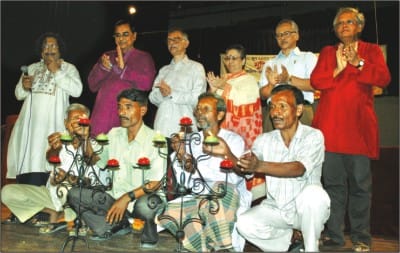
Freedom Fighters light candles at the inaugural session (front row) while leading civil society members join the commemorative programme. PHOTO: STAR |

