Formulate strategy to earn $30b remittance by 2015
Govt urged
Star Business Report
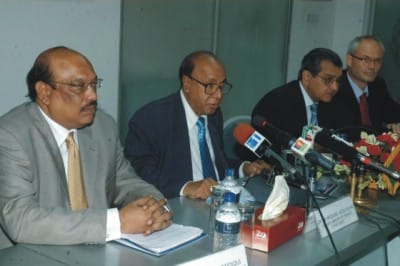
Bangladeshi workers need to develop more diverse set of skills as a part of a grand strategy to tap potential employment markets overseas to increase Bangladesh's remittance earnings to $30 billion by 2015, according to two new studies released at a roundtable in Dhaka yesterday.The discussion on Strategy for Increasing Annual Migrant Remittances for Bangladesh was jointly organised by Bangladesh Enterprise Institute (BEI) and the Royal Danish Embassy at the BEI auditorium. Finance Adviser Mirza Azizul Islam, who addressed the function as chief guest, called on the Expatriates Welfare and Overseas Employment Ministry to identify loopholes of manpower exports and propose guidelines for future action in consultation with other government ministries. He suggested studies into the matter in order to improve labour conditions overseas and remittance through banks. Currently, one-third of Bangladesh's forex earnings come from remittances, according to Bangladesh Bank figures as revealed by its Deputy Governor Ziaul Hassan Siddiqui at the roundtable. One of the studies on the subject by Indian Institute of Management (IIM), Calcutta, titled "Making Bangladesh a Leading Manpower Exporter: Chasing a Dream of US $30 billion Annual Migrant Remittances by 2015," said the government needs to play an overarching role as a legislator, a regulator and an enabler to tap the full economic potential of migration. The study suggested enacting and amending laws to bring transparency to the migration process to prevent illegal human trafficking and also to eradicate Bangladeshi workers' maltreatment overseas. The study also identified growing and high-skill labour markets in United States, Britain, Bahrain, Malaysia and Saudi Arabia as the next target for economic migrants, but they also recommended workers to look at emerging markets in Korea, Japan, Spain and Australia. The IIM research team also found a lack of professionals in the management of overseas employment agencies. While another study on the subject by the BEI, titled, "Policy and Public Benefit Interventions to help Bangladesh Achieve an Annual Migrant Remittances of US$30 Billion Per Annum by 2015," suggested that the government should prioritise skilled workers to command higher wages than the unskilled workers to remit more money back home. The BEI study also recommended removal of all impediments for women to work overseas, especially in the Middle East countries. They also suggested that travel agencies should be 'totally barred from engaging in the manpower business," and the Ministry of Expatriates Welfare should form a 'policy cell' to coordinate policy formulation. Farooq Sobhan, one of the authors of the study and BEI president, said, "It is easy to set targets, but a lot of hard work needs to go in from all the stakeholders." Danish Ambassador Einar Jensen said that meeting the high-skilled workers' demand is one of greater challenges for Bangladesh and he cited the example of Denmark as a potential high-skill labour market. Labour and Employment Secretary Ashfaq Hamid spoke on the occasion among other government and non-government agencies who presented their observations on the topic.
|