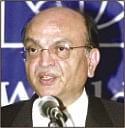
Govt must show some 'teeth' in prosecution
Patel tells of big fish arrested over graft
Staff Correspondent
World Bank (WB) Vice President for South Asia Praful C Patel yesterday said the government will have to show some 'teeth' in quickly prosecuting the arrested 'big fish' to ensure its credibility.Rising inflation and having only ten advisers are the two significant downsides of this government, he observed. Speaking at a press conference in a city hotel, Patel said it has not been proven that the Anti-Corruption Commission (ACC) has any teeth, but "now that they have some big fish in jail, over the coming period they will have to make sure they have teeth". They will lose out otherwise, he said. The government had informed him that "They are going to take action on the prosecution side," Patel said adding, it is important to move quickly on prosecutions as a delay would raise questions of the government's credibility. He said the government had told the WB that "They will move on to the next step on taking high profile cases, prosecute them and complete the process." Patel added that the government would do it to demonstrate to the public that it will not only arrest, but also take action against them. "What is critical at this stage is that the investigations and prosecutions are thorough and that due process guarantees are respected," he said adding, "Focusing on credible prosecutions of several big fish, rather than casting the net too widely, will send the right signals and enhance the credibility of the ACC in the eyes of the public." Regarding recovery of 'stolen assets' from abroad, he said, "We have similar global experience. If the government asks we will provide every assistance so that the assets return to the country." Patel also identified a lack of "implementation capacity" as a significant downside to the current interim administration. He observed that having only ten persons to manage the portfolios that were previously managed by some 40 ministers is "not satisfactory." "This is surely going to cause overstretching in the span of control over the machinery and decision-making...and even day-to-day decisions." It creates a situation where "we (WB) are going to increase our support, but the amount of money on the table is not being implemented in a timely way," added Patel. He said there is clearly a desire to improve the quality of politics and he has gained confidence that there are "competent people at the wheel" and he believes that the government will be able to implement its planned reforms in the electoral system and within political parties. The public should consider the timeframe if they become impatient with the speed of change, and be reassured that "if all the reforms are done, the quality of politics cannot go anywhere but up," Patel said. Bangladesh's potential growth rate of 8 to 9 percent has been hampered by "confrontational politics" and corruption in the past, and that 3 percent of "lost growth" has led to millions remaining in poverty unnecessarily, Patel observed. The WB vice president also identified the rising inflation as a significant downside and he disagreed with the governments' position over the issue and encouraged the government to "think very hard about it." Johnathan Dunn, mission head of IMF in Bangladesh however said although global and regional inflation levels are comparable to the levels in Bangladesh, it is important that the public understand that there is enough scope for the government to make policy adjustments to rein in the high inflation levels. Currently, Patel said, consumer price index inflation in India and Pakistan were 7.6 and 7.7 percent respectively, in comparison to Bangladesh's 7.4 percent, which is higher than the central bank's 'comfort level'. However, he added, inflation above the comfortable level will happen and measures against runaway inflation have to be taken. Saying that it is important to bring down the current inflation level, Dunn suggested tighter monetary policy as well as adjustments to the demand side as possible policy solutions, but added that it is not good that people here are getting "used to" the high levels of inflation. Dunn further advised, the exchange rate to be made more flexible to complement the monetary goals of reducing inflation, scope for further appreciation of taka, especially with high foreign reserves. Patel said the change in the government after 1/11 "has not created any imbalance," and that the government has done well to take policy decisions that have been pending at the ministries for years. "Through my discussions over the past three days it is clear to me that the present period provides a rare window of opportunity to make fundamental economic and political reforms which must be seized," said Patel, adding, the WB will continue to work with the government in reforms to crucial sectors -- water, power and education. During his visit, Patel met Chief Adviser Fakhruddin Ahmed, Finance and Planning Adviser M Azizul Islam, senior government officials, development partners, civil society members, and representatives of NGOs, private sector and the media. "There should be no softening on the critical challenge of improving the lives of the poor during this important political transition" and the government is in a unique position to institute reforms with a lasting impact, he added. The WB is set to disburse a total of $450 million by the end of this fiscal year. Patel said, "What matters is that we have the environment and conditions for the World Bank to provide the maximum support for the mission we pursue here, which are largely to eradicating poverty and for Bangladesh to meet the Millennium Development Goals (MDG) by 2015." The vice president for South Asia added that Bangladesh is one of the rare countries to be on its way towards meeting the MDGs within 2015 and many of them have already been met. Patel cautioned saying, "Those making decisions on the eviction of road-side businesses or small business that are on government land [should] keep in mind the consequences for the poor people" because "this sector is the lifeblood of the poor and [it] makes an important contribution to growth [of the economy]." Patel also expressed his satisfaction over the government's commitment to addressing weak revenue mobilisation, large energy sector losses, trade liberalisation and outstanding state-owned enterprise liabilities. He said the WB will do all it can to assist the government to recover the illegally earned money that has been sent overseas and the WB is also hopeful that the strengthening of the ACC would bring greater efficiency in retrieving the illegally earned money. The WB vice president also advised the media to ensure accountability in the government by publicising government inefficiency in recovering the ill-gotten money or prosecuting corruption suspects.
|