Ramkinkar Baij and his craft
Discussion by Centre for Asian Art and Culture
Ahsan Habib
To celebrate Ramkinkar Baij (1906-1980) centenary, Centre for Asian Art and Culture (CAAC) arranged a special speech titled "Ramkinkar and his Artworks" on the legendary sculptor of the subcontinent. Professor Abul Mansur, Department of Fine Arts, Chittagong University delivered the speech at the auditorium of CAAC on May 30.In the speech, Professor Mansur provided a brief account on Ramkinkar's life and traced his place and importance in the Indian art history. Several of Ramkinkar's famous works were projected through multimedia at the programme. Ramkinkar is considered as the pioneer of "Modern Indian Sculpture". According to Mansur, historically Indian art has had a tradition of parampara (knowledge passed on to successive generations), continuing despite interventions and external influences. This continuity was interrupted by colonialist Europeans as their artistic preferences became dominant, suppressing the local tradition. Indian sculpture of the time lost its own characteristics -- many confusing ideas made way into it. "With the rise of nationalist ideas, Abanindranath Tagore founded the Bengal School that upheld swadeshi values. However, Abanindranath's brother Rabindranath Tagore didn't agree with what the art school was promoting. He was in favour of a fusion of eastern and western art and brought Nandalal Bose to Shantiniketan. As a student, Ramkinkar was helped greatly by these stalwarts -- Nandalal and Tagore -- as mentors," said Professor Mansur, on Ramkinkar's background. "Contemporary aesthetic ideas of the east and the west were incorporated in the works of Ramkinkar. He came to Shantiniketan at an early age, in 1925. From the very beginning his sculptures took a different dimension, owing to a special organic engagement, demonstrating simplicity and directness of approach. His inspiration was the working life of the common people. Portrayals of those he knew, their dreams, desires, drives and debacles, were delineated in the deft and quick gestures of this artist. His sculptures contain the quality of monumentality. He was highly expressionistic yet very disciplined," explained the professor. Apart from being a renowned sculptor, he was also a well-known painter. Ramkinker's interests in life and art were wide, his theatrical performances and stage designs deserve a special attention. Member of the CAAC trustee board, Salimullah Khan presided over the programme. Md. Rafiqul Islam, the managing director of Radio Today was the special guest of the event.
|
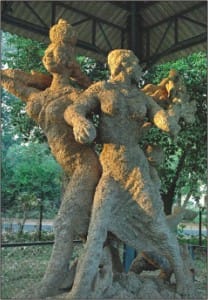
Santal Paribar by Ramkinkar Baij |

