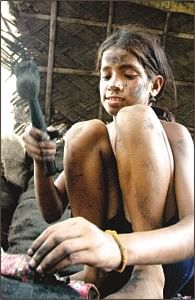
Children mired in hazardous jobs
Mahbuba Zannat
A significant number of children in the country are still engaged in labour especially in hazardous jobs in the informal sectors, as the main reason behind child labour is yet to be addressed properly, experts say.Even though different organisations have been working to prevent child labour by sensitising trade unions and providing education and vocational training to the working children, a new section of children appear in economical activities and engage themselves even in hazardous jobs due to poverty that prevails in their families. A total of 532,373 children aged between 5-17 are still engaged in labour. Of which, 521,614 are involved in hazardous work, according to a survey conducted jointly by the Bangladesh Bureau of Statistics (BBS) and International Labour Organisation (ILO) in 2005. The Baseline Survey for Determining Hazardous Child Labour Sectors in Bangladesh 2005 revealed that 20.3 percent establishments are employing these children labourers. "In fact, the number of children engaged in hazardous child labour has not increased significantly in comparison to the figures of five years ago, but it has intensified along with the increased population," said Dr Munir Ahmed, head of Household Economic Security Programme, Save the Children UK. He said 90 percent of these children are engaged in informal sectors. "Increased population and poverty is compelling the parents to send their children to earn money to subsidise the family. The parents who have lost their income source due to natural disasters or loss of job, find it easier to send his or her child to earn rather than sending them to school," said Syeed Milky, programme communication officer of Unicef. "Although different organisations are working for the rehabilitation of the working children, a new section of child labourers is appearing as the programmes have failed to address the main issue--poverty. So, a vicious cycle has been created and if the parents could not be made aware, hazardous child labour will continue," he added. Under a safety net programme, the government took a number of steps to reach the poorer sections, but it could not achieve the goal as the targeting was improper and it failed to reach the targeted people. "The Government's Income Generation for Vulnerable Group Development (IGVGD) could not cover even one third of the total targeted people. Monitoring system was also poor," said a Save the Children UK source, adding that existing legislation is antiquated and fragmented and deals only with children working in the formal sectors. "The child labour policy has not yet been finalised," said Chief Technical Adviser of International Programme on the Elimination of Child Labour (IPEC) of International Labour Organisation (ILO) Ronald E Berghuyf, adding that, government has not yet determined what the hazardous sectors, occupations and activities are and so it is difficult to do something. "The official figures show a very small declining of child labour in formal sectors," he continued, the major effort is now in policy-level work, making legislation and reforms to address the main reason behind child labour and also their rehabilitation. While talking to The Daily Star Adviser to the Caretaker Government Geeteara Safiya Choudhury, concerned for the Ministry of Women and Children Affairs, said she came to know about the child labour policy a few days ago and asked the secretary concerned to update her. "Of course the country should have a child labour policy and I will do whatever necessary for its formulation and implementation," she said. However, a "National time-bound programme on the elimination of the worst form of child labour" has started in January this year in collaboration with the government and the non-government organisations (NGOs) to prevent children entering into hazardous labour and at the same time rehabilitate the children who are already engaged in hazardous jobs. "It is a very positive beginning as the comprehensive and holistic approach involving different stakeholders will work for the informal economy, both in rural and urban areas, by building capacity of institutions and through advocacy and poverty reduction," said Berghuyf, the ILO representative.
|