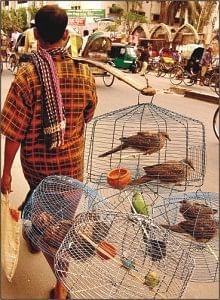
Wildlife on sale here!
Rizanuzzaman Laskar
The existing laws are too poorly enforced to effectively constrict the trade of various species of endangered birds in the city and conserve the rich biodiversity.Even though the Department of Forest is very much aware of the open violation of the wildlife preservation policies and open trade of endangered species, it can do little to protect them due to lack of awareness and adequate staff, sources said. According to the Wildlife Preservation Act of 1974, only creatures including dogs, cats, hares, lovebirds, pigeons and quails -- the species that can be bred in captivity -- are permitted for commercial trading. "It is a criminal offence to sell or purchase wild birds for keeping in captivity or breeding, but you can buy exotic birds bred in captivity," said Nazrul Islam, deputy secretary of the Ministry of Environment and Forest. However, exotic birds of endangered species are being freely traded throughout the city while the authorities put a blind eye to it. Local bird species like munia, parakeet, hill mynah and dove attract a large number of customers each day in the pet-outlets of Dhaka, most of which are located at Katabon and a number of isolated pet markets in the city. "I don't know if such a law exists...how come no one charged us for anything after all these years of business," said Munir, a salesperson of a pet shop at Katabon who was seen selling cage full of black-headed and white-throat munias. Besides these shops at Katabon, several other pet-shops and mobile traders run brisk business in and around the capital throughout the year. Some go door to door with cages of small, chirpy wild birds. Moktar Hossain, a roaming pet vendor who was seen with cages full of green munias and parrots told this correspondent that he is not aware if his birds are wild or were bred in captivity as he purchased them from another seller. "Birds are birds...does it really matter if they are wild or not wild because everyone likes them for what they really are," said Hossain. Rare and exotic species of birds including spotted doves, rose-ringed parakeets, Alexandrine parakeets, blossom-headed parakeets, red munias, green munias, black-headed munias, white-throat munias, hilly mynahs and some finches are seen selling throughout the city. These exotic birds draw customers who purchase them being unaware of the fact that these birds could be on the international list of endangered species. Despite the enforcement of the Wildlife Preservation Act, trading in birds and other wild species is thriving, putting the existing eco-system in jeopardy, said experts. The importance of protecting nature through conservation of wild birds remains a top agenda of the local green groups. On the other hand, a large section of urban dwellers simply fail to understand the significance of wildlife conservation. "The Department of Forest should be blamed for not enforcing the Wildlife Preservation Act properly as it is their responsibility to create awareness among the general people and assist the police in identifying wildlife crime offenders," says Munjurul Khan, an expert of World Conservation Union (IUCN). "Without assistance from the Department of Forest the police can barely do anything as they cannot identify wild birds and are ill-equipped to handle the situation," he added. According to Department of Forest officials, conservation of the endangered species is all the more sensitive and difficult in the capital because of the sheer vastness of the city and the lack of specialised manpower in the department. "We are aware that an unscrupulous section of the society is involved in illegal trade of these endangered species but we simply don't have the manpower to bring any big changes," said Sultan Ahmed, deputy secretary of Department of Forest. "We will discuss the issue with the law enforcement authorities and see if we can do anything different," he added.
|