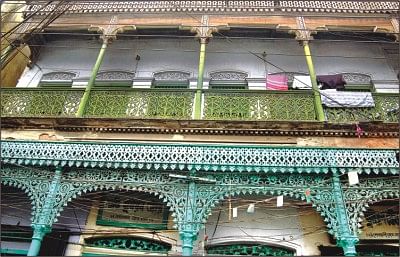
Heritage of Tantibazar
Shocking demolition of old buildings
Conservationists urge for immediate step to protect buildings with architectural and historical significance
Tawfique Ali
A number of old buildings with immense architectural and historical significance in the city's Tantibazar area have recently been marked for renovation and demolition by their owners, to the utter shock of the conservationists. Seven to eight buildings located in the area -- from English Road to Islampur Road -- are being demolished by private individual owners. Conservation of historical monuments, architectural heritage sites and edifices of cultural significance in the capital now largely depends on Rajdhani Unnayan Kartripakkha (Rajuk), as the metropolitan building rules of 2006 entrusted it to make a list of such buildings and sites and take measures for their conservation. The building number 28, 32, 27/1 and some more should be conserved by any standard, as they bear historic testimony to a significant phase of Dhaka's urban history, said conservationist architect Taimur Islam of Urban Study Group. These intricately decorated edifices are roughly 150 years old and located in Tantibazar and Shankharibazar belonging to the pre-Mughal, Mughal and colonial era, he said. "These old buildings form a living cultural entity," Taimur said. "Features of colonial architecture are dominant in these buildings with manifestation of architectural influence of the Mughal era. The architecture of these buildings reflects mostly classical style as well as influences of contemporary European architecture reminding the spectators of the Mughal legacy. An urban revival took place in today's old part of Dhaka during mid-19th century propelled by a thriving trade of jute-based industry and handicrafts. Tantibazar and Shankharibazar during colonial period were abuzz mainly with a business elite class including artisans and craftsmen community. Architects said some of the buildings of colonial period have been redeveloped from time to time. Architectural and historical significance of all the buildings may not be equal but all the buildings have to be conserved for the sake of area conservation and total urban fabric of the particular area. It is all the more necessary to conserve the entire stretch of the old buildings to retain the sense of place and symmetry and harmonious look of the set-ups, they said. Over past couple of weeks, the locality has seen a mindless demolition of a number of irreplaceable historic buildings. The private owner of the building no 28/29, an architecturally very significant building, has already demolished the entire structure. Demolition of another similar building, holding no 27/1, is towards the end. In case of the building no-32, the elegant decoration of classical motifs on the elevation (frontal facade) has been flattened and replaced with plastering of dull look, Taimur said. Owner of the house Salah Uddin said it was not in his knowledge that there is any need to conserve such buildings. "The beautiful look of these old buildings is all that catches our attention." "Nobody has approached us for conservation of these buildings," he said, "The government has to take initiative for conservation, mere words will not do." He further said, "There are many such buildings in Tantibazar and Shankharibazar areas but it is very risky to live here, as the old buildings are in dilapidated state." President of the IAB architect Mubasshar Hussain said the government must take necessary measures to pay due compensation to the private owners in the same manner as private land is acquired for public infrastructures like roads, to conserve sites of historical and architectural significance. Director of Department of Archaeology Md. Shafiqul Alam said that they are very much aware of such destruction of historical monuments particularly in the city area but they hardly can do anything for conservation. "We do feel that a particular site or edifice should be protected," Alam said. "But we cannot protect it unless and until its private owner gives consent in favour of conservation." Authorised officer of Rajuk Nurul Islam said that conservation of heritage buildings is difficult for Rajuk unless the Department of Archaeology specifically declare such sites. "But I will send a building inspector to Tantibazar to see what we can do there," he said. Nurul Islam said that none of the private building owners has obtained design approval for construction of new buildings. Building owner Salah Uddin claimed that he has obtained approval of design for construction of a six-storey building from Rajuk. Originally, during the pre-Mughal times this mohallah (traditional neighbourhood) belonged to the Tanti (weavers) community, reputed for the famous Muslin of Bengal. It is from this community that the mohalla borrowed its name "Tantibazar". During much of the 18th and 19th centuries, Tantibazar used to be considered one of the elite neighbourhoods of the city. A relic of the pre-Mughal era, Tantibazar even today boasts of a fair collection of 2 to 3 storeyed shop houses.
|