An umbrella university for South Asia
Kanak Mani Dixit
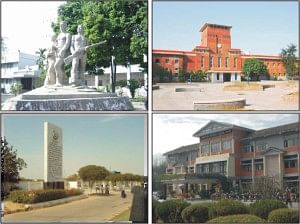
Everybody welcomes the idea of a "South Asian University;" it's like mother's milk. But even mother's milk has to have the proper nutrients, or the baby will grow up malformed. The idea of a South Asian University is so overwhelmingly important that it must not be wasted at the altar of good intentions or individual ambition.The very evolution of South Asia can be given direction by a South Asian University with practical, achievable goals and staying power. India's support for such a venture is critical, as it would be able to provide significant funds and faculty, and hopefully would have the circumspection not to smother the institution in India-centrism. Manmohan Singh, in his speech at the Dhaka SAARC Summit on November 12, 2005, said that he would push for a South Asian University as a "centre of excellence." Said the prime minister: "We can certainly host this institution, but are equally prepared to cooperate in creating a suitable venue in any other member country." It is said that Prime Minister Singh has committed $100 million to the project, which is good of him. It now appears likely that the idea will see fruition at the upcoming SAARC Summit in New Delhi, in early April. Unfortunately, what is currently known of the project does not inspire confidence. Pushed by the Dhaka-born scholar and international administrator Gowher Rizvi, the plan is to develop a centralized institution with "a single campus … working under the direction of a single president/chancellor and academic council." The proposed campus would be set up on a hundred acres in the locality of Dwarka -- now practically a New Delhi suburb -- which would attract scholars-in-residence and a South Asia-wide student body. The placement is already problematic. The first university of South Asia must be one that promotes a regional vision quite distinct from the capital-centric model of the SAARC organisation. As such, the university needs to be physically removed from any capital, in particular the region's most powerful one. Fortunately, decentralized models have been developed, including by a team headed by Rizvi's compatriot, the political scientist Imtiaz Ahmed. This writer would suggest that the money India seeks to invest in the South Asian University, together with contributions from other SAARC members according to GDP, be made available to a trans-national South Asian University Grant Commission, constituted of top-notch academics and administrators. Such a commission could well be headquartered in New Delhi, but its core activity would be to detect, fund and monitor universities across the region. The commission would remain independent of national interests, not compromise on tokenism, and institute stringent reporting requirements of the grantee institutions. At least to start with, the South Asian University would not be a campus but an umbrella institution. It would provide support to select post-graduate departments in, say, JNU, Delhi University and Jamia Milia in the Indian capital, Jadavpur University in Calcutta, LUMS in Lahore, Benaras Hindu University, Tribhuvan University in Kathmandu, the universities of Dhaka, Karachi, Colombo and Madras, and so on. Many of these institutions delivered South Asia its intellectual stalwarts in the twentieth century, the nation-builders of the modern era; now, most have deteriorated due to political interference of every sort and lack of comfortable endowment. It is important to revive these hallowed universities, rather than to build a spanking new one that would only further suck away energy and dynamism from the existing institutions. A lack of social-science learning has robbed our societies collectively of an upright intelligentsia amidst dislocating modernization and economic globalization. As such, it is important for the proposed university to make attractive once again post-graduate courses in history, political science, anthropology, sociology, philosophy, as well as education, public health, and science and technology. Those studies supported by the private-sector -- information technology, medicine, engineering, business management -- should be left out by the planners of the new institution, at least at the outset. A South Asian University should be one that germinates and grows along with the multi-layered understanding of regionalism amongst our societies. It should not be an institution mandated from on high. Nor, of course, should the new university be a cyber-institution that floats in midair without ownership of its constituent units. This would be the greatest challenge, because a dispersed university of this kind has rarely been tried. Indeed, the departments and faculties under the Grant Commission must be proud of being part of the South Asian University network. We must get the South Asian University right the first time around, because the costs of failure would be high. Manmohan Singh is a thinking South Asian; may he back the right idea. Kanak Mani Dixit is Editor of the Kathmandu-based Himal Southasian magazine.
|