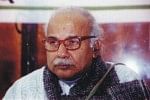
Waheedul Haque: In heartfelt remembrance
Dearest Kaku,
I remember a night in 1987, when I saw you from afar. You were mingling with artists and guests outside the Shilpakala Academy auditorium after a performance of Anandadhwani's "Thakur Barir Gaan." We had not yet met. My husband and I were in our teens. He had brought me to the performance, and when he left me standing by the auditorium door to go speak to you, I saw you gather him in your arms. You looked in my direction as he pointed me out. It was not until a year later, however, that we were formally introduced... on a night train ride to Rajshahi. I had come from New York on another summer vacation, and was traveling with my uncle's family and their many friends, including you. We were a large, loud group consisting of young and old. You were as comfortable conversing with us as you were with our guardians, perhaps even more so. The intellectual level of the dialogues with the youngsters made an impression. Your narrations on the subtleties of Bengali grammar and prose, however, were somewhat going over my head. Halfway throughout the journey, we boarded the ferry and at one point, the younger generation accompanied you to the roof and sat down on the floor. We encountered fierce winds, and almost as suddenly as the rain started to pour did the group break out in unison, "Aashar, kothha hote aaj pele chhara ..." Having previously become enamored with and immersing myself in Rabindrasangeet, I perceived myself to be acquainted with the musical genre, its known artists, and hundreds of renditions. Yet, I had heard nothing like this. The chorus approached near perfection, as aesthetically pleasing to the ear as a Gregorian polyphony. After the song ended and before the next began, you called out, "Rita, you will sing with us." You didn't ask whether I knew how to sing. I was struck by the fact that you remembered my name and the familiarity of the address, as if you had known me for years. As one song followed another and you addressed the songs, renditions, and subtleties, I thought to myself that this was probably the closest I would ever come to experiencing what those nearest to Rabindranath must have. It would be yet another year before we were to truly become close. Apprised by my fiancé that our relationship had gotten serious, you sought to get to know me better. Thus it was that one brilliant summer afternoon, you appeared at the house in Dhaka where I resided, clad in your familiar, utterly Bengali attire. I was struck again by the ease of your movements. The three of us sat on a sun-drenched verandah and spoke, of nothing in particular at first. Yet, slowly but surely, as the days passed, you coaxed a shy 21 year old into speaking of what she was learning at university, what she was reading. So began our conversations -- on Crick & Watson's discovery of DNA, on Lewis Thomas and the notes of a biology watcher, on S.J. Gould's musings on natural history, on Bohr, Schrödinger and quantum mechanics, Einstein's relativity, Darwin and evolution, fractals and chaos theory, on Madame Curie, Rosalind Franklin, Barbara McClintock and other women in science, on plate tectonics and the Mid Atlantic Ridge, on "selfish genes," on Penrose and consciousness, on the Big Bang and the Manhattan Project, on ancient civilizations and existing wonders, etc. We spoke of Euripides' Medea, of Shakespeare and E. B. Browning, of Conrad and O'Neill, of Marquez and Kundera, of Spinoza and Hume, of Vermeer and I.M. Pei, of symmetry in classical Greek sculpture. Could Plato's Theory of Forms be the origin of both Christianity and Marxism? How does one account for variations among different renditions of such a tightly structured form as the symphony in Western Classical music? Is Harold Bloom correct in asserting that exposure to the western canon is essential to becoming a literate individual? Can Descartes be discussed within a literary, as well as philosophical, context? How did the Maya die off? Was there anything you hadn't read? I was just beginning to cover the texts and there was an excitement in me. Yet, to this day I remain amazed and truly gratified that a thinker of your stature chose to sit and talk to someone as common, as ordinary as I. You narrated beautifully composed and intricately detailed tales in Eastern history, culture, and thought from your treasure trove memory, and re-acquainted me with the world of Rabindranath. Taking me by the hand, you introduced me to those closest to you throughout Dhaka and in Rajshahi, Mymensing, Sylhet, Comilla, Chittagong, etc. I watched in awe as you brought out the best in young minds, hearts, and voices, constantly weaving individuals of different sizes, shapes, colors, hopes, talents, and religions together into garlands of potential. Instilling in each a sense of self-worth, you initiated us into a philosophy of knowledge, tolerance, and inclusion. I remember early morning walks and lessons on nature with you in the lead, as a modern day pied piper followed by legions of young, untarnished hearts; I remember gatherings of smaller groups and discussions on science and the arts; I remember waking to ethereal music emanating from rooms, houses of differing sizes, shapes, and degrees of affluence. And I remember sitting in on lessons from a beautiful, raspy voice that could bring a song to life before our eyes and touch our souls, where the indispensable consonance of the music and lyrics became instantly apparent. The next few years consisted of teary-eyed farewells and exuberant reunions. I, who grew up in America, was unaffected by Eastern inhibitions of open affection, and ran to you, as a child runs to her father, with hugs and kisses each time we met. The only request you ever made of me still rings in my ears, "Bring me books, hot off the press!" Our discussions continued, and my ease and confidence in sharing my thoughts grew. Nevertheless, as more time passed, the individuals in the garlands you strung me into grew older. We married, started families, and became busy and pragmatic. Ultimately, armed with the talent and self-confidence that you helped to instill, we grew arrogant, drifting apart from you, forming groups, and excluding others. Yet, undeterred, you tirelessly continued stringing new garlands across this country and beyond its borders. With a simplicity of manner and attire that deceptively hid the legend that you were, you tried to change this society one individual at a time. As we clung to each other in agonizing restlessness that of January 27 with tears streaming down our faces, waiting to hear the unthinkable, we wondered how we would ever continue without your presence, your guidance. I am told that on the day of your admission to the hospital, you spoke of a Japanese gardener brought for his expertise to Santiniketon, and of the cross-cultural ties that formed, one by one, producing direct descendents that reside even in Bangladesh. Supposedly, you shook your head softly as you reassured yourself, "You people will remember, you will remember." But how could we ever forget, dearest Kaku, that for a fleeting moment in our so mundane lives, you showed us a world of unearthly beauty and camaraderie. Yes, you were a thinker, activist, writer, musicologist, linguist, organizer, teacher, and freedom fighter of unparalleled eminence and boldness, but you were so much more than that. You were a molder, an inter-weaver of countless Bengali minds and identities. --Rita
|
|

