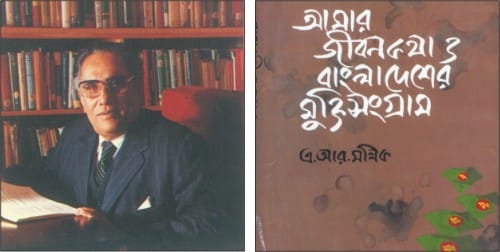
The book with no end: A tribute to Dr AR Mallick
Aziz Mallick writes from London
It was nearly ten years since I re-lived the stories. I was flipping through my grandfather's memoirs on the flight back to London, and dramatic events that had shaped our country over a period of fifty years flashed before my eyes. Even though my Dadabhai, Dr Azizur Rahman Mallick had served the country in various pioneering roles such as the founder vice-chancellor of Chittagong University, the first education secretary, the first high commissioner to India, the first technocrat finance minister, chairman of ADB, the one identity he always preferred was that of an academician. As I leafed though the pages I still couldn't fathom which period of his life I found more fascinating. In 1953, at a time when the British influence was still strong in this region, he completed his PhD in London, factually denouncing the crippling British policies in the region. He had completed his degree in a record time of just under 21 months. Nearly 50 years later, when I came to study in the UK, I travelled from Oxford to London just to have a look at the original thesis that was still on display. I still remember the day and it felt like I had come full circle. After returning to Rajshahi University to resume his role as head of the history department, Dadabhai was requested by the erstwhile government to set up Chittagong University. Dadabhai was faced with an impossible timetable. Never to back away from a challenge, he took charge, literally razed mountains to clear the terrain and built the university from the ground up much before the scheduled time. He had a fiery temper on the outside, but during political upheavals when students were thrown in jail, it was Dadabhai who personally put up bail. And when Eid came around, it was his house that played host to the students. In the 4-5 years as vice-chancellor, there was hardly any untoward incidence in the campus. He loved the university with his whole being but when the country-wide atrocities began in March 1971, he did not wait a moment to resign and turn his focus on building resistance. To him country always came first. In fact, his patriotism is something that had drawn him back to the country on numerous occasions. In the 1960s he was a full professor at the University of Pennsylvania, one of the eminent Ivy League universities. Even though he had helped set up the department of South Asian regional studies and was looking at a dream career, he turned his back and returned to his beloved country. During the Liberation War, he addressed at the UN, and toured 36 universities in the US and Europe as president of the Liberation Council of Intelligentsia to raise support for our cause. After the war, he was made special envoy and represented Bangladesh in key bi-lateral dialogues to win international recognition for our newly liberated country. He was appointed the country's first high commissioner to India and concurrently ambassador to Nepal and Bhutan. In his new role, he negotiated the repatriation of the refugees from Afghanistan. I remember how proud he looked in the photograph as he stood next to King Zaheer Shah the day the final agreements were signed. It's all the more special to me, as many years ago he gifted me the suit he had worn that day. Though it fits me perfectly, I haven't had the courage to walk in that suit, lest I do damage to the memory. Given his far-flung responsibilities, travel was always a challenge. There were times when he had to take a helicopter to his office in Bhutan! Pictures of him leading meetings with President V V Giri, Prime Minister Indira Gandhi and other world leaders always appealed to me as a child, and they still do. It was at this time when he was asked once more to return to Bangladesh and take on the difficult role of a technocrat finance minister. People close to him remember walking into his study in Delhi to see that he hadn't slept, the ashtray overflowing with cigarettes he had smoked throughout the night. He was a personal friend to Tajuddin Ahmed, and he was being asked to replace him. Though he was never a politician, Dadabhai felt the request was forcibly thrusting him into a sensitive role. He asked for time until he had spoken to Tajuddin himself. When he met Tajuddin, Dadabhai was taken by surprise. Tajuddin embraced him emotionally, and is quoted to have said: "The country needs a non-political personality to take this challenge and I cannot think of anyone other than you." Such was the charisma of Tajuddin that Dadabhai found it impossible to say no to either his country or his dear friend. As finance minister, his budget was the one time in the country's history that taxes were not raised. Also, one of the rare occasions when the 100-taka note was de-monitised to check the inflow of black money. I remember Dadabhai narrating stories of how Bangobondhu had wanted the decision to be discussed at a cabinet meeting. Dadabhai disagreed for the sake of maintaining secrecy, and suggested that the discussion be limited to the head of the government, finance minister and the Central Bank governor, as was done in other countries. Tajuddin's foresight in requesting Dadabhai to step into this role was evident. Dadabhai's political non-affiliation actually gave him tremendous leverage when working with his peers, and like that day in the cabinet, Dadabhai's will prevailed. The day Dadabhai was to announce the de-monitisation, he requested a few top ministers and other high officials to remain in the conference room until the announcement was made. He had the operator switch off the telephone to that room and along with Finance Secretary Kafiluddin Mahmood went to various parts of the city to check for rumours of the impending announcement. The final operation was a tremendous success. There was the expected uproar from people whose illegal fortunes were now worthless, and there were even people who burnt sacks of now-useless 100-taka notes near the border areas and in front of the Deputy High Commission office in Kolkata. Such instances and countless more, always seemed to me reflective of Dadabhai's iron will, charisma and his inherent desire to be true to himself and his country. Dadabhai now lies peacefully at the Shaheed Buddhijibi Graveyard in Mirpur, side by side with his compatriots, scholars and intellectuals who together had shaped a nation. Dadabhai's presence was so pervasive in my life that I hadn't realised it had been ten years since I lost him. Next to where he lies, it was only the small sign that said February 4, 1997, that made me realise a decade had passed since that night at the hospital. I suppose there are a couple of reasons why it took me this long to open the pages of his memoirs. On the one hand, it seems to remind me of the unbridgeable emotional void with every page I turn. On the other, every line I read seems like ones I have read a hundred times before, memories burned into my mind from countless stories I heard him tell me on so many occasions. I don't think I'll ever finish reading the book like most people do. To me, these memoirs will always be like ones that have no beginning and no end, an epic novel that will live and grow with every breath I take. Aziz Mallick is an Associate, Corporate Finance, for Europe, Middle East and Africa, JPMorgan Chase, London.
|