No Nonsense
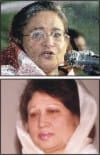
Saviour of democracy: Hasina vs Khaleda
Dr Abdullah A Dewan
Neutral observers at home and abroad consider the political crisis and tortuous standstill of the past few weeks symptomatic of a crumbling democracy. The growing feeling is that antagonistic politics and mutual abhorrence of Khaleda Zia and Sheikh Hasina has turned too personal to qualify them as leaders of their parties, let alone of a nation, and that democratic reforms under the leadership of either will not follow a normal course. What is most disconcerting though is the role retired justices have played ever since they were grafted in civilian positions demanding the highest degree of neutrality in the discharge of their obligations to the nation. Both Justice KM Hasan and Justice MA Aziz had to be shunted out of power because of their BNP partisanship. Another former justice, Mahfuzur Rahman (a member of the EC) usurped the vacant CEC position; a move that echoed President Iajuddin Ahmed's brazen seizure of the position of chief advisor. ACC chairman, Justice Sultan Ahmed, is also considered a BNP sympathizer and so is the chairman of Bangladesh Press Council, Justice Abu Sayeed Ahmed. There are likely other justices holding politicised positions of public service. I grew up with the notion that the judges of the higher judiciary are the ultimate model citizens who could be trusted to protect citizens' rights and the constitution. Do the justices cited above constitute exceptions to this belief, or they are no different from any other self-serving politicians, devoid of conscience and moral fabric? The justices are setting the precedents of two roles with two faces -- one role that was disciplined by the legal framework while in a position of "justices" and another in a post retirement public service position wherein their activities display the true colour of their partisanship. The latest shocker came on November 30, when the current chief justice put a stay order on the proceedings of writ petitions that challenged the legality of the president's taking over as chief adviser and his unilateral decisions, just minutes before a High Court bench was expected to issue a ruling on them. Chief Justice Syed Mudassir Husain is now another defamed name in the country's politicized partisan justices. Article 58C of the constitutional provisions which allows retired Supreme Court chief justices to assume the position of the chief advisor were guided by the deep-rooted belief that they will be non-partisan. But that belief is now shattered after the impasse with Justice KM Hasan and subsequent developments leading to the current imperial presidency. The weaknesses of the CTG provisions are now clearly exposed and they must be amended by the next parliament. Given that these justices did not play by the rules, the country should not blindly trust retired justices to safeguard our democratic institutions. The partisan justices have also denigrated our democratic values abroad. The Economist Intelligence Unit (EIU) on November 24 ranked Bangladesh 75th among 165 democracies and grouped it in the category of "flawed democracies," based on the poor performance of the last parliament and continued political standoff leading to the upcoming elections. The EIU also placed Bangladesh on a "negative list" and cautioned about the potential for triggering a political crisis and a rollback of democracy if the election is not free and fair. The EIU democracy index is measured using five categories: electoral process and pluralism, civil liberties, the functioning of government, political participation, and political culture. Bangladesh's overall score was a meager 6.11 out of a maximum of 10. The upshot of the above discussions leads to one simple question: Has democracy in Bangladesh become hostage to BNP's politicization? Whose leadership, between Sheikh Hasina and Khaleda Zia, promises better prospects for strengthening democratic institutions, secularism, and the rule of law? In a November 19 article in The Bangladesh Today, M. Asafuddowlah wrote: "The oversized ego of the two housewives-turned-politicos providing accidental leadership to the country's two principal political parties has turned democracy into a virtual mockery. People are held hostages by two families who run the two parties like their private properties." But let me point out that Hasina is not just a housewife and an accidental leader, and her family members are not heavily involved in politics at this juncture either. What is true of Khaleda is not true of Hasina. Leadership attributes are often genetically disposed, but can also be harnessed through education and experience. In an study Blema Steinberg (Ref.: Political Psychology, Vol. 22, 2001) confirmed that first-born women, like first-born men, are over-represented among female political leaders as compared with their numbers in a larger sample population; and that fewer female political leaders have an older brother than would be expected to occur in a larger sample population. Steinberg's study on parent-daughter dynamics suggests a possible explanation for the success of women who achieve senior-level positions of political power. These findings are consistent with Hasina's political background, while Khaleda's (who is neither a first born, nor the daughter of a political leader) ascension to leadership was simply accidental. Despite having a university degree, years of political grooming, and favourable father-daughter dynamics, Hasina has not convinced many that she is an astute leader. However, if she surrounds herself with good and trusted advisors, she can attain the stature of a great leader if she assiduously works for it. Why representative democracy would be further maligned under Khaleda's leadership is clearly articulated in three of my recent articles (Nov 6, 21, 27). In the November 21 piece, I wrote: "Khaleda Zia, who over the last two years feverishly dismissed the AL reform proposals as self-serving and meritless, could have promoted the institutions of democracy, instead were affianced in an all out scheme to politicize the civil and police administration, including the EC and all its operatives in order to harvest political advantage in the ensuing election. Her rule has surpassed any other government in the subcontinent's history in terms of corruption, politicization, black money laundering, and loan defaulting. The police brutalities she unleashed against oppositions are rivaled only by the struggle for democracy against Pakistani military juntas." In an opinion column in The Gulf News (UAE) on November 29, Husain Haqqani wrote: "Like Begum Khaleda Zia in Bangladesh today, Nawaz Sharif [of Pakistan] tried to re-write the rules of the political game to the detriment of Benazir Bhutto while he was in power. Bhutto, too, did not bridge the divide with her opponent during her terms of office, which were cut short each time by the establishments of pseudo-constitutional interventions." Haqqani pleaded that Khaleda Zia and Sheikh Hasina should heed the lesson learnt belatedly by Benazir Bhutto and Nawaz Sharif. The two former Pakistani prime ministers worked out a "Charter for Democracy" recently, several years after being exiled as a result of military rule. Haqqani viewed that "Given the Bengali Muslims' commitment to popular politics, Bangladesh should have been an example for Pakistan. But now there are fears that current trends in Bangladesh would lead to a gradual Pakistanization of Bangladeshi politics." During the last five years, Khaleda's pretensions of not seeing what every one else sees, not hearing what every one else hears, and not acting on matters what everyone expected of her to act on, has earned Bangladesh the top corruption ranking for five consecutive years, recently caused a worldwide concern as a "flawed democracy." Thomas Jefferson once said: "The price of democracy is eternal vigilance." Given that Khaleda has already started the process of the "Pakistanization" of Bangladeshi politics through her alliances with fundamentalist parties, how can anyone trust Khaleda as a saviour of democracy? Dr Abdullah A Dewan is Professor of Economics at Eastern Michigan University. The article was presented at a human rights conference in Toronto, Canada held on December 2.
|