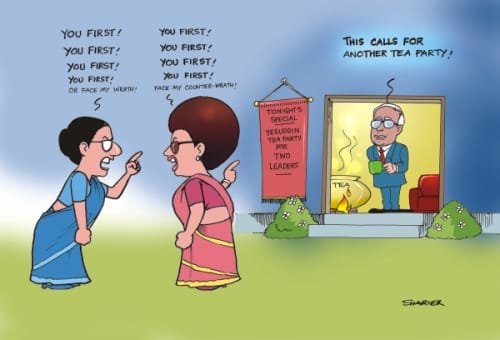
Long talks yield no solution
Hopeful advisers sit today to give 'acceptable formula' to end crisis
Staff Correspondent
President and Chief Adviser Iajuddin Ahmed's much advertised crucial talks last night with the chiefs of the two major political alliances separately to resolve the prevailing political crisis ended without producing any instant positive result. Coming out of the summit between Iajuddin and Awami League (AL) President Sheikh Hasina at 12:55 this morning AL General Secretary and Coordinator of 14-party Coalition Abdul Jalil told reporters that his coalition will go on with enforcing the scheduled countrywide indefinite blockade today. The summit between BNP Chairperson Khaleda Zia and Chief Adviser (CA) Iajuddin Ahmed ended at 9:45pm. After the meet BNP sources said their leader told the CA that her alliance is ready to accept some changes in the Election Commission (EC) and corrections on the voter list but it is not ready to concede to the 14-party demand for resignation of the current CA to the caretaker government (CG). Khaleda-led four-party delegation also told the CA that rescheduling of the polling date is not something they are ready to accept as an option although some changes in the over all election schedule is alright. Withdrawal of 14-party's countrywide blockade must precede any amicable settlement, stressed Khaleda Zia, according to the sources. BNP Secretary General Abdul Mannan Bhuiyan told reporters after the meet, "There is no question of conceding to the demand for the CA's resignation. But we told the CA that the voter roll can be corrected until the day of the poll." On the other hand AL General Secretary Abdul Jalil said his leader told the CA that her coalition demands a thorough reconstitution of the EC instead of 'band-aid' solutions and it also demands scrapping of the announced poll schedule and rescheduling of it. Hasina-led 14-party delegation also demanded reshuffling of the administration, said Jalil. Asked when they will withdraw the blockade, Jalil said they will wait for a response from the caretaker government and the withdrawal of the blockade depends on the government's response. Adviser to the CG Mahbubul Alam told reporters early this morning following the summits that the advisory council will meet today to discuss the demands of both the alliances and to come to a decision that he hopes will end the crisis. Replying to a question, the information adviser said the advisory council to the CG requested the 14-party delegation to withdraw the blockade, in reply to which the delegation assured the council of a withdrawal if they get a positive result in favour of their demands. The move by the president and CA to invite the two rival leaders to discuss ways out of the deadlock was the first of its kind since the formation of the caretaker government over a month ago ahead of the next parliamentary election, the schedule of which had been announced on Monday. Responding to the chief adviser's invitation, both the chiefs of the two major alliances --- Khaleda Zia and Sheikh Hasina, met him last night and discussed the ongoing political crisis. The ten advisers to the caretaker government were also present at the discussions, making an exception to the usual practice of the current caretaker government in such situations. The two top leaders accompanied by the alliances' senior leaders placed their electoral demands to the CA during the discussions. In the last one month, Hasina met the CA three times and Khaleda met him twice, to place their demands to the caretaker government chief. Political analysts are considering the CA's latest move a last ditch effort to break the political standoff. If the move ultimately fails, they fear, the ongoing crisis might deepen further diminishing the possibility of holding a free and fair election. Before the summits began, the committee of advisers on law and order had a meeting presided over by the CA, where it reviewed the law and order situation. After the meeting, Adviser Hasan Mashhud Chowdhury told reporters, "If this evening's talks bring about a political consensus then there will be no reason to be concerned about law and order until the election." Khaleda and Hasina accepted the invitation for talks with the CA on Friday night after a meeting of the council of advisers had decided that the president and CA would sit separately with the two top leaders on the eve of the scheduled resumption of 14-party's indefinite countrywide blockade. But there were complexities over the meeting schedules as to who would sit first with the CA, and neither Bangabhaban nor the senior leaders of the alliances were sure when the talks would begin. Finally, BNP Chairperson Khaleda Zia entered Bangabhaban at 7:45pm accompanied by BNP Secretary General Abdul Mannan Bhuiyan, Jamaat-e-Islami Chief Matiur Rahman Nizami, and BNP Standing Committee Members M Saifur Rahman, Khandaker Mosharraf Hossain, Khondkar Delwar Hossain and others. They had a two-hour long meeting with the CA. AL Chief Sheikh Hasina entered Bangabhaban at 10:15pm yesterday accompanied by senior leaders of 14-party coalition and the meeting went on until 12:50am today. Iajuddin, who had assumed the office of chief adviser to the caretaker government on October 29 triggering a constitutional debate, has so far failed to create a level playing field for the next election, rather steps taken by him like taking decisions unilaterally, appointing two controversial persons as new election commissioners and the sudden announcement of the election schedule deepened the political crisis. Iajuddin's unilateral moves and decisions however were in line with the demands of BNP-led four-party alliance while most of the demands of 14-party remain unrealised. In the wake of the prevailing situation, advisers to the caretaker government started expressing their frustration over the ongoing political deadlock and pressures at home and from abroad on the president and CA were mounting for initiating steps to resolve the crisis. Amid such a situation, the president and CA on last Wednesday sought to initiate dialogues with the two major political alliances led by AL and BNP. He sent his adviser Mokhlesur Rahman to AL President Sheikh Hasina and BNP Chairperson Khaleda Zia to discuss different burning issues, including the possibility of rescheduling the election date. IAJUDDIN'S CULPABILTIY?
Since Iajuddin assumed the office of chief adviser to the caretaker government on October 29, he has been mired in controversies due to his unilateral decisions and dubious moves that rather deepened the political crisis. Some of his moves, in an amazing coincidence, matched the demands of BNP-led four-party alliance that had elected him the president during the immediate past parliament's tenure. The chief adviser had unilaterally decided to deploy the army keeping all the advisers in the dark, but in the face of severe criticisms he later retracted the decision. He had termed the form of the current caretaker government as a 'presidential form of government', which he also retracted. He did not consult with the advisers before appointing the two new election commissioners, diminishing the hope of a solution to the crisis surrounding reconstitution of the EC. He reportedly made the EC announce the election schedule hurriedly limiting the scope of reshuffling the administration. He made himself the chief of two advisory committees on administrative affairs and law and order although he is in charge of the two ministries --- establishment and home affairs. Seething with frustration with the way the chief adviser had been taking his decisions unilaterally and treating the advisers with a distant interest, five advisers on November 23 refrained from attending their offices.
|