A festival like no other
Shahidul Alam on 'Chobi Mela IV'
Karim Waheed
Chobi Mela IV -- International Festival of Photography, Bangladesh 2006 -- ended on November 30. The three-week-long festival included 49 exhibitions highlighting works of photographers from 23 countries, seminars, workshops and more. In an interview with The Daily Star, Shahidul Alam, noted photographer and the festival director shared his views on Chobi Mela, photography as a profession and more. This year the theme of Chobi Mela was "Boundaries", themes of previous festivals were "Differences", "Exclusion" and "Resistance"; is there a certain trend when it comes to themes? Shahidul Alam, who is also the managing director of Drik says, "Drik has always tried to be socially aware. We try to come up with themes that can include diverse views and can be stretched by the photographers." How does Chobi Mela rate when compared to other international photography festivals? Alam's response: "Chobi Mela has become one of the most important photography festivals in the world. Historically, photography has been Euro-centric. So the festival culture developed in the western world. Chobi Mela became the first photography festival in Asia and that's a significant achievement for us. Photographers from other Asian countries attended our festival to get ideas to start their own photography festivals. "Chobi Mela is not just another assortment of exhibitions. It includes lively debates, critique and discussions. The festival was more interactive this year; diverse range of issues like copyright, archival process, value of visual heritage and more engaged a broader public. Mobile exhibitions (on rickshaw vans) generated interest among people that are not traditionally gallery-goers. We had rag-pickers from the streets come to the galleries; they had some interesting questions regarding the images." "I feel we're at a point where we can be proud of Chobi Mela. Outside of London and New York, Dhaka has become an exuberant centre for photography exhibitions. Yet, unfortunately, our people are not aware of this phenomenon and photography remains an underrated art form," he adds. On the difference between how western and eastern photographers view the world, Alam says, "Western photographers are mostly driven by their editorial needs. For the most part, developing countries to them are -- poverty, diseases and natural disasters. Eastern photographers tend to be more comprehensive. They engage themselves with the subjects, which becomes apparent in their work." And what is his opinion on upcoming Bangladeshi photographers? According to Alam, "They are perceptive and talented. They are driven by motivation and they possess certain values that have become sort of passé in the western world." However, Alam feels photography as a profession has yet to evolve in our country: "Bangladeshi photographers have yet to understand the international market. We do have some brilliant photographers but being able to take good pictures is just a part of the profession. Learning how to develop a network, how to communicate efficiently are extremely important. Use of freelance photographers is still an alien idea to the newspapers. It's tragic that none of our public institutions offers extensive courses in photography. However, Pathshala, The South Asian Institute of Photography (the educational wing of Drik) offers basic, diploma and degree courses and is at par with the best of the world." Is he content with the way Chobi Mela IV turned out? "Extremely!" -- Alam says, "we had anticipated 200,000 visitors and the turn out exceeded that. We were discouraged initially by the oborodh (blockades), but despite the continuing political turmoil, people thronged the galleries. The media should be thanked. BBC World service aired a special report on the festival. The Daily Star, a media partner of Chobi Mela IV, has been very supportive as well." An exhibition titled "By Brahmaputra Banks", featuring photographs by Alam, was held at the Drik Gallery as part of Chobi Mela IV.
|
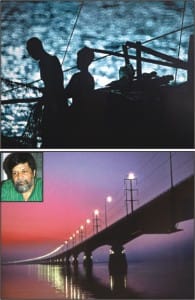
Photographs by Alam featured at the festival. Inset: Shahidul Alam. PHOTO: STAR |

