Talk out differences in a spirit of compromise
Concerned UN special emissary urges major political parties
Diplomatic Correspondent
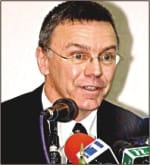
Terming the present situation in Bangladesh worrying, UN special envoy Craig Jenness yesterday urged principal political parties to resolve their differences over the election through dialogue in a spirit of compromise."The gap in confidence is greater than the divide in substance...I am convinced that the principal political parties of Bangladesh, who have themselves sacrificed for democracy in the past, will be able to make the necessary compromise again," he said. Addressing a press conference at Hotel Sheraton ending his 3-day visit to Bangladesh, he said there are legitimate concerns about electoral environment and whether it will be possible to hold free and fair elections. Jenness, who arrived in Dhaka on November 29 as a special envoy of UN Secretary General Kofi Annan, said this concern and crisis need to be overcome in a spirit of compromise. He wondered whether there is enough political will to reach a compromise through dialogue. "There is a deep sense of worry that the current political disagreements are harming the economy, increasing tensions and threatening the chances for a credible elections. Bangladesh's hard earned democratic advances and even its great international reputation could be affected if the current crisis continues," the envoy said. Asked whether Bangladesh's international reputation and UN peacekeeping would be affected if the army steps in as speculated by many, the envoy said, "Anything that is seen backward in important development of democracy might negatively affect the country's reputation and have various implications." He said the UN is prepared to provide additional support to the electoral process in the country as Bangladesh is important to UN and plays a very important role in the UN peacekeeping operation. Jenness, who was involved in many elections as Head of the UN Electoral Assistance Division, said, "Each is different, but there are a number of aspects that are essential to every democratic election -- a level playing field, a peaceful environment, a trusted election commission which is trusted by the electorate and all parties, assurances that all eligible voters can cast their ballots freely and an honest and impartial voting, counting and tabulation process." All of these points are crucial to ensuring public confidence in an election, he said, adding, "If elections do not meet these concerns, they run the risk of not being considered credible, either inside or outside the country." "I believe all political parties would participate in the upcoming elections," Jenness said when asked whether the results would be acceptable to the international community if all parties could not participate in the elections. He, however, said it is important that the people should be given fair chance to vote for parties of their choice and at the same time the environment should be such that all political parties have trust and confidence in the election process. Replying to a question, the UN envoy said more work needs to be done for holding free and credible elections and the caretaker government, the Election Commission and the political parties have great responsibility to create the environment for such credible polls. Asked if he has any formula to overcome the crisis, he said, "I am not here as a mediator but I am convinced that there are lot of rooms for cooperation in resolving the issues through dialogue." The envoy said he has encouraged the political parties he met during his stay to resolve their differences through dialogue. Asked whether he is convinced about fair elections in the prevailing circumstances, he said, "One has to be hopeful because Bangladesh is hopeful...everyone I spoke to wants free and fair election." Referring to his discussion with the president, advisers, government officials, political parties and others concerned, he said, "I found general agreement on the need for peaceful, credible and transparent elections and the importance of avoiding violence at all costs." It was widely expressed that whoever wins the election should govern in the best interests of all and that whoever does not win should accept the results and the very important place reserved in all democracies for the opposition, he added. Jenness said the UN itself will not send election observers but coordinate international election observers from EU, Commonwealth and USA that would send both long and short term missions to monitor the elections. Approximately, 320 foreign observers would be coming to Bangladesh to observe the elections, UNDP country representative Reneta Lok Dessallien said.
|