TechFocus
Can Biodiesel mitigate global warming?
Ahsan Habib Shimul
Biodiesel is a completely natural, renewable fuel applicable in any situation where conventional petroleum diesel is used. The notion of bio fuel dates back to 1885 when Dr. Rudolf Diesel fabricated the first diesel engine with the full target of running it on vegetative source. In 1912 he observed, "... the use of vegetable oils for engine fuels may seem insignificant today. But such oils may in the course of time become as important as petroleum and the coal tar products of present time."In 1970, scientists revealed that the viscosity of vegetable oils could be abridged by a simple chemical process and that it could perform as diesel fuel in modern engine. Since then the technical developments have come a long way and the plant oil today has been highly recognized as bio fuel, equivalent to diesel. Latest environmental (e.g. Kyoto Protocol) and economic concerns have prompted renaissance in the use of biodiesel throughout the world. In 1991, the European Community proposed a 90% tax reduction for the use of bio fuels, including biodiesel. Today 21 countries worldwide produce biodiesel. Advantages of biodiesel over conventional diesel Biodiesel, derived from the oils and fats of plants like sunflower, rape seeds, Canola or Jatropha Curcas, can be used as an alternate or an additive to diesel. As an alternative fuel biodiesel can afford power similar to conventional diesel fuel and thus can be used in diesel engines. Biodiesel is a renewable liquid fuel that can be produced locally thus helping reduce the country's dependence on imported crude. - Biodiesel is non toxic & environmental friendly as it produces substantially less carbon monoxide and 100% less sulfur dioxide emissions with no unburnt hydrocarbons and thus it is ideal fuel for heavily polluted cities. Biodiesel reduces serious air pollutants such as particulates and air toxicity.
- Due to its less polluting combustion, biodiesel provides a 90% reduction in cancer risks and neonatal defects.
- Biodiesel is biodegradable and renewable by nature.
- Biodiesel can be used alone or mixed in any ratio with conventional diesel. The preferred ratio of mixture ranges between 5 and 20%
- Biodiesel extends the life of diesel engines.
- Biodiesel could be cheaper than conventional diesel.
- Biodiesel has good potential for rural employment generation.
Plant sources for Biodiesel
Under Bangladeshi conditions such plants varieties, which are non-edible and which can be grown abundantly in large-scale on wastelands, can be considered for biodiesel production. Some of the prominent non-edible oil seed producing plants include jatropha curcas, pongamia pinnata or karanj, calophyllum inophyllum or nagchampa, hevea brasiliensis of rubber seeds, calotropis gigantia or ark, euphorbia tirucalli or sher, boswellia ovalifololata, neem etc. Considering all the options available among non-edible Tree Bearing Oil (TBO) seeds, Jatropha Curcas has been identified as the most suitable seed. Jatropha is a genus of approximately 175 succulents, shrubs and trees from the family Euphorbiaceae. Plants from the genus are natives of Africa, North America and the Caribbean. Originating in the Caribbean, the Jatropha had spread as a valuable hedge plant to Africa and Asia by Portuguese traders. Jatropha Curcas is a widely occurring variety of TBO. It grows practically all over Bangladesh under a variety of agro-climatic conditions especially heavy rain-prone areas and Chittagong Hill Tracts, Sylhet and Mymensingh hilly regions are the good locations for Jatrafa cultivation. Thus it ensures a reasonable production of seeds with very little inputs.
The advantages of the specie are as follows: - Jatropha can be grown in arid zones (20 cm rainfall) as well as in higher rainfall zones and even on land with thin soil cover.
- It is a quick yielding specie even in adverse land situations viz. degraded and barren lands under forest and non-forest use, dry and drought prone areas, marginal lands, even on alkaline soils and also as agro-forestry crops. Jatropha can be a good plantation material for eco-restoration in all types of wasteland.
- Jatropha grows readily from plant cuttings or seeds up to the height of 3 - 5 m.
- Jatropha is not considered good forage material.
- The plant is highly pest and disease resistant.
- Various parts of the plant are of medicinal value, its bark contains tannin, the flowers attract bees and thus the plant is honey production potential.
- Jatropha removes carbon from the atmosphere, stores it in the woody tissues and assists in the build up of soil carbon.
Biodiesel Production
Biodiesel is made through a chemical process called transesterification whereby the glycerin is separated from the fat or veggie oil. Once the glycerol is removed from the oil, the remaining molecules are, to a diesel engine, similar to petroleum diesel fuel. The process leaves behind two products -- methyl esters (the chemical name for biodiesel) and glycerin (a valuable byproduct usually sold to be used in soaps and other products). Expellers or continuous screw presses are used throughout the world for the extraction of oil from copra, palm kernels, peanuts, cotton seeds, flaxseed and almost every other variety of seed, wherever there is a large enough seed supply to justify a continuous operation. An expeller can exert much greater pressure on the seed cake than a hydraulic press can. This increased pressure permits the recovery of a larger proportion of the oil, about 3-4% of the oil is left in the cake with an expeller, compared to 4-6% with a hydraulic press. The expeller is an essential part of almost all modern oil seed extraction plants. It is used both by itself and as a pre-press before solvent extraction. Expellers vary in size from machines that process 100 pounds of seed per hour, to machines that process 10 or more tons of seed per hour. Different types of oil expellers for jatropha seeds are built in many countries. Biodiesel technology providers worldwide are Lurgi PSI, Superior Process Technologies, Biodiesel Industries, Cimbria Sket Bratney, Crown Iron Works, Renewable Energy Group etc. Storage
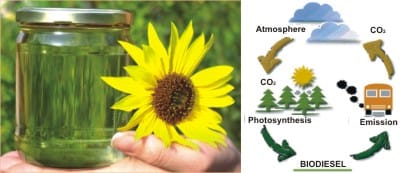
In general, the standard storage and handling procedures used for petroleum diesel can be used for biodiesel. The fuel should be stored in a clean, dry, dark environment. Acceptable storage tank materials include aluminum, steel, fluorinated polyethylene, fluorinated polypropylene and teflon. Copper, brass, lead, tin, and zinc should be avoided. A 1998 biodiesel lifecycle study, jointly sponsored by the US Department of Energy and the US Department of Agriculture, concluded biodiesel reduces net CO2 emissions by 78 percent compared to petroleum diesel. This is due to biodiesel's closed carbon cycle. The CO2 released into the atmosphere when biodiesel is burned is recycled by growing plants, which are later processed into fuel. Is biodiesel safer than petroleum diesel? Scientific research confirms that biodiesel exhaust has a less harmful impact on human health than petroleum diesel fuel. Biodiesel emissions have decreased levels of polycyclic aromatic hydrocarbons (PAH) and nitrited PAH compounds that have been identified as potential cancer causing compounds. Test results indicate PAH compounds were reduced by 75 to 85 percent, with the exception of benzo(a)anthracene, which was reduced by roughly 50 percent. Targeted nPAH compounds were also reduced dramatically with biodiesel fuel, with 2-nitrofluorene and 1-nitropyrene reduced by 90 percent, and the rest of the nPAH compounds reduced to only trace levels. References: savoiapower.com (Biodiesel: fuel produced from any vegetable oil), tifac.org.in (Biodiesel: Technology & Business Opportunities An Insight). The author is a student of Biotechnology and Genetic Engineering Discipline, Khulna University.
|
|

