Ganokendra Success Story
A journey from destitution to economic stability
Star National Desk
Here is a success story of rural poor women of Daripara, a neglected village at Uttar Shilmandi in Narsingdi district who are breaking away from tradition while making tremendous change in the society.Earlier, working outside home was discouraged by the communities, but these audacious women became self-reliant by dint of their strength of character, initiative and determination. Nahar, 26, became a destitute when her husband left her for a new wife 8 eight years ago. She took up the job of domestic help. She could not maintain her three-member family with the meagre income. But, things turned around when she was enrolled with Chanderhat Ganokendra, a people's centre. Aimed to uplift the disadvantaged and destitute women, Dhaka Ahsania Mission (DAM) established it on December 18, 1997. Nahar took non-formal education and necessary training on income generating activities at the Ganokendro. Utilising the training, She bought wool from market and began to make sweaters. She took orders and sold those in the neighbourhood. Soon, good times returned. Now, economic prosperity brought her social recognition while two of her children are growing up with education. Like Nahar, 39 other rural women took training there on human rights, gender equity, primary health and nutrition, numeracy and income generating activities in collaboration with various government and non-governmental organisations. All are now employed and maintaining their families earning on average between Tk 200-250 per week, said DAM Programme Division coordinator Md Shahidul Islam. From its inception, Chanderhat Ganokendra was funded by DAM. Ultimately, it became self-reliant through its own resources, Islam said. Now, tt has emerged as a comprehensive development approach and is rendering linkage services of different government (GO) and non-government organisations (NGOs), he added. Chanderhat has become the heart of the entire community catering to the individual needs as well as community needs. Such type of model is being emulated in other countries of South Asia. Its activities are being supervised by an executive committee elected from among its members, 60 per cent of whom are women. The activities include helping children to get themselves admitted to schools, resisting school dropouts, improving the standard of literacy, setting up sanitary latrines, prevention of child marriage and dowry, rendering health care to poor villagers, establishing satellite clinic and nutrition centre, organising people's drama, essay competition, poetry recital, debate, rally, bringing out wall magazines, helping to keep birth and marriage registration, as well as motivating people to improve social atmosphere. National and international days are also observed regularly under the auspices of Chanderhat.
|
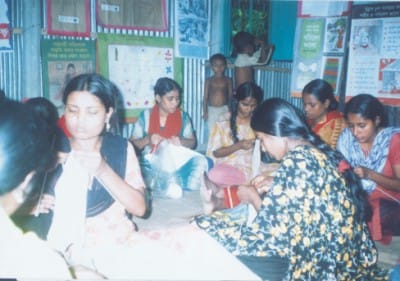
Chanderhat Ganokendro members are seen engaged in income generating activities at Daripara village in Uttar Shilmandi, Narsingdi. PHOTO: STAR |

